Blog
Are Sweepstakes Casinos Legal? The Real Answer, State by State
Casino
- The legal test that decides everything
- Where sweepstakes casinos are banned, as of 2026
- The lawsuits reshaping the industry
- Why "no purchase necessary" is the detail that matters most
- A closer look at how California's ban actually works
- The Los Angeles lawsuit in more detail
- Lessons from an earlier legal fight: internet cafes and fantasy sports
- How to check your own state's current status
- A snapshot of the current legal landscape
- What regulators appear to be signaling for the future
- What this means if you already play at one
- Common misconceptions about the legal status
- Key takeaways
- Frequently asked questions
- Are sweepstakes casinos legal?
- How are sweepstakes casinos legal if the games look like gambling?
- What are sweepstakes casino laws based on?
- Is sweepstakes casino legit, or a scam?
- Do sweepstakes casinos pay real money?
- What is the no purchase necessary law?
- Can a sweepstakes casino ban me from my own state after I've already been playing there?
The honest answer is: it depends on where you live, and the picture has been shifting fast. As of mid-2026, sweepstakes casinos remain lawful in most of the country, but a growing number of states have banned them outright, and several cities and states have filed lawsuits arguing the entire model is a disguised form of illegal gambling. Neither side of that argument has fully won yet, which is exactly why this is worth understanding in some depth rather than taking either a marketing page or a critic's headline at face value.
This is general information, not legal advice. If you need a definitive answer for your specific situation, a licensed attorney in your state or your state's gaming and consumer protection authority is the right resource.
The legal test that decides everything
Gambling, under the law of nearly every US state, requires three elements to exist together: a prize, an element of chance, and consideration. Consideration means the participant has to pay money or risk something of real value to take part. If any one of those three elements is missing, most state courts will not classify the activity as illegal gambling.
Sweepstakes casinos are built specifically around removing consideration. Because Sweeps Coins, the redeemable currency, must always be obtainable without payment, whether through a signup bonus, a daily login reward, or a mail-in Alternative Method of Entry, operators argue that no one is ever required to pay to win. That argument has held up in most states so far, which is why the industry has been able to operate at meaningful scale since the early 2020s.
Where sweepstakes casinos are banned, as of 2026
A specific and growing list of states has passed legislation that closes the promotional-sweepstakes exemption these platforms relied on. As of mid-2026, that list includes:
- California, effective January 1, 2026, under Assembly Bill 831. Continued operation after that date is treated as a criminal misdemeanor in California, with fines reported up to $25,000 per violation and up to a year in county jail for willful violations, and liability that extends beyond the operator to payment processors, geolocation vendors, game suppliers, and platform providers.
- Connecticut and Montana, where sweepstakes-banning legislation took effect on October 1, 2025.
- Indiana, under House Bill 1052, signed in March 2026 and effective July 1, 2026, making it the seventh state with an outright ban.
- Maine, under LD 2007, which brought the total number of outright ban states to eight as of mid-2026.
- Idaho, Louisiana, Michigan, Nevada, New Jersey, New York, Tennessee, and Washington, each of which has separately restricted or banned this model through its own legislation.
That is roughly a dozen states with binding restrictions, out of fifty, meaning sweepstakes casinos remain available in most of the country, including much of the South, Midwest, and West. This list is a moving target. Several additional states have active bills working through committee, and the pace of new legislation has picked up noticeably since California's ban took effect. Checking your state's current statute, not a snapshot from a year ago, is the only reliable way to know where things stand.
The lawsuits reshaping the industry
Legislation is not the only pressure this industry is facing. A wave of civil lawsuits and enforcement actions has targeted individual operators directly, arguing that specific platforms cross the line into unlicensed gambling regardless of what the sweepstakes label claims.
The most significant of these came in August 2025, when the Los Angeles City Attorney filed a civil enforcement action, naming more than twenty defendants reaching well beyond the operator itself, including the platform's game suppliers, its know-your-customer vendor, and even executives personally. That suit set a template other jurisdictions have since followed: naming payment processors and game studios alongside the operator, rather than treating the operator as the only responsible party.
In March 2026, the City of Baltimore filed its own suit against six major sweepstakes operators, arguing that the games offered are functionally indistinguishable from online casino gambling, which Maryland does not permit. By that point, similar cases had already been filed or were pending in states including Illinois, Alabama, Massachusetts, South Carolina, Minnesota, Missouri, New Mexico, Virginia, Ohio, New York, and New Jersey, with reporting suggesting well over a dozen public lawsuits or enforcement actions in progress industry-wide.
None of this means every sweepstakes casino is operating unlawfully, and none of these cases has produced a final ruling that settles the underlying legal question nationwide. It does mean the legal footing under any specific operator is worth more scrutiny than it might have received a couple of years ago, before this wave of litigation began.
Why "no purchase necessary" is the detail that matters most
Every one of these legal disputes tends to circle back to the same question: is the free entry path real, or is it a token gesture designed to look compliant on paper? Courts and regulators have generally focused on whether an operator's Alternative Method of Entry is genuinely usable, meaning a person can actually request and receive Sweeps Coins by mail without jumping through unreasonable hoops, and whether marketing and account flows quietly steer players toward paying regardless.
This is also the exact area where earlier, unrelated business models ran into trouble. Internet cafe sweepstakes terminals, a precursor industry from the 2000s and early 2010s, were frequently found to violate gambling law specifically because the "free" product attached to the sweepstakes entry, usually internet time or a phone card, was a pretext nobody actually wanted. Regulators have carried that skepticism forward, which is part of why a platform's official rules and AMOE process deserve a closer look than most players give them.
A closer look at how California's ban actually works
California is worth examining in detail because it shows how far a state can go once it decides the sweepstakes exemption no longer applies. Assembly Bill 831 did not just prohibit new sweepstakes casino operations. It closed the specific promotional-game exemption that operators had relied on to argue their model was distinct from gambling in the first place, then attached real criminal exposure to continued operation after the effective date: a misdemeanor charge, fines reported as high as $25,000 per violation, and up to a year in county jail for willful violations. Just as notable is who the law reaches. Liability is not limited to the operator running the platform. It extends to payment processors handling transactions, geolocation companies confirming player location, gaming-content suppliers licensing the games, and platform or media affiliates promoting the service.
That last detail is what makes California's approach a template other states are watching closely. By attaching liability to the entire supply chain rather than just the consumer-facing brand, the law makes it considerably harder for an operator to simply rebrand or shift entities to keep operating. Whether other states adopt this exact structure remains to be seen, but Indiana's and Maine's more recent bans suggest legislators are increasingly comfortable moving beyond simple prohibition toward broader enforcement mechanisms.
The Los Angeles lawsuit in more detail
The August 2025 Los Angeles City Attorney lawsuit is worth understanding beyond the headline, because its structure previews how similar cases have been built since. Rather than suing only the consumer-facing operator, the city named the platform operator, its corporate holding structure, a streaming platform used for promotional content, a know-your-customer verification vendor, and several of the underlying game studios supplying the slot and table titles, along with company founders individually. The legal theory was that everyone in that chain played a role in offering what the city alleged was unlicensed gambling to California residents.
This matters for two reasons. First, it signals that being a game studio or a payment processor rather than the operator itself is not automatically a legal shield. Second, it explains why some established, licensed game studios have reportedly become more selective about which sweepstakes platforms they will supply, since supplying games to an operator now carries litigation exposure it did not carry a few years ago. Neither of these developments has been fully resolved in court as of mid-2026, and the outcome could reshape how the entire supply chain operates going forward.
Lessons from an earlier legal fight: internet cafes and fantasy sports
This is not the first time an industry has tried to operate casino-style games under a legal theory other than a gambling license. Daily fantasy sports operators spent years arguing, with mixed success across different states, that their contests were games of skill rather than chance, which is a different legal distinction than the one sweepstakes casinos rely on, but it followed a similar pattern: rapid growth, state-by-state legal challenges, and an eventual patchwork where some states allowed the activity under specific regulation, some banned it, and some let it operate in a gray zone for years before deciding.
The internet cafe sweepstakes terminal industry mentioned earlier in this piece is an even closer parallel, since it used the identical prize-chance-consideration framework. Several operators in that industry lost in court specifically because judges found their "free" product was not genuinely free in any practical sense, a finding that did real damage to the credibility of the sweepstakes defense generally. Today's larger, more established sweepstakes casino operators appear to have learned from that history, which is part of why the more reputable platforms invest real effort into making their Alternative Method of Entry usable rather than symbolic. It is also why regulators remain skeptical by default, rather than taking a platform's "no purchase necessary" claim at face value.
How to check your own state's current status
Because this changes often, the following approach works better than relying on any single article, including this one, as a permanent answer:
- Search your state legislature's official website for recent bills mentioning "sweepstakes," "dual currency," or "social casino."
- Check whether your state's attorney general has issued any public statements, cease-and-desist letters, or consumer alerts about sweepstakes casinos.
- Read the specific operator's own terms of service, since many voluntarily restrict access in additional states beyond what current law technically requires, often to get ahead of anticipated legislation.
- If you want certainty rather than a reasonable estimate, a consultation with a licensed attorney in your state is the only way to get an answer specific to your situation.
A snapshot of the current legal landscape
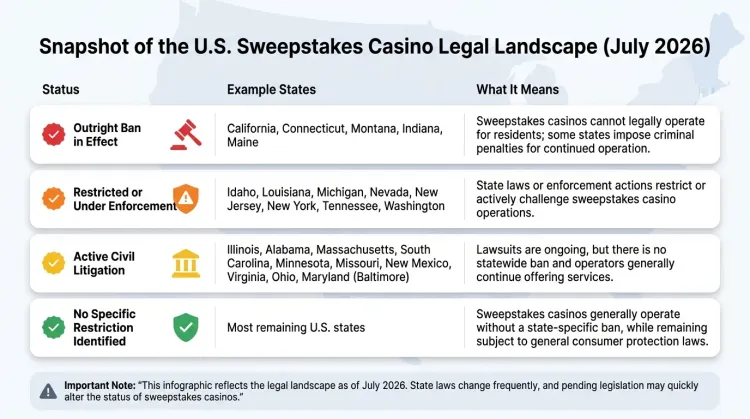
This table reflects a snapshot, not a permanent map. Several states in the third and fourth categories have pending bills that could move them into the ban category within a single legislative session, which is exactly what happened in Indiana between the bill's introduction and its July 2026 effective date.
What regulators appear to be signaling for the future
Reading across the California statute, the Los Angeles and Baltimore lawsuits, and the pace of new state bills, a pattern is starting to take shape. Regulators are less interested in litigating the abstract legal theory behind sweepstakes casinos and more interested in whether a specific operator's free-entry process actually functions as advertised. States that have moved to outright bans have generally done so through legislation rather than waiting for a court to settle the question, which suggests lawmakers see this as a policy decision they would rather make directly than leave to years of litigation. At the same time, the breadth of defendants named in the Los Angeles suit, reaching into payment processors and game studios, suggests regulators are also trying to make the business model itself harder to sustain financially, not just harder to advertise.
None of this guarantees where things land nationally. It does suggest that the current patchwork, lawful in most states, banned in a growing minority, and under active legal challenge in several more, is likely to keep shifting for at least the next several legislative cycles.
What this means if you already play at one
If a sweepstakes casino currently serves your state, that is a reflection of the law as it exists today, not a permanent guarantee. States have shown they can and do act quickly, sometimes with only a few months between a bill's introduction and its effective date, as happened with Indiana's HB 1052. Reasonable practices for any player, regardless of what happens legislatively, include keeping records of account activity and any pending redemption requests, reading update notices from the platform rather than ignoring them, and understanding that if your state passes a ban, the operator is legally required to stop serving you, which may affect pending redemptions depending on the platform's own wind-down process.
Common misconceptions about the legal status
"If it's advertised, it must be fully legal everywhere." Advertising reach does not equal legal clearance in every state. Some operators run national marketing while explicitly excluding residents of banned states in their actual terms of service, which is why the account signup process, not the ad you saw, is where the real restriction shows up.
"A lawsuit means the model is illegal." A pending lawsuit is an allegation, not a finding. Several of the cases described above are still working through the courts, and the outcome could range from a full win for the operators to a settlement to a finding against them, depending on the specific facts of each case.
"Since it's not gambling, there's no regulation at all." Sweepstakes casinos are not free of oversight. They remain subject to general consumer protection law, false advertising statutes, and state sweepstakes and prize statutes, all of which give attorneys general real tools to act against operators who misrepresent their free-entry process.
Key takeaways
- Sweepstakes casinos are legal in most states because they are structured to remove "consideration," one of the three elements required to classify something as gambling under US law.
- As of mid-2026, at least eight states have passed outright bans, including California, Connecticut, Montana, Indiana, and Maine, with several more states restricting the model in other ways.
- A significant wave of lawsuits, including actions filed by the Los Angeles City Attorney in 2025 and the City of Baltimore in 2026, is actively challenging individual operators, though none has produced a nationwide, final ruling.
- Courts and regulators focus heavily on whether "no purchase necessary" is genuinely usable in practice, not just a line in the fine print.
- Because state law changes quickly, checking your specific state's current statute and a given operator's own terms of service is more reliable than any single article, including this one.
If you want to understand exactly how a specific operator structures its no-purchase entry path and legal disclosures, its published official rules are the place to look, since that is where the practical difference between a well-run program and a risky one tends to show up.
Still have questions? Discover how sweepstakes casinos work from start to finish.
Frequently asked questions
Are sweepstakes casinos legal?
In most states, yes, because they are built to remove consideration, one of the three elements required to classify an activity as gambling. As of 2026, roughly a dozen states have passed laws specifically banning or restricting this model, and that number continues to grow.
How are sweepstakes casinos legal if the games look like gambling?
Legality in the US turns on a specific three-part test: prize, chance, and consideration. Sweepstakes casinos are structured so that Sweeps Coins, the only currency that can be redeemed for cash, are always available for free, which removes the consideration element even though the games themselves resemble casino games.
What are sweepstakes casino laws based on?
They are based on each state's own sweepstakes and promotions statutes, the same body of law that governs contests run by retailers, radio stations, and consumer brands, rather than on state gambling and gaming statutes.
Is sweepstakes casino legit, or a scam?
The legal structure itself is a recognized model used across most of the country. Whether any specific operator is trustworthy depends on that operator, which is why checking for published official rules, a genuinely usable free-entry process, and transparent redemption terms matters more than judging the model as a category.
Do sweepstakes casinos pay real money?
Yes. Once Sweeps Coins clear an operator's playthrough requirement and identity verification, they can typically be redeemed for cash, often at a 1:1 rate, through methods like check, ACH transfer, or digital payment.
What is the no purchase necessary law?
It is the principle, rooted in state sweepstakes statutes, that anyone must be able to enter and potentially win without paying. It is the legal foundation the entire sweepstakes casino model depends on, and courts have focused closely on whether this free path is genuinely usable in practice.
Can a sweepstakes casino ban me from my own state after I've already been playing there?
Yes. If your state passes a ban or an operator decides to voluntarily exit a state ahead of anticipated legislation, the platform is expected to stop offering new play to residents of that state going forward. What happens to an existing account balance or a pending redemption in that situation depends on the specific operator's wind-down process, which is another reason reading update notices from a platform, rather than dismissing them, is worth doing.
Purchase Securely With