
Virtual Currency: Why Games Use Coins Instead of Cash, and What Those Coins Represent
Published Oct 31, 2026
Casino
Open almost any mobile game, loyalty app or online platform and you will meet a made-up unit of value: gems, stars, points, tokens, coins. Nobody hands you a banknote. You get a number on a screen that you can spend inside that one environment. That number is virtual currency, and it is one of the most common design choices in digital products.
This guide explains what virtual currency is, why companies build it into their products, and what it does and does not represent. It also covers a case that confuses a lot of people: sweepstakes casinos such as GoldenDragon.Casino, which use two kinds of coins, Gold Coins and Sweeps Coins, that look similar on screen but mean very different things legally and practically.
A note on how this was written. This is a plain-language explainer from the GoldenDragon.Casino editorial team. It is meant for education, not persuasion. Where the rules vary by place or by platform, we say so rather than guess, and we point you to the official terms of whichever service you are reading about. Nothing here is legal or financial advice.
Key Takeaways
- Virtual currency is a unit of value that exists inside a specific platform. It is not legal tender, and it usually cannot be spent outside the platform that issued it.
- Companies use it for practical reasons: it simplifies pricing across countries, keeps spending inside their own system, and lets them control how value is earned, used and expired.
- Not all virtual currency is the same. In-game currency, loyalty points, closed-loop tokens and cryptocurrency are four different things with different rules and different risks.
- Holding virtual currency generally gives you a right to use it under the platform's terms. It is rarely a deposit account, an investment, or a claim on cash.
- In the sweepstakes model, Gold Coins are for entertainment only and cannot be redeemed. Sweeps Coins are promotional, are distributed through free methods, and may be redeemable for prizes under the official rules.
- "No purchase necessary" is the legal backbone of the model. It means there must be a free way to take part, with the same chance as someone who buys coins.
- Sweepstakes casinos operate under sweepstakes and promotion law, not gambling law, but regulation varies by region and is changing. Always read local rules and the platform terms.
- Read the terms before you rely on any virtual currency for anything. Expiry, account verification and redemption conditions are where most misunderstandings begin.
What Is Virtual Currency?
Virtual currency is a digital unit of account created and managed by a specific company or community. It lets people hold, earn, spend or exchange value inside a defined digital environment.
The key phrase is "defined environment." A dollar works at a bakery, a gas station and an online shop because law and custom say so. A game's gems work inside that game. A coffee chain's reward stars work at that coffee chain. The issuer decides where the currency is accepted, how it is earned, and whether it ever expires.
A simple way to sort the idea is by asking three questions:
- Who issues it? One company, or a decentralized network?
- Where can it be used? Inside one product, across a group of partners, or anywhere that accepts it?
- Can it be converted back into regular money? Never, sometimes under conditions, or freely?
The answers separate a game's gold from a loyalty point and both of those from something like Bitcoin.
Virtual currency vs. digital money vs. cryptocurrency
People often use these terms as if they were interchangeable. They are not.
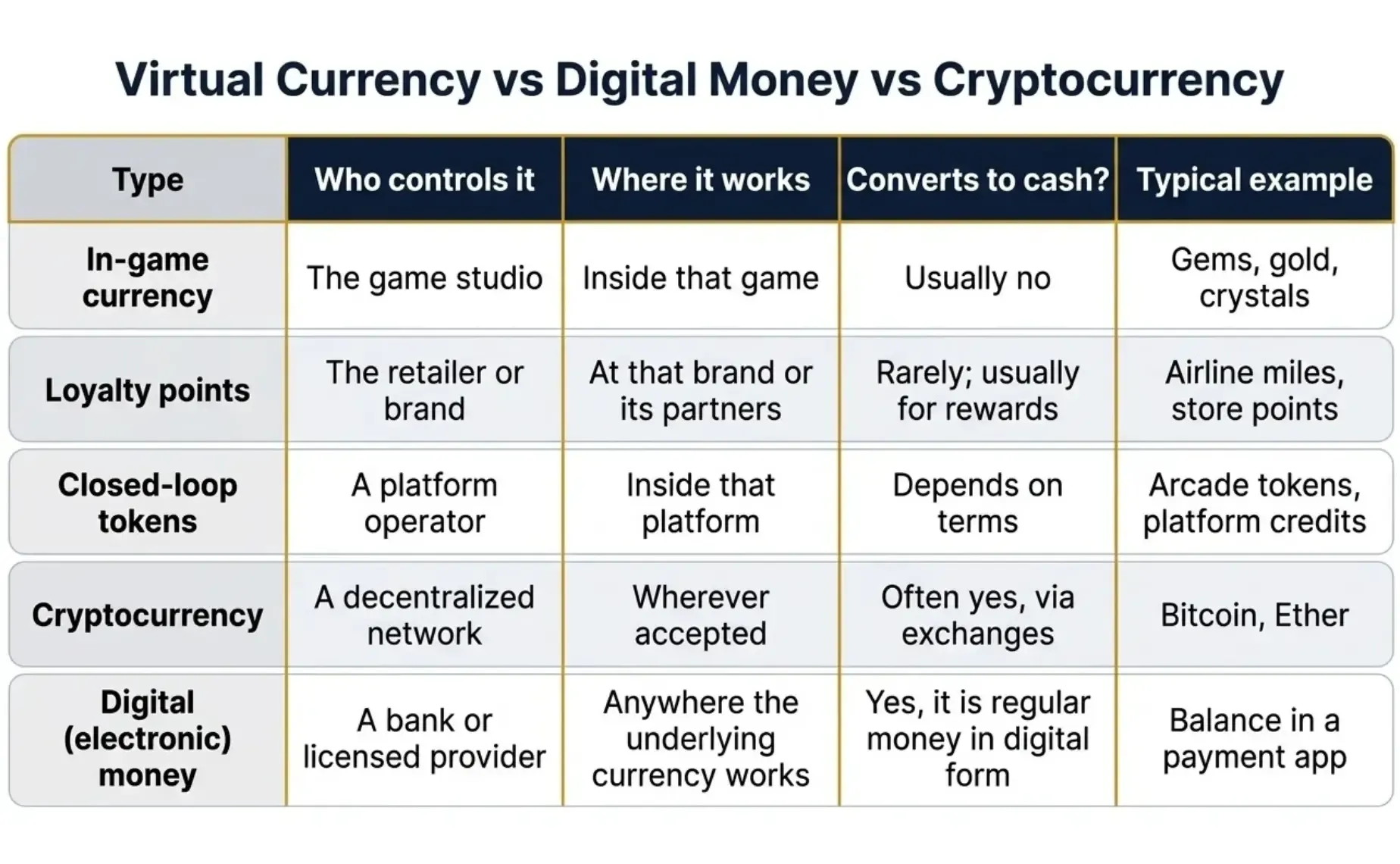
The last row is the one that trips people up. A balance in a licensed payment app is regular money represented digitally. A game's gems are not. They are a record in the game's database that the studio agrees to honor under its terms.
Why Games Use Coins Instead of Cash
If you ever wondered why a game cannot simply charge you two dollars for a sword, the answer is that a coin layer solves several real problems at once. None of this is sinister. It is mostly plumbing, though like any design choice it can be used well or badly.
1. It simplifies pricing across countries
A studio with players in dozens of countries faces dozens of currencies and tax rules. If everything inside the game is priced in "gems," the studio sets one internal price list and converts only at the single point where a player obtains gems. Players see the same sword for 300 gems whether they live in Toronto or Tokyo. That consistency is easier to design, test and balance.
2. It keeps spending inside the system
Once value is converted into an internal unit, each small decision inside the product becomes a game decision rather than a payment. Spending 40 coins on a cosmetic item feels different from authorizing a card charge. That difference is useful for smooth design. It is also the reason consumer advocates often urge people to keep an eye on how many real purchases the coin layer sits on top of.
3. It lets the company control value
When a platform issues the currency, it also sets the rules. It can decide how fast coins are earned through play, whether they expire, whether they can be gifted, and whether they can ever leave the platform. Real money is governed by public law. Virtual currency is governed by a contract, usually the terms of service you accepted on sign-up.
4. It supports fraud control and compliance
A closed system where coins cannot be cashed out reduces certain risks. If virtual items cannot be turned into cash, there is less incentive to steal accounts and launder value through them. This is one reason many platforms prohibit selling accounts or trading coins on third-party sites.
5. It makes free play and paid play fit together
Many games let you earn currency just by playing, logging in daily, or completing tasks, while also offering the option to buy more. A shared unit makes both paths work with the same menus and prices. The sweepstakes model takes this a step further, as we will see below.
A fair criticism
There is a legitimate concern here. Researchers and consumer groups have raised questions about whether abstracting prices into in-game units makes it harder for people, particularly younger players, to keep track of what they are actually spending. We are not going to put a number on how widespread that is, because we have not seen a figure we would stand behind. What we can say is that it is reasonable to check your account's purchase history now and then, and to use any spending limits a platform offers.
What Virtual Currency Does and Does Not Represent
This is the heart of the topic, and the part that causes the most confusion.
What it generally represents
Most virtual currency represents a license, meaning permission to use something inside the platform under the platform's terms. Think of it like a ticket stub for an amusement park ride: it has a use, but only at that park, and only under the park's conditions.
It also represents a record. Somewhere in a database, your account shows a balance. The company has promised, in its terms, how that balance can be used.
What it generally does not represent
- Legal tender: No government has declared a game's gems to be money.
- A bank deposit: Money in a bank account is typically protected by deposit rules in many countries. Virtual currency balances typically are not covered the same way, though the details depend on where you live and the platform's structure.
- An investment: Platforms do not normally promise that coins will gain value. In most cases they can change prices, add new ways of earning, or retire the currency.
- Property you fully own: Many terms of service state that virtual items and currency remain licensed to you, not sold to you. If an account is closed for breaking the rules, the balance may go with it.
- A guaranteed claim on cash: Unless the terms say coins can be exchanged for money or prizes, and under what conditions, you should assume they cannot.
If you take one habit from this guide, make it this: before you assume a virtual coin is "worth" something, find the sentence in the terms that says what it is worth, to whom, and under what conditions.
The loyalty-points comparison
Loyalty points are the version of virtual currency most of us have lived with for decades. Airline miles are a good example. They are issued by the company, spent on that company's products or partners, subject to changing rules, and often come with expiry or inactivity conditions. Nobody expects to walk into a bank and exchange miles for cash. Yet miles do have real value to the traveler who uses them well.
That mix, no cash-out right but real usefulness, describes most virtual currency. It also helps explain how a sweepstakes platform can have one coin type that is purely for fun and another that is tied to promotional prize entries. Different coins, different rules.
Types of Virtual Currency You Will Run Into
In-game currency
Used in video games, usually earned through play and sometimes sold. Many games have two layers: a soft currency that you earn easily, and a premium currency that is mostly purchased. The rules about gifting, trading and expiry are set by the studio.
Loyalty and rewards points
Issued by retailers, airlines, hotels and credit programs. They reward repeat behavior. They are usually redeemable for products, services or discounts rather than cash. Expiry and program changes are the most common points of friction.
Closed-loop platform tokens
Think of arcade tokens: you obtain them at the venue, use them on the venue's machines, and they are worthless outside it. Digital platforms use the same logic. A token may be redeemable for in-platform items, or, in some systems, for rewards under specific rules.
Cryptocurrency and blockchain tokens
These run on decentralized networks and are not issued by a single operator. They sit in a different regulatory conversation and carry price volatility and security considerations that closed-loop game currencies do not. They are not the same thing as a game coin, even when a platform uses the word "token." If you are curious about them, rely on official regulator guidance in your country rather than a casino or game blog.
How the Sweepstakes Model Uses Two Kinds of Coins
Now to the case that prompted this article. Sweepstakes casinos use a dual-currency structure, and it is more careful than it looks. Here is the plain version.
Gold Coins: play for fun
Gold Coins are a virtual currency for entertainment. They let you try the platform's games in a play-for-fun mode. They have no cash value and cannot be redeemed for prizes. In effect, they are the in-game currency we described above: a token that works inside the platform and nowhere else.
Sweeps Coins: promotional and redeemable under the rules
Sweeps Coins are a promotional currency. Under the official rules of the sweepstakes, Sweeps Coins that are used in the prize-eligible mode may, subject to conditions, be redeemed for prizes. They are distributed as part of a promotion rather than sold as a stand-alone product. The specifics of how they are distributed, what verification applies and what redemption conditions exist are set out in the platform's sweepstakes rules, and those documents are the source of truth.
Two things are worth stressing. First, nobody can guarantee a prize, and no responsible source should imply one. Second, the existence of a redemption route does not turn the coins into a bank balance or a paycheck. They remain promotional tokens that exist under a rulebook.
Why two coins at all?
The separation is deliberate, and it relates to the legal structure.
In many jurisdictions, regulators and courts have traditionally looked at three elements when deciding whether something is a lottery or gambling: a prize, an element of chance, and consideration, which broadly means something of value paid to take part. A sweepstakes can generally still include a prize and chance, as long as there is no required payment to enter. Remove the third element and the activity is typically treated under promotion and sweepstakes law, not gambling law.
That is the logic behind the two-coin design. Gold Coins can be acquired in ways that include purchase, and they carry no prize value. Sweeps Coins are provided through free methods and as a promotional extra. The aim of this arrangement is to ensure that buying Gold Coins is not a payment for a chance at a prize. Whether a given arrangement actually satisfies the law is a question for courts and regulators in each place, and it has been debated. We are explaining how the model is designed, not claiming that every regulator agrees it works.
What "no purchase necessary" actually means
"No purchase necessary" is a legal requirement in the sweepstakes world, not a slogan. It means the platform must offer a genuine way to take part without buying anything, and that entrants who use the free route must have the same opportunity as entrants who purchased.
In practice, the official rules typically describe one or more free methods of entry. Common structures in the sweepstakes industry include mail-in requests, and some platforms also describe periodic free credit for logging in or other promotions. The exact methods are different at every operator, and we will not claim a specific method for any one of them here. The right place to check is the official sweepstakes rules page of the platform you are reading about.
A useful test: if you cannot find a clear, readable description of the free route in the rules, treat that as a warning sign.
Sweepstakes law vs. gambling law
A sweepstakes casino is not licensed as a traditional gambling operator in the way a land-based or licensed online casino is. It operates under sweepstakes and promotion rules. That difference shapes everything from how coins are distributed to who can take part.
It also means the legal ground is not uniform. Some places have treated the model as lawful sweepstakes activity. Others have restricted or questioned it, and rules have been tightening in several areas in recent years. We are not going to list jurisdictions here because the situation changes and we would rather not give you an out-of-date list. What we will say is simple: availability depends on where you live, and it is your responsibility to check local rules and the platform's eligibility terms before taking part. If you are unsure, local consumer-protection or gaming regulators are the better authority than any blog.
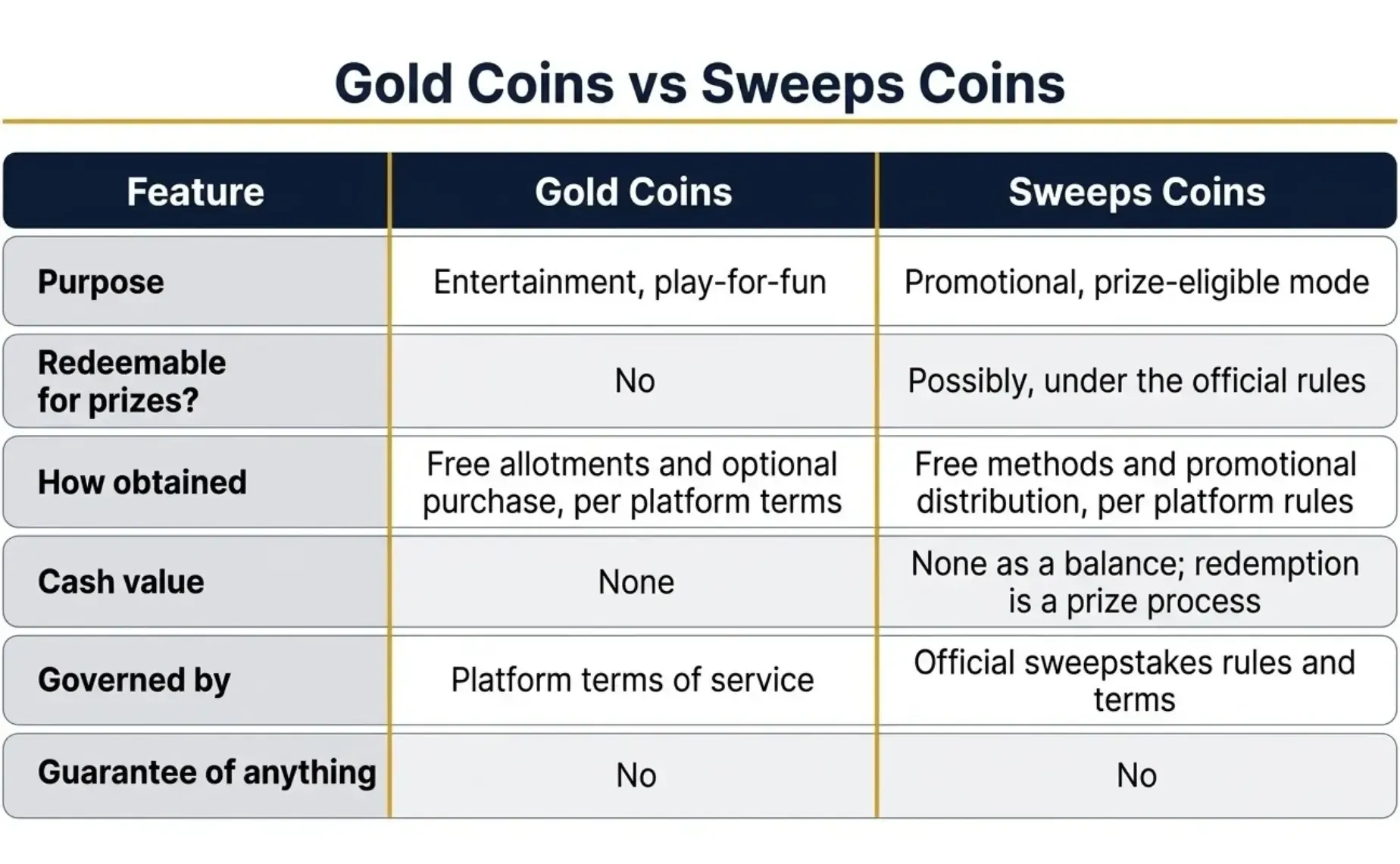
A side-by-side look
How Sweepstakes Coins Compare With Everyday Virtual Currency
Putting this in context helps. A rewards program issues points and promises certain rewards. A game issues gems and promises certain items. A sweepstakes platform issues two kinds of coin and promises, via its rules, a certain play mode for each, with a possible prize pathway for one.
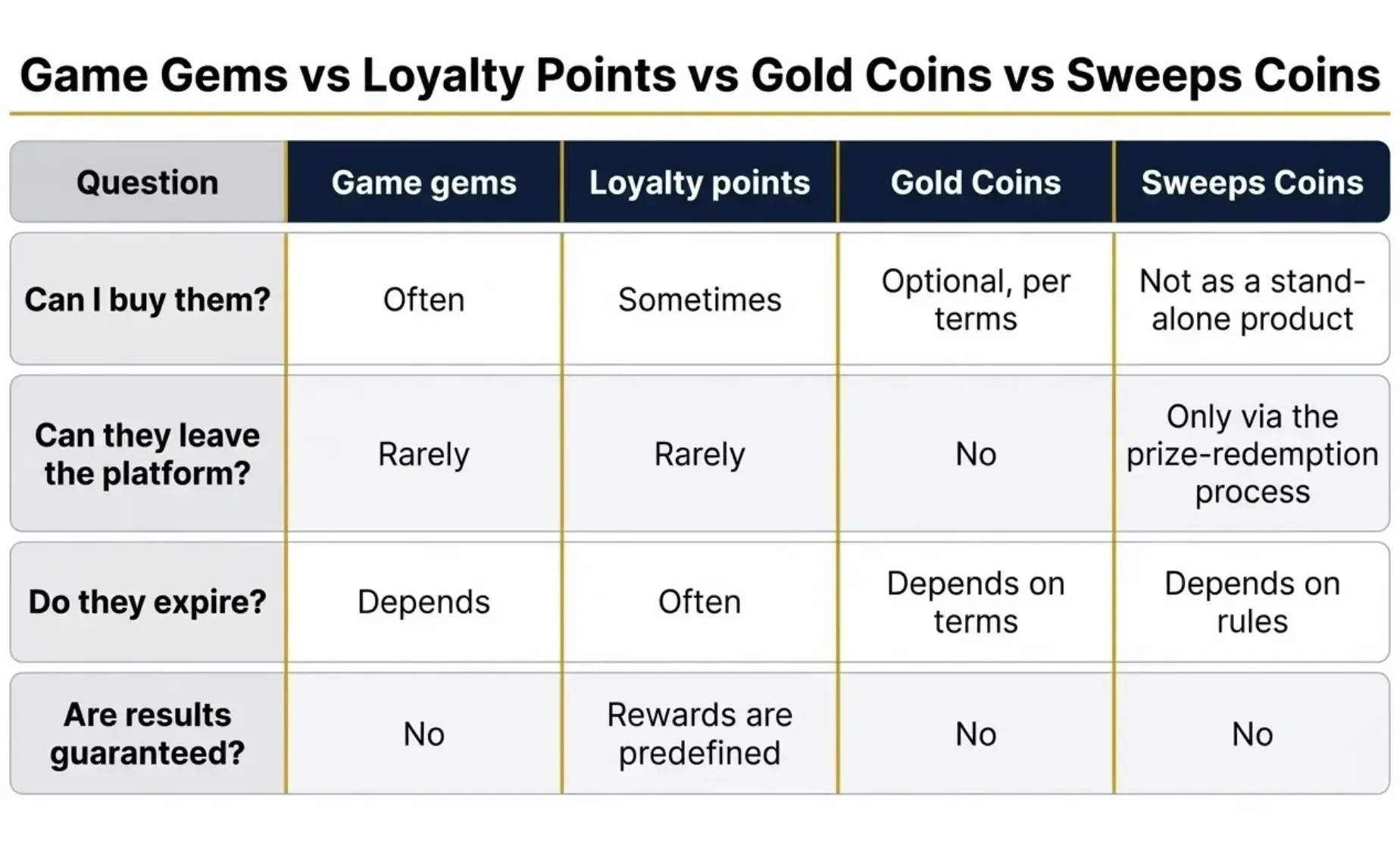
The comparison also shows why reading the terms is not optional. Two products can both say "coins" and have entirely different obligations behind them.
Common Misunderstandings
Several mistakes come up again and again. A few of them are worth naming directly.
"My coins are my money." They are not, unless the terms say so and explain how. Virtual currency is permission to use something, held inside someone else's system.
"If I can buy it, it must be redeemable." Not necessarily. In the sweepstakes model, the coin you can buy (Gold Coins) is the one that cannot be redeemed. Buying coins is not the same as entering a prize draw.
"Free coins are a trick." Free distribution is a legal requirement in the sweepstakes model. Whether a particular platform's free route is easy to use is a fair thing to examine, and that is why reading the rules matters.
"This is the same as online gambling." The structure is different, and the legal treatment is meant to be different. But the experience on screen can look similar to people familiar with casino-style games, which is exactly why clear labeling of coin types matters. And neither format should be treated as a way to make an income.
"A site's marketing copy is the rules." It is not. Marketing summarizes. The official rules and terms govern.
"All crypto is virtual currency in the same sense." Game coins and blockchain tokens may both be called "digital currency" in casual speech, but their legal and technical nature differs.
Practical Guidance for Evaluating Any Platform With Virtual Currency
You do not need a law degree. A short checklist covers most of the ground.
- Find the terms and the rules. Look for separate documents: general terms of service, and, where relevant, official sweepstakes rules.
- Identify each currency. What is it called, what can it do, what can it not do?
- Look for expiry and inactivity conditions. Many platforms retire balances after a period of inactivity.
- Check eligibility. Age requirements and location restrictions are common, and identity verification is often required before any redemption.
- Find the free-entry route. If a sweepstakes is involved, the rules should describe how to take part without buying anything.
- Look at the limit tools. Does the platform let you set time or spending limits? Using them is sensible even when you feel in control.
- Keep your own records. Screenshots or exports of balances and purchases are useful if you ever have to dispute something.
- Know how to get help. If activity ever stops being fun or starts causing stress, free support is available from responsible gaming and problem-gambling helplines in many countries. Search for your national or regional service.
Responsible Use and Age Requirements
Even when no cash wagering is involved, screen-based entertainment with reward mechanics can hold your attention in ways you may not intend. A few principles apply to any virtual currency platform.
- Treat any money spent on coins as entertainment spending, similar to a movie ticket, not as an investment and never as a way to recover losses elsewhere.
- Do not use funds you need for essentials.
- Platforms that follow the sweepstakes model generally require participants to meet a minimum age, which is commonly 18 or 21 depending on the region and the operator. Check the specific terms for your location.
- Take breaks. Use the account's limits if they exist.
If any of this feels hard to follow in practice, that is a reason to step back, not push forward.
A Short History of Why This Idea Stuck
Closed-loop currency is much older than the internet. Company scrip in industrial towns, arcade tokens, casino chips and stamps given out with groceries are all earlier versions of the same trick: a unit that works in one place. Digital products inherited the idea because it is cheap to implement and flexible to adjust. Without claiming a precise origin story, it is fair to say that the arrival of free-to-play games, and later of mobile app stores, made in-game currency an everyday part of consumer life.
Sweepstakes promotions also have a long history in marketing, from product-packaging contests to mail-in drawings. Putting them together with an in-game coin system is a modern recombination. Whether you find that clever, confusing or a bit of both, it helps to understand both parents of the idea.
Frequently Asked Questions
1. What is virtual currency?
Virtual currency is a digital unit of value issued and managed inside a specific platform, such as a game, a loyalty program or an online service. It is not legal tender and usually cannot be spent outside the platform that created it. Its value, if any, comes from the terms the issuer sets: what it can be used for, how it is earned, and whether it can ever be exchanged for something outside the platform.
2. What are Sweeps Coins?
Sweeps Coins are a promotional virtual currency used in the sweepstakes model. Under the platform's official rules, they are distributed through free methods and may, subject to the rules and eligibility conditions, be redeemable for prizes. They are separate from Gold Coins, which are for play-for-fun only and cannot be redeemed. The details, including how they are obtained and what redemption requires, are in the official sweepstakes rules for each platform.
3. Do sweepstakes casinos pay real money?
Sweepstakes casinos do not operate as real-money wagering sites. Gold Coins have no cash value and cannot be redeemed. Sweeps Coins are promotional, and where the official rules allow, they may be redeemed for prizes, which can include cash prizes, after eligibility and verification steps are met. Nothing is guaranteed, and the prize process is governed by the rules, not by a deposit-and-withdraw relationship like a bank account or a traditional casino. Read the official rules for the specific conditions.
4. How can I get free Sweeps Coins?
Sweepstakes platforms are required to offer a free route, and the rules describe the methods. These can include a mail-in request and, on some platforms, promotional distributions such as login rewards or limited-time offers. Because methods differ by operator and can change, the official sweepstakes rules page is the reliable place to check. Be skeptical of any third-party site that promises a shortcut, a code or a guaranteed amount.
5. What does "no purchase necessary" mean in sweepstakes?
It means you can take part without paying anything, and that people who use the free route have the same chance as people who purchased something. It is a core legal feature of a sweepstakes: without it, the activity could be treated differently under the law in many places. The rules should spell out the free method of entry in plain terms.
6. Is virtual currency the same as cryptocurrency?
No. Most virtual currency, such as game coins and loyalty points, is issued by one company and works inside that company's system. Cryptocurrency runs on decentralized networks and is not controlled by a single issuer. Their risks, regulation and uses are different, so it is worth treating them as separate topics.
7. Are sweepstakes casinos legal everywhere?
No. Sweepstakes law and gambling law differ by country, state and region, and the treatment of sweepstakes casinos has been contested and appears to be changing in some places. Eligibility depends on where you live. Check the platform's eligibility terms and your local consumer or gaming regulator's guidance before taking part.
Closing Thoughts
Virtual currency is neither mysterious nor magical. It is a record in someone else's system, governed by that company's terms, and shaped by a few practical motives: simpler pricing, tighter control and smoother design. What it represents depends on the contract behind it.
The sweepstakes model is a more elaborate version of the same idea. Two coin types, one for fun and one tied to a promotional prize route, sit on top of a legal structure built around the "no purchase necessary" rule. Understanding who issues each coin, what the rules say, and where the free route is described will tell you almost everything you need.
If you remember one thing, make it this: the word "coin" tells you nothing. The terms tell you everything. Read them, set your own limits, and treat any platform of this kind as entertainment first. Rules and regulations differ by location and change over time, so confirm current details with the official rules of the service in question and with your local regulator.
New to GoldenDragon.Casino? Use code DRAGON20 for 20% off when eligible. Limited to one use per user, valid through January 1, 2030.
This article is for general information and education only. It is not legal, financial or gambling advice. Eligibility, availability and rules vary by location and may change. Participation in any sweepstakes is subject to its official rules, which govern in the event of any difference from this article. If gaming of any kind is causing you concern, free confidential support is available through responsible gaming and problem-gambling services in your region.