Blog
No Purchase Necessary: What It Actually Means at Sweepstakes Casinos
Casino
- Where “No Purchase Necessary” Comes From
- Gold Coins and Sweeps Coins: How the Two Currencies Split the Legal Risk
- The Free Paths: What NPN Looks Like in Practice
- AMOE: The Legal Backstop Behind the Marketing
- Common Misconceptions About “No Purchase Necessary”
- A Side-by-Side Look: Paid Path vs. Free Path
- How to Evaluate Whether a Site’s NPN Offer Is Legitimate
- A Quick Example of How This Plays Out
- Consideration in the Digital Age
- Why This Model Exists At All
- Key Takeaways
- Frequently Asked Questions
- 1. How does a sweepstakes casino work?
- 2. What is the difference between a sweepstakes casino and a casino?
- 3. Is no purchase necessary a real legal requirement, or just a suggestion?
- 4. Do sweepstakes casinos pay real money?
- 5. Is a sweepstakes casino legit if it requires personal information to claim free coins?
- 6. How can I get free sweeps coins without paying anything?
You’ve seen the phrase in tiny print at the bottom of a sweepstakes casino’s homepage: “No Purchase Necessary.” It sits next to a dozen other disclaimers, easy to skim past on the way to the games. Most people assume it’s boilerplate legal filler, the same way nobody reads the terms and conditions before clicking “I agree.”
That assumption is backwards. “No purchase necessary” isn’t decoration. It’s the single legal requirement that determines whether a sweepstakes casino is a sweepstakes at all, or an illegal lottery operating under a different name. Understanding what the phrase actually obligates a company to do, and what it doesn’t, tells you more about how these platforms work than almost anything else on the page.
This guide walks through where the rule comes from, how sweepstakes casinos build it into their coin systems, what a legitimate free-entry path looks like versus a token one, and the state-level wrinkles that have gotten more complicated heading into 2026.
Where “No Purchase Necessary” Comes From
The phrase exists because of a legal concept called consideration. In US law, a lottery is defined by three elements: prize, chance, and consideration. Prize and chance are obvious — there’s something to win, and winning isn’t guaranteed. Consideration is the tricky one. It means something of value was given up to enter, usually money.
If all three elements are present, you’ve got a lottery, and running a private lottery without a state gaming license is a criminal offense in every US state. Sweepstakes avoid that classification by removing consideration from the equation entirely. If entry is free and open to anyone who wants to participate, the “prize plus chance” combination is legal promotional activity rather than gambling.
That’s the whole trick, and it’s not new. Cereal companies have run “collect the letters, win a prize” promotions under this exact framework since the 1950s. Fast food chains, soda brands, and airline loyalty programs use it constantly. Sweepstakes casinos didn’t invent the model. They applied a decades-old promotional law to online slot and table games.
Federal law and every state’s consumer protection statutes agree on the baseline: if a promotion has a prize component, requiring payment or a purchase as a condition of entry makes it an illegal lottery unless the operator holds a gambling license. That’s why “no purchase necessary” has to appear clearly, not buried in a footer link three clicks deep.
Gold Coins and Sweeps Coins: How the Two Currencies Split the Legal Risk
Every sweepstakes casino running this model uses two separate currencies, and the split exists purely to keep the purchase question clean.
Gold Coins are the play-money side. You can buy packages of Gold Coins with a credit card, and it’s a straightforward retail transaction, no different from buying credits in a mobile game. Gold Coins have no cash value, can’t be redeemed for anything, and using them to play a slot or blackjack game is functionally identical to playing a free demo. There’s no prize at stake, so there’s no legal issue with charging money for them.
Sweeps Coins are the promotional currency. They’re the ones that can be redeemed for cash prizes once you meet whatever playthrough or redemption threshold the site sets. Because Sweeps Coins carry a prize dimension, they cannot be sold. Every legitimate sweepstakes casino gives them away, through a purchase bonus attached to a Gold Coin package, through daily login rewards, through social media giveaways, or by mail.
That last detail is where “no purchase necessary” actually gets tested. If the only way to get Sweeps Coins were to buy a Gold Coin package that happens to include some as a “bonus,” the operator would be selling entries into a prize drawing, which erases the legal distinction the whole model depends on. That’s why every compliant site has to offer an entry path that costs nothing at all.
The Free Paths: What NPN Looks Like in Practice
A sweepstakes casino typically offers Sweeps Coins through several no-cost channels, usually stacked so a player who never spends a dollar can still participate meaningfully.
Daily login bonuses are the most common. Most platforms hand out a small allotment of free Sweeps Coins just for logging in each day, sometimes on an escalating schedule that rewards consecutive days.
Sign-up bonuses come next. New accounts often receive a starter batch of Sweeps Coins simply for registering and verifying an email or phone number.
Social media giveaways are another route. Operators frequently post bonus codes on Instagram, X, or Facebook that redeem for free coins, no purchase and no account history required beyond claiming the code.
Email and SMS promotions work similarly. Subscribing to marketing communications is another zero-cost route some sites use to distribute coins periodically.
Mail-in requests, known formally as AMOE, are the last and most important one. This is the formal legal backstop, discussed in more detail below, and it has to exist even if almost nobody uses it.
None of these paths require spending money. They do require time, attention, or in the case of the mail-in method, a stamp. That’s an important nuance: the law prohibits consideration (something of monetary or economic value exchanged specifically for the entry), not effort. Reading an email or claiming a social post takes a minute, but courts have consistently held that ordinary effort doesn’t count as consideration the way a cash payment does.
AMOE: The Legal Backstop Behind the Marketing
AMOE stands for Alternative Method of Entry, and it’s the specific legal safety valve built into every properly run sweepstakes. Even if a company’s main distribution channel for Sweeps Coins is a purchase-linked bonus (buy a $20 Gold Coin pack, get some free Sweeps Coins attached), the law still requires a path that involves absolutely no purchase in any part of the transaction, not even an incidental one like data plan costs for entering online.
The classic AMOE is a mail-in request: a player writes their name, address, and account details on a plain postcard or letter and mails it to the company’s stated address, then receives the same Sweeps Coin allotment as anyone using the “bonus” path. A legitimate operator has to disclose the mail-in address clearly, typically in the official rules linked from the site footer. It has to grant the exact same coin quantity and the exact same odds as any purchase-linked path. It has to process mail-in requests without discrimination or unreasonable delay, and it can’t make the process so obscure or slow that it functions as a deterrent in practice.
If a site buries its AMOE instructions, requires information beyond what’s reasonably needed to fulfill the request, or gives mail-in participants worse odds or smaller coin grants than paying customers, that’s a compliance failure, not just an inconvenience. It defeats the entire legal purpose of having an AMOE in the first place.
In practice, very few players ever use the mail-in method. Most just claim daily login bonuses or social codes because it’s faster. But the option has to exist and has to be genuinely equal, because regulators and plaintiffs’ attorneys look specifically at whether the “free” path is real or theatrical.
Common Misconceptions About “No Purchase Necessary”
One common misconception is that it’s just a legal disclaimer with no teeth. In reality, NPN compliance is one of the first things state attorneys general and consumer protection agencies check when they investigate a sweepstakes operator. Several enforcement actions against social and sweepstakes casino operators in recent years have centered on exactly this question: whether the free entry path was genuine or a token gesture designed to look compliant.
Another is that getting free Sweeps Coins is basically impossible without paying. This varies by operator, and it’s a fair criticism of some platforms where the daily free allotment is small enough that it barely lets you spin a slot machine a handful of times. But the free paths are required to be functional, not generous. A stingy free allotment that technically works is different from a fake one that doesn’t exist.
A third misconception is that “no purchase necessary” means the whole platform is risk-free. NPN addresses the legal structure of how you enter, not whether spending real money on Gold Coins is a good financial decision for you personally. Gold Coin purchases are real money transactions for play-only currency with no redemption value. Treating that purchase as an “investment” in your odds misunderstands what you’re actually buying.
Finally, people assume all sweepstakes casinos handle this the same way. They don’t. Coin allotment sizes, how often free bonuses refresh, whether the AMOE process is genuinely accessible, and how transparently the official rules are written all vary between operators. Reading a site’s official rules page, not just its marketing copy, is the only way to know how a specific platform actually implements NPN.
A Side-by-Side Look: Paid Path vs. Free Path
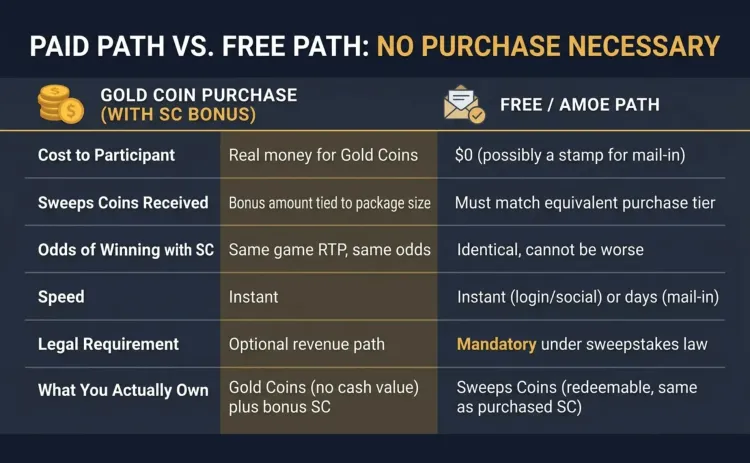
The table above is really the whole concept in miniature. The dollar amount you didn’t spend has no bearing on what the Sweeps Coins in your account are worth or how they perform in games. That parity is the legal point.
How to Evaluate Whether a Site’s NPN Offer Is Legitimate
A few practical checks separate a well-run sweepstakes casino from one cutting corners.
- Look for the official rules page, not just a homepage banner. Legitimate operators publish a full “Official Sweepstakes Rules” document, often linked in the site footer, that spells out eligibility, entry methods, odds, and the mail-in address in detail. If you can’t find this document at all, that’s worth noting regardless of how prominent the “No Purchase Necessary” banner is.
- Compare the free daily allotment to the platform’s minimum bet sizes. A functional free path should let you actually play games, not just log in and immediately run out of coins. There’s no fixed legal minimum here, but a free allotment that’s essentially symbolic suggests the operator is checking a box rather than building a genuine free-entry program.
- Check whether the mail-in method grants equal value. The official rules should state explicitly that mail-in entries receive the same number of Sweeps Coins as the site’s standard purchase-linked bonus tier. If the rules are vague about quantity or say mail-in requests are handled “at the company’s discretion,” that’s a detail worth reading twice.
- Check your state’s current status. Because sweepstakes law is state by state, a handful of states have moved to restrict or ban the dual-currency, cash-redeemable model entirely as of 2026, even though it’s legal in most of the country. If you’re in one of the more restrictive states, some platforms may only be available in a Gold-Coin-only, no-cash-prize format, or may not operate at all. That isn’t a sign the operator is doing anything wrong. It just reflects where state law has landed.
A Quick Example of How This Plays Out
Say a platform runs a promotion: buy a $9.99 Gold Coin package and get 5 free Sweeps Coins as a bonus. Under the law, that $9.99 has to be understood as payment for the Gold Coins alone, which have no cash value and exist purely for entertainment. The 5 Sweeps Coins are a gift attached to that purchase, not something you paid for directly, and the same 5 Sweeps Coins have to be available to someone who requests them by mail without spending a cent.
If you called the site’s customer support and asked, “If I never buy anything, can I still end up with the same Sweeps Coins as someone who does?” a properly run operator should be able to answer yes, and point you to exactly where the mail-in instructions live. If the answer is vague, or the representative doesn’t know their own AMOE process exists, that’s a more useful signal than any marketing claim on the homepage.
Consideration in the Digital Age
Courts have had to stretch the old consideration doctrine to cover things that didn’t exist when the underlying case law was written. Watching a video ad, for instance, has been argued in some contexts as a form of consideration since it generates ad revenue for the platform. Most sweepstakes operators avoid this argument entirely by never conditioning entry on watching anything, requiring only account registration and basic verification steps that courts have consistently treated as free of consideration.
This is part of why the free entry methods tend to look almost old-fashioned. A mailed letter feels like a relic in 2026, but it survives specifically because it is the cleanest, most litigation-tested way to prove that no economic exchange occurred. Newer methods, like claiming a code from a social post, work for the same reason: clicking a link and typing a code isn’t consideration under any court’s reading, even though it takes a small amount of effort.
Why This Model Exists At All
It’s worth stepping back and asking why any of this complexity is necessary rather than sites just calling themselves what they are. The honest answer is that US gambling law was largely written state by state, over more than a century, for physical casinos and lottery terminals. Online, browser-based games that mimic slot machines didn’t fit neatly into any existing license category when they started appearing.
Sweepstakes promotions, on the other hand, have an established, well-tested legal framework that’s been in use since mid-century marketing campaigns. Applying that framework, consideration-free entry, equal-odds AMOE, redeemable promotional currency, gave a new category of casino-style entertainment a route to operate legally without needing a state gambling license, in places where such licenses either don’t exist for online formats or are restricted to a small number of commercial operators.
That’s a legitimate legal structure, not a loophole in the pejorative sense. It’s the same category of law that lets a burger chain give away a car to whoever finds the right code under a wrapper. But it only stays legitimate if the “no purchase necessary” piece is real, which is exactly why it’s worth understanding rather than skimming past.
Key Takeaways
- “No purchase necessary” isn’t marketing language. It’s the legal condition that keeps a sweepstakes from being classified as an illegal lottery.
- Sweepstakes casinos split their economy into Gold Coins (purchasable, no cash value) and Sweeps Coins (free-only, redeemable for prizes) specifically to keep the purchase question separate from the prize question.
- Free Sweeps Coins typically come from daily logins, sign-up bonuses, social media codes, and a mandatory mail-in request option known as AMOE.
- A legitimate AMOE process must offer identical odds and coin value to any purchase-linked bonus, no exceptions.
- Ordinary effort, like reading an email or mailing a letter, isn’t the same as consideration in the legal sense, which is why these free methods satisfy the law even though they take a small amount of time.
- Sweepstakes law is enforced state by state, and several states have restricted or banned the redeemable dual-currency model as of 2026, so availability isn’t uniform nationwide.
- The best way to judge a specific operator is to read its official rules document, not its homepage banner.
Wondering what a fully compliant free-entry path looks like? GoldenDragon.Casino lays out every no-cost way to get Sweeps Coins, daily bonuses, sign-up offers, and the mail-in option, all in one place.
Frequently Asked Questions
1. How does a sweepstakes casino work?
A sweepstakes casino runs on two currencies: Gold Coins, which you can buy and which carry no cash value, and Sweeps Coins, which are always given away for free (never sold) and can be redeemed for cash prizes once you meet the site’s redemption requirements. Playing games with either currency uses the same software and the same odds. The difference is entirely in what each currency can be exchanged for afterward.
2. What is the difference between a sweepstakes casino and a casino?
A traditional online or land-based casino accepts direct wagers of real money and pays out winnings directly, which requires a gambling license in the jurisdiction where it operates. A sweepstakes casino never accepts a wager. You’re entering a promotional sweepstakes using coins that were either purchased separately (with no cash value) or given away for free, and it operates under sweepstakes and prize promotion law rather than gambling law.
3. Is no purchase necessary a real legal requirement, or just a suggestion?
It’s a hard legal requirement, not a suggestion. Under both federal consumer protection principles and state lottery statutes, any promotion combining a prize and an element of chance must allow entry without payment. Sweepstakes casinos that fail to provide a genuine, equally weighted free-entry path are exposed to regulatory action and civil liability.
4. Do sweepstakes casinos pay real money?
Yes, through Sweeps Coins specifically. Once you’ve accumulated Sweeps Coins and met the platform’s redemption conditions, which typically include identity verification and a minimum threshold, they can be redeemed for cash prizes. Gold Coins, by contrast, never convert to cash under any circumstances.
5. Is a sweepstakes casino legit if it requires personal information to claim free coins?
Requesting an email, phone number, or mailing address to send Sweeps Coins is normal and doesn’t violate the no-purchase-necessary requirement, since providing contact information isn’t consideration in the legal sense. What would be a problem is requiring a purchase, a paid subscription, or a hidden fee, like requiring certified mail, as a condition of using the free method.
6. How can I get free sweeps coins without paying anything?
The most common no-cost routes are daily login bonuses, new account sign-up bonuses, social media giveaway codes, and the formal mail-in AMOE request described in a platform’s official rules. All of these are designed to require zero payment, though they do take a small amount of time or a stamp for mail-in entries.
This article is intended for general educational purposes about how sweepstakes casino promotions are structured under US sweepstakes law. It is not legal advice. Sweepstakes regulations vary by state and change over time, so always check a platform’s current official rules and your state’s specific requirements before participating. For a deeper look at how the coin systems themselves work, see our guides on Sweeps Coins and Gold Coins.
Purchase Securely With