Blog
Sweepstakes Laws: How Promotional Giveaways Are Actually Regulated in the U.S.
Casino
- The legal question sweepstakes law answers
- Where this law actually comes from
- A brief timeline of how this law developed
- Sweepstakes law across different industries
- State quirks worth knowing about
- Why sweepstakes are called "sweepstakes"
- Sweepstakes vs. Contests vs. Raffles vs. Lotteries
- How this framework applies to sweepstakes casinos
- What "no purchase necessary" actually requires
- How enforcement actually works
- Cross-border and multi-state promotions
- Common misunderstandings about sweepstakes law
- Key takeaways
- FAQ
- 1. Why is it called a sweepstake?
- 2. How does sweepstakes casino work?
- 3. Are sweepstakes the same as gambling?
- 4. No purchase necessary sweepstakes: is that really enforceable?
- 5. Is sweepstakes casino legit as a legal model, not just a specific brand?
Every year, companies give away millions of dollars in prizes through sweepstakes, and almost none of them need a gambling license to do it. That's not an accident or an oversight in the law. Sweepstakes occupy a specific, well-defined legal category that's existed for most of a century, built around a distinction that shows up everywhere from cereal box promotions to social media giveaways to, more recently, online sweepstakes casinos.
Understanding sweepstakes law as a general category makes it much easier to understand any specific application of it, including the sweepstakes casino model. This guide covers where the law comes from, what makes something a legal sweepstakes rather than an illegal lottery, how the rules differ across industries and states, and how enforcement actually works when a company gets it wrong.
The legal question sweepstakes law answers
At its core, sweepstakes law exists to answer one question: when does a promotional giveaway cross the line into being an illegal lottery?
Historically, most U.S. states banned private lotteries outright, reserving the right to run lotteries exclusively for the state itself (or, in earlier eras, banning them entirely). That created an obvious problem for any company that wanted to run a giveaway promotion: if a giveaway looked enough like a lottery, it could be illegal no matter how good the marketing intent behind it was.
Courts and legislatures settled on the same three-part test that still applies today. An illegal lottery requires consideration (payment or something of value given up to enter), chance (a random or unpredictable outcome), and prize (something of value to be won). Remove any one of the three, and the activity isn't legally a lottery, regardless of how it's marketed.
Sweepstakes promotions are built specifically to remove consideration, by guaranteeing a free method of entry alongside any paid option. Contests are built to remove chance, by having winners determined through skill or judged criteria rather than randomness. Both categories exist as a direct legal response to lottery law, not as a separate, unrelated concept.
Where this law actually comes from
There isn't one federal sweepstakes statute. Instead, the legal framework comes from a combination of sources.
State lottery and gambling statutes define what counts as an illegal lottery in each state, which indirectly defines what a legal sweepstakes has to avoid. These statutes date back, in some form, to the 19th and early 20th centuries, long before modern marketing sweepstakes existed.
State sweepstakes and prize promotion statutes were added later, generally in the mid,20th century, specifically to regulate the format once sweepstakes promotions became common through radio, television, and mail-order marketing. These statutes typically require published official rules, a genuine no-purchase entry method, and accurate odds disclosure.
Federal consumer protection law, primarily enforced by the Federal Trade Commission, covers deceptive or unfair practices in how sweepstakes are advertised and run, regardless of which state the promotion operates in.
Federal mail and wire fraud statutes have historically been used against sweepstakes operators that ran outright scams, particularly the "you've already won, just pay a processing fee" style of fraud that these laws were partly designed to stop.
A small number of state-specific registration and bonding requirements, notably in New York, Florida, and Rhode Island, apply to sweepstakes with prize pools above a set threshold, requiring the promotion to register with the state and post a bond guaranteeing prizes will be paid.
A brief timeline of how this law developed
Sweepstakes law didn't arrive fully formed. It built up in stages, each one responding to a specific problem.
In the early to mid 20th century, most states banned private lotteries outright as a matter of public policy, a reaction to widespread lottery fraud in the 1800s. That left companies wanting to run giveaway promotions with a real legal problem, since any random, chance prize drawing risked being classified as an illegal lottery.
By the 1930s and 40s, marketers and their lawyers had worked out that removing the payment requirement, offering a free way to enter alongside any paid option, took the activity outside the legal definition of a lottery. Mail-in contest cards and radio call-in promotions built around this structure became common.
The 1950s brought a wave of scrutiny after televised quiz show scandals revealed some competitions were rigged, which pushed both broadcasters and regulators toward more formal rules around disclosure and fairness, indirectly shaping how sweepstakes rules got written and published from that point forward.
Starting in the 1960s, states began legalising their own state-run lotteries, beginning with New Hampshire in 1964, which created an interesting split: state governments could now run the exact activity they still banned everyone else from running, while private sweepstakes remained legal specifically because they avoided the consideration element.
The 1990s and 2000s saw sweepstakes law get tested by internet-based promotions, chain email "forward to win" schemes, and eventually online instant-win games, most of which had to fit the same decades-old legal test even though the format was entirely new.
The 2010s brought a related but distinct debate over daily fantasy sports and social casino apps, both of which raised similar "is this actually gambling" questions under different legal theories (skill, based competition for fantasy sports, no, prize, value arguments for social casino apps).
The 2020s introduced sweepstakes casinos specifically, applying the classic no-consideration sweepstakes structure to an ongoing series of casino-style games rather than a single drawing, which is the application this guide focuses on, and which has now generated its own dedicated wave of state legislation less than a decade after the format became popular.
Sweepstakes law across different industries
It's worth seeing how broadly this legal category actually gets used, because it makes clear that sweepstakes casinos are one application among many, not a uniquely engineered exception.
Consumer packaged goods and retail run some of the oldest and most common sweepstakes, the "collect codes, enter online or by mail" format seen on snack food and beverage packaging for generations.
Restaurants and quick-service chains use sweepstakes for promotions tied to menu items or app engagement, almost always with a printed or online alternate entry method required by law.
Airlines, hotels, and loyalty programs run sweepstakes for points, upgrades, or trips, subject to the same rules, which is why loyalty program terms almost always include a "no purchase necessary" clause even though the promotion is tied to a paid membership program.
Broadcast media, radio in particular, has used call-in and mail-in sweepstakes for decades, and was central to some of the earliest legal precedent on what counts as a genuine alternate entry method.
Social media platforms host an enormous volume of "like, follow, and comment to win" giveaways run by brands, which technically still need to satisfy no-purchase-necessary requirements even though platform terms of service add another layer of rules on top of state law.
Online sweepstakes casinos are the newest major category, distinguished mainly by running an ongoing series of chance-based games rather than a single prize drawing, which is why they've attracted their own dedicated legislative attention faster than most other applications of sweepstakes law.
State quirks worth knowing about
Beyond the general framework, a handful of states have specific wrinkles that matter if you're trying to understand sweepstakes law in real depth.
Florida and New York both require registration and a bond for sweepstakes with prize pools above roughly $5,000, a threshold that predates online sweepstakes casinos but still applies to them. Rhode Island has a similar registration requirement at a lower threshold.
Some states have specific rules about disclosing the exact odds of winning where mathematically calculable, which is more straightforward for a single prize drawing than for an ongoing series of casino-style games, and is part of why sweepstakes casino rules pages tend to describe odds in more general terms than a traditional single-prize sweepstakes would.
A few states restrict or add extra requirements to sweepstakes specifically tied to alcohol, tobacco, or firearms promotions, which is more relevant to retail sweepstakes than to sweepstakes casinos but is a good example of how sweepstakes law isn't a single uniform rule even outside the casino-specific debate.
Why sweepstakes are called "sweepstakes"
The term has a specific history worth knowing, because it explains some of the legal terminology still used today. "Sweepstakes" originally referred to horse races where the entire prize pool ("stakes") was contributed by the entrants and swept to the winner, a usage that dates back well over a century in racing and card game contexts. The term was later adopted for prize promotions generally, and by the mid,20th century it had become the standard legal and marketing term for a chance, based giveaway that doesn't require payment to enter, distinct from both a raffle (which typically does require payment, and is regulated as a form of lottery) and a contest (which is decided by skill rather than chance).
Sweepstakes vs. Contests vs. Raffles vs. Lotteries
These four terms get used loosely in everyday conversation but mean specific, different things legally.
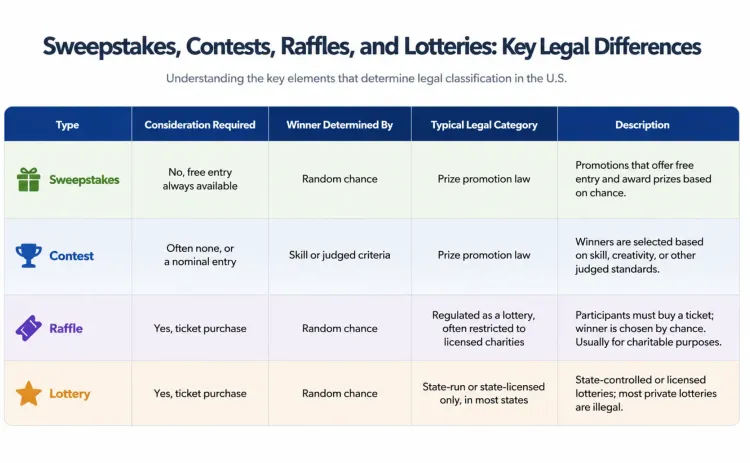
This is why a nonprofit's 50/50 raffle typically needs a specific charitable gaming license, while a company's "enter for a chance to win" social media giveaway doesn't. Both involve chance and a prize; only the raffle requires payment to enter, which is what pulls it into lottery regulation.
How this framework applies to sweepstakes casinos
Sweepstakes casinos are simply a newer application of this same, long-standing legal category, applied to slot-style and table-style games instead of a single prize drawing. The Gold Coins and Sweeps Coins structure exists specifically to satisfy the no-consideration requirement described above: Gold Coins are the paid, play-for-fun currency, while Sweeps Coins, the redeemable currency, are always obtainable through a free method as well as through bonus allocations tied to Gold Coin purchases.
This is worth understanding on its own terms rather than as an exception invented for online gaming. The same legal reasoning that permits a retailer's "no purchase necessary, enter online or by mail" promotion is the reasoning that permits a sweepstakes casino's Sweeps Coins system. Where sweepstakes casinos differ from a typical retail sweepstakes is mostly in scale and frequency. A retail sweepstakes usually runs once, with a single prize or prize pool and a defined end date. A sweepstakes casino runs an ongoing series of game-based prize opportunities, which is part of why a growing number of states have begun writing legislation aimed specifically at this application rather than relying purely on general sweepstakes statutes.
What "no purchase necessary" actually requires
Because this phrase shows up constantly and is often treated as boilerplate, it's worth spelling out what it actually legally requires, since not every "free entry" method satisfies it.
The free entry method has to be genuinely available, not hidden behind confusing instructions or unreasonable delays. A method that technically exists but takes months to process while paid entries are processed instantly would be vulnerable to a regulator or court finding it isn't a real alternative.
The free entry method has to offer a comparable chance of winning to the paid method. If free entries are quietly capped or weighted to receive worse odds than paid entries, that undermines the legal basis for the no-purchase distinction even if a free method technically exists.
The rules have to be clearly published, typically including how to use the alternate method of entry, what the odds are (where calculable), and any limits on frequency of free entries.
This is the standard that separates a compliant sweepstakes, casino-based or otherwise, from one that's using "no purchase necessary" as a legal fig leaf without actually implementing it. Regulators and plaintiffs' attorneys have both gone after companies for the latter, historically in class action suits over vague or practically unusable AMOE language.
How enforcement actually works
Sweepstakes law enforcement mostly comes from three directions, and it's useful to know which one is likely to act in a given situation.
State attorneys general handle most sweepstakes enforcement, typically starting with a cease and desist letter when a company's promotion appears to violate the state's sweepstakes or lottery statute, with escalation to civil penalties for continued noncompliance.
The FTC steps in primarily around deceptive advertising, meaning cases where the sweepstakes itself might be structured fine, but the marketing around it misrepresents odds, prizes, or terms.
Private litigation, often as class actions, has become a significant enforcement mechanism in its own right, particularly around AMOE language that plaintiffs argue is misleading or practically unusable. These cases don't require government action to proceed and have resulted in real settlements against companies that treated "no purchase necessary" as a formality rather than an operating requirement.
Cross-border and multi-state promotions
Any sweepstakes open to entrants nationwide has to satisfy the strictest applicable state rule across every state it's offered in, plus the general federal rules, which is why national sweepstakes rules pages tend to read like they were written to survive the most demanding state's requirements rather than the most typical one. A promotion open to Canadian residents adds another full layer of provincial contest law, which is stricter in some respects, including a near-universal requirement in Canada for a skill-testing question before a prize can be awarded. Most online sweepstakes casinos avoid this complexity entirely by restricting entry to U.S. residents in eligible states, which keeps them inside a single, more consistent regulatory framework.
Common misunderstandings about sweepstakes law
"No purchase necessary" is just a legal disclaimer nobody actually uses. Whether people use the free method doesn't change its legal function, but a company that makes the free method deliberately hard to use is taking on real legal risk, not just a reputational one.
Sweepstakes are unregulated compared to lotteries. They're regulated differently, not less. The lighter regulatory footprint reflects the different risk profile of a no-payment promotion compared to a paid lottery ticket, not an absence of rules.
All sweepstakes are basically legal everywhere. Most are, but a small number of states have unusual restrictions or extra requirements, and the sweepstakes-casino category specifically now has an active, growing body of state-specific restrictions layered on top of general sweepstakes law.
Winning a sweepstakes prize is tax-free. It isn't. Sweepstakes prizes, including cash, are generally treated as taxable income by the IRS, and larger prizes typically come with a 1099 form documenting the payment for tax purposes.
Sweepstakes law is basically the same in every state. The core three, part test is consistent nationwide, but the details, registration thresholds, odds disclosure requirements, and industry, specific carve, outs vary enough that a promotion designed around one state's rules can run into trouble in another without careful review.
Key takeaways
- Sweepstakes law exists to distinguish legal prize promotions from illegal lotteries, using the same consideration, chance, and prize test used across gambling law generally.
- A sweepstakes removes the consideration requirement through a genuine free entry method; a contest removes the chance requirement through skill-based judging; a raffle and a lottery both retain paid entry and are regulated more strictly.
- The legal framework comes from a mix of state lottery statutes, state sweepstakes-specific statutes, federal consumer protection law, and in a few states, registration and bonding requirements for larger promotions.
- Sweepstakes casinos apply this long-standing legal category to an ongoing, game-based prize structure rather than a single promotional drawing, which is why they've drawn new, targeted legislation in some states.
- "No purchase necessary" has real legal substance behind it: the free method must be genuinely available, comparably fast, and comparably likely to win, not just technically present.
FAQ
1. Why is it called a sweepstake?
The term originally described horse races where entrants' contributions were "swept" entirely to the winner. It was later adopted for prize promotions generally, and by the mid,20th century became the standard legal term for a chance-based giveaway that doesn't require payment to enter.
2. How does sweepstakes casino work?
A sweepstakes casino uses two currencies, Gold Coins for non-redeemable play and Sweeps Coins for potential prize redemption, structured so Sweeps Coins are always obtainable for free, which satisfies the same no purchase necessary requirement that governs sweepstakes generally.
3. Are sweepstakes the same as gambling?
No, legally. Gambling requires consideration, chance, and prize together. Sweepstakes remove the consideration element through a required free entry method, which places them under prize promotion law rather than gambling law.
4. No purchase necessary sweepstakes: is that really enforceable?
Yes. It's a substantive legal requirement, not a formality, enforced through state attorneys general, FTC advertising rules, and in many cases private litigation when a company's free entry method turns out to be difficult or practically impossible to use.
5. Is sweepstakes casino legit as a legal model, not just a specific brand?
As a legal model, yes: it applies a legal category that's existed for decades to a new format of game. Whether any individual operator is legitimate depends on whether it actually implements the requirements: genuine free entry, clear rules, and honest redemption terms, rather than treating them as decorative.
This article is for general educational purposes and isn't legal advice. Sweepstakes law varies by state and changes over time; consult your state's statutes or a licensed attorney for guidance specific to your situation. For more on how this framework applies specifically to online casino-style sweepstakes, see our companion guides on sweepstakes casino laws and how sweepstakes casinos are legal.
Purchase Securely With