

What Is RTP? The Number That Explains How Games Pay Back Over Time
Published Sep 6, 2026
Casino
Open the information screen on almost any digital slot or table game and you'll find a percentage sitting quietly next to the rules: something like 94%, 96.5%, or 98%. That number is RTP, short for return to player, and it's one of the few pieces of hard data a game actually discloses about its own math. Most players glance past it. That's a mistake, because RTP is genuinely useful once you know how to read it correctly, and genuinely misleading if you don't.
This guide answers what is RTP, walks through exactly how the percentage is calculated and tested, and clears up the handful of misunderstandings that trip up even experienced players. By the end, you'll be able to look at any game's disclosed RTP and know exactly what it is, and isn't, telling you.
Key Takeaways
- RTP stands for return to player: the percentage of all money wagered on a game that is designed to be paid back to players over a very large number of rounds.
- RTP is a long-run statistical average, not a promise about any single session, hour, or spin.
- The number is calculated during game development by simulating tens of millions of rounds, then verified by independent testing labs before and after launch.
- RTP and volatility are two different things. RTP tells you how much comes back over time; volatility tells you how bumpy the ride is getting there.
- On sweepstakes platforms, the same certified RTP applies to a game regardless of whether it's played with Gold Coins or Sweeps Coins, since RTP is a property of the game's math, not the currency.
What Is RTP, in Plain Terms?
RTP is a percentage that represents the theoretical proportion of total wagers a game is designed to return to players over an extremely large sample of play. If a slot has a 96% RTP, the math model behind it is built so that, across millions of spins from many different players, roughly 96% of everything wagered comes back out in wins.
That last part matters more than it might seem. RTP is a population-level statistic, not an individual guarantee. A single player could sit down and lose every spin in a session, or could hit a jackpot on their third spin, and neither outcome would say anything meaningful about whether the RTP figure is accurate. RTP only becomes a reliable descriptor once you're looking at a large enough sample: thousands or millions of rounds, not dozens.
It helps to flip the number around for a second. A 96% RTP also implies a house edge of 4%. That's the portion of total wagers the game is mathematically designed to retain over time. Every RTP-based game has a corresponding house edge; they're two ways of describing the same underlying math.
How RTP Is Actually Calculated
RTP isn't measured by watching a handful of live sessions and doing rough math. It's built into the game before launch and then verified against real-world data afterward. The process generally has two phases.
- Phase one: theoretical RTP, set during design. When a game studio builds a slot or table game, the paytable, the reel strips, the odds of triggering bonus features, and every other probability-affecting element get fed into a simulation. That simulation runs the game's RNG through tens of millions, sometimes hundreds of millions, of virtual rounds and tracks the ratio of total payouts to total wagers. The result is the theoretical RTP: the number that gets published on the game's information screen and submitted for certification.
- Phase two: actual RTP, measured during live play. Once a game is live, operators and regulators can track the actual RTP based on real wagers and real payouts across the full player base. Over a long enough period, actual RTP converges toward theoretical RTP. Early on, or over a small sample, actual RTP can vary noticeably from the theoretical figure simply due to normal statistical variance. This is the same reason flipping a fair coin ten times might give you seven heads and three tails, even though the "true" probability is 50/50 for each flip. Run it a million times and the ratio settles in close to 50/50.
Independent testing labs are involved at both phases. Before launch, they verify that the simulation results match the claimed theoretical RTP. After launch, on regulated platforms, ongoing monitoring can confirm actual performance stays consistent with what was certified.
RTP vs. Volatility: Two Different Questions
RTP and volatility (sometimes called variance) get confused constantly, but they answer completely different questions.
RTP answers: over a very long run, what share of total wagers comes back as wins? Volatility answers: how are those wins distributed along the way? A low-volatility game tends to pay out smaller amounts more frequently. A high-volatility game pays out less often but with bigger amounts when it does hit. Two games can have the exact same RTP, say 96%, while feeling completely different to play, because one smooths its payouts across many small wins and the other concentrates them into rarer, larger ones.
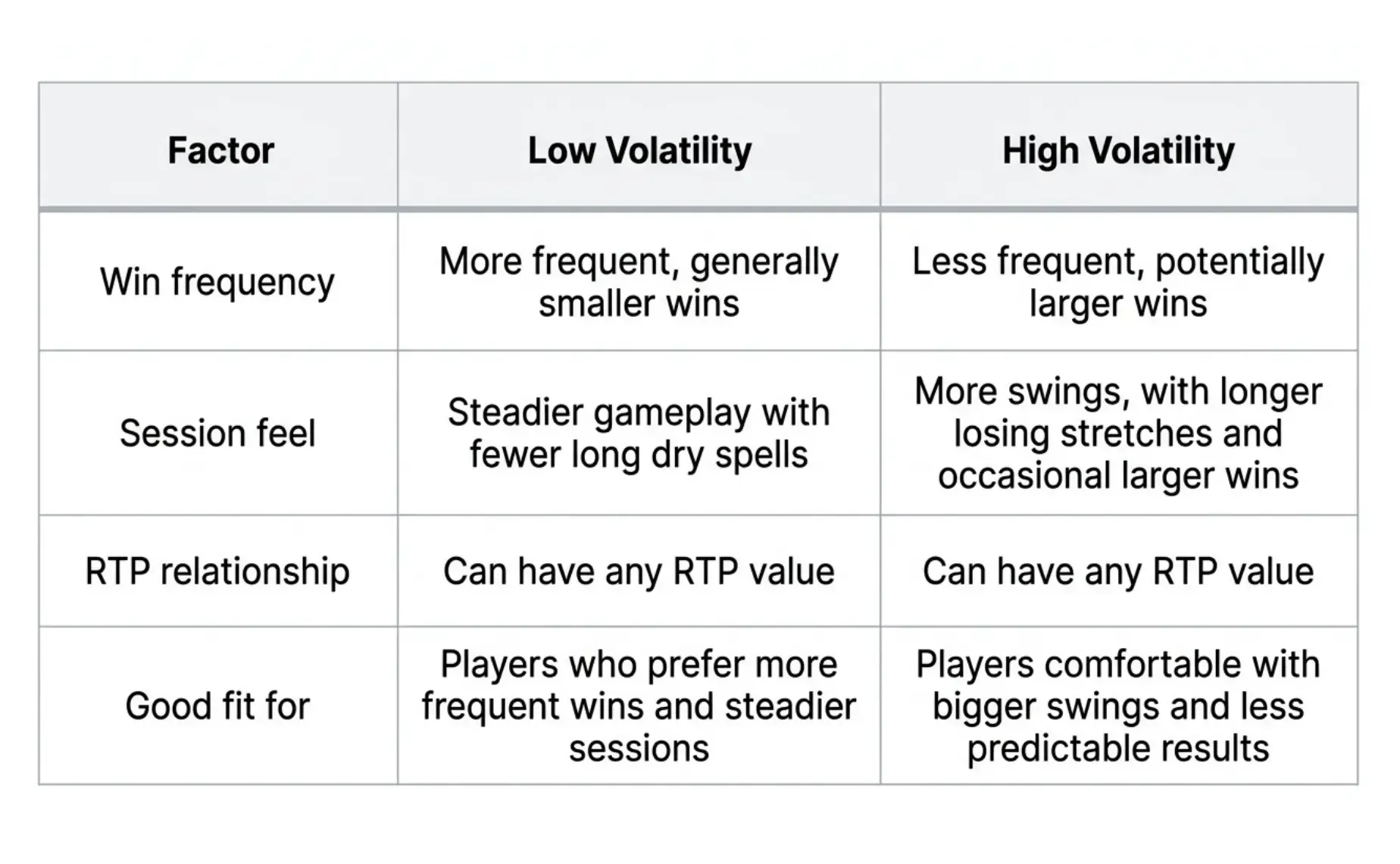
Neither profile is objectively "better." They're different risk shapes layered on top of the same underlying RTP concept, and most game info screens disclose both figures side by side, along with a volatility or variance rating (often shown as low, medium, or high, or sometimes a simple star rating).
Where to Actually Find a Game's RTP
Most reputable platforms and game studios make RTP easy to locate, though the exact placement varies.
- The in-game information or paytable screen. This is the most direct source. Look for an "i" icon, a "rules" button, or a "paytable" tab within the game itself. RTP is typically listed alongside the game's volatility rating and bonus feature odds.
- The game provider's official site. Established game studios often publish RTP figures for their full catalog on their own compliance or game-info pages, which is useful for cross-checking what's shown in-platform.
- Platform-level disclosures. Some platforms maintain a central page listing RTP for every game they offer, which is a faster way to compare multiple titles at once than opening each one individually.
If you can't find an RTP figure anywhere for a specific game, that's worth treating with some skepticism. Reputable, independently tested games disclose this number as a matter of course; it's not proprietary information they're protecting.
It's also worth noting that disclosure formats aren't perfectly standardized across the industry. Some platforms list RTP as a single flat percentage per game. Others break it down further, showing a base game RTP alongside a separate figure for when bonus features are active, since some features are optional or purchasable in certain game formats and shift the math when engaged. Neither approach is wrong, but it's worth reading the fine print on the info screen rather than assuming every platform presents the number the same way.
Why RTP Isn't the Whole Story
RTP is a genuinely useful number, but it gets misapplied constantly, usually in one of these ways. Most of these mistakes come from a single root cause: treating a long-run statistical average as if it were a short-run prediction.
- Assuming RTP predicts your specific session. A 97% RTP does not mean you'll get back 97 cents of every dollar you play tonight. It's a long-run average across a huge sample. Your specific session could land well above or well below that figure purely from normal variance, especially on a shorter session or a higher-volatility game.
- Treating RTP as the only variable that matters. Two games with identical RTP can play completely differently once volatility, bonus frequency, and maximum win potential are factored in. RTP is one input, not the whole picture.
- Assuming a higher RTP always "feels" better. Because RTP is a long-run average, a high-RTP, high-volatility game can still produce long losing stretches punctuated by rare big wins. Meanwhile, a slightly lower-RTP, low-volatility game might feel steadier session to session, even though its long-run math is marginally less generous. Which one "feels" better is genuinely subjective.
- Confusing advertised RTP with what a specific version delivers. Some games ship in multiple configurations (different RTP tiers chosen by the operator from a range the studio makes available). When this applies, reputable platforms disclose which configuration is live. If you're comparing RTP figures across two different platforms offering what looks like the same game, it's worth confirming they're running the same configuration.
A Worked Example: Seeing RTP in Practice
Numbers land better with a concrete example, so here's one, using round figures for clarity rather than any real game's actual math.
Say a slot has a published RTP of 95%. Now imagine, purely as a thought experiment, that ten thousand players each spin the game 500 times using the same-sized wager per spin, for a combined total of five million spins. The math model behind that 95% RTP predicts that across all five million spins combined, total payouts will land close to 95% of total wagers.
Individually, those ten thousand players will have wildly different outcomes. Some will finish well ahead. Some will lose every session. A handful might hit a rare bonus feature that pays out a large multiple of their wager. None of that individual variation contradicts the 95% figure, because RTP was never describing any one of those players. It describes the aggregate. This is exactly why a friend's lucky night or unlucky streak tells you nothing reliable about whether a game's published RTP is accurate. You'd need the friend's data, plus everyone else's, plus a genuinely large sample size, to see the number actually converge.
This is also why short-term results are a poor way to judge whether a platform is being honest about its disclosed RTP figures. Trustworthy platforms don't rely on players doing this math themselves. They rely on the certification process happening before the game ever launches, which is a far more reliable check than any individual's play history could be.
How RTP Concepts Apply Across Different Game Formats
RTP as a concept originated with, and is most cleanly demonstrated by, slot machines, because a slot's outcomes are a single RNG-driven event per spin with a clearly defined paytable. Other game formats apply the same underlying logic, with some adjustments.
Fish table games distribute payback differently. Instead of one clean per-spin outcome, RTP in a fish game is spread across many individual shot attempts, each with its own probability of successfully catching a fish worth a certain point value. The aggregate math still produces a measurable long-run payback percentage, but it's calculated across the full sequence of shots rather than a single discrete event, and skill-adjacent input (your aim and timing) interacts with the underlying probability rather than replacing it.
Table-style digital games (digital versions of card or wheel-based games) typically have RTP figures that are more directly tied to the mathematical structure of the game itself, since the rules and payout structure are usually fixed and well documented, leaving less room for the kind of feature-driven variance you see in modern video slots with multiple bonus rounds.
Across all of these formats, the core idea holds steady: RTP is a long-run measure of payback built into the game's certified math, verified through the same category of independent testing regardless of exactly how the game presents that math to the player.
RTP and the Cost of Casual Play
One more practical way to think about RTP: it's a useful way to compare relative game math when you're deciding what to spend time on, but it works best as a comparison tool rather than a prediction tool. If you're weighing two similarly styled games and one discloses a 92% RTP while the other discloses a 97% RTP, that difference is meaningful information about the long-run math, even though it won't tell you anything about what happens in your next ten minutes of play. Treating RTP as one input among several, alongside volatility, personal budget, and how you want a session to feel, is a more grounded way to use the number than expecting it to forecast any individual outcome.
RTP and the Sweepstakes Model
RTP is a property of the game itself: it comes from the game studio's math model and applies the same way regardless of which platform offers the game or which currency you're using to play. On a sweepstakes platform like GoldenDragon.Casino, that means the certified RTP for a given title is identical whether you're playing with Gold Coins, the play-for-fun virtual currency with no cash value, or Sweeps Coins, the promotional currency tied to the sweepstakes structure that can potentially be redeemed for prizes under the platform's official rules.
This is worth stating plainly because it's a common point of confusion: RTP describes game math, not the entry or redemption process. The rules around how you obtain Sweeps Coins without a purchase, how redemption works, and what the sweepstakes framework requires are governed by sweepstakes law, entirely separate from the certified RNG and RTP testing that applies to the games themselves. Both matter, but they're answering different questions, and a platform being transparent about one doesn't automatically tell you it's transparent about the other. Check both independently: the game's disclosed RTP, and the platform's official sweepstakes rules.
If you’re ready to explore Golden Dragon for yourself, you can also save on your first experience with promo code DRAGON20, which gives you 20% off. The code is limited to one use per user and remains valid until January 1, 2030.
Frequently Asked Questions
1. What is RTP in slots?
RTP in slots is the theoretical percentage of all wagered credits a specific slot game is designed to pay back to players over a very large number of spins. It's calculated through simulation before launch and verified through independent testing.
2. What is RTP in casino games?
Across casino-style games generally, RTP works the same way: it's the long-run payback percentage built into a game's math model, whether that game is a slot, a table game, or another RNG-based format. The exact mechanics of how RTP is achieved differ by game type, but the underlying concept, wagers paid back over time as a percentage, stays consistent.
3. Is a higher RTP always better?
Generally, a higher RTP means a more favorable long-run payback percentage, all else being equal. But "all else" isn't always equal. Volatility, bonus frequency, and how you personally define an enjoyable session all factor into whether a higher-RTP game is actually the better fit for you specifically.
4. How is RTP different from odds of winning?
RTP describes the aggregate payback percentage across all outcomes combined. It doesn't tell you the specific odds of hitting any one particular symbol combination, bonus feature, or jackpot. A game can have a solid RTP while still having a low probability of hitting its top prize, because that top prize contributes to the overall RTP average alongside many smaller, more frequent wins.
5. Does RTP change over time or by region?
For a given, specific version of a game, no; the certified RTP is fixed at that configuration. However, some game titles are released in multiple RTP configurations, and it's the operator's choice which configuration to offer. This is why the same game name can occasionally show a different RTP figure on different platforms. The disclosed number for the specific version you're playing is the one that applies.
6. Can I verify RTP myself?
Not directly through casual play, since individual sessions are too small a sample to be statistically meaningful. What you can do is check the disclosed RTP on the game's info screen, cross-reference it against the game studio's official published figures, and look for evidence of independent testing certification on the platform.
7. Who actually verifies RTP figures, and how often?
Independent testing laboratories that specialize in gaming compliance and statistical auditing verify RTP before a game launches, checking the simulation results against the claimed figure. Many jurisdictions and reputable platforms also require or perform periodic re-verification, and any update to a game's code that could plausibly affect its math is expected to trigger a fresh review rather than being assumed safe. This layered approach, pre-launch certification plus ongoing scrutiny, is what makes a disclosed RTP figure meaningfully different from an operator simply asserting a number with nothing behind it.
The Bottom Line
RTP is one of the most genuinely informative numbers a game will show you, but only if you treat it for what it is: a long-run statistical average, verified through simulation and independent testing, that describes the game's math model rather than any individual outcome. Pair it with a game's volatility rating for a fuller picture, and remember that it applies to the game itself regardless of which currency you're playing with on a sweepstakes platform.
If you want to see how RTP connects to the technology generating each outcome, our guide on how RNG works in games covers the mechanics underneath the percentage. And for a broader look at the term itself and how to use it well, our companion guide on return to player walks through the practical side of applying this number to your own play.