

Return to Player Explained for Actual Use (Not Just Definition)
Published Sep 6, 2026
Casino
Most explanations of return to player stop at the definition: it's a percentage, it tells you how much a game pays back over time, the end. That's accurate as far as it goes, but it leaves out the more useful question, which is how to actually apply that number when you're deciding what to play, how to think about a session, or how to compare one game against another.
This guide covers the practical side of return to player: where the concept came from, how to compare it meaningfully across different games, what it can and can't tell you about any given session, and how it fits into the broader picture of playing responsibly on a sweepstakes platform. If you already know the textbook definition and want the part that actually helps you make decisions, this is the version written for you.
Key Takeaways
- Return to player (RTP) is the long-run percentage of wagers a game is mathematically designed to pay back, but its real value comes from how you use it to compare games and set expectations, not from memorizing the definition.
- RTP figures are most useful as a comparison tool between similar games, not as a forecast for any specific session.
- Reading RTP alongside volatility, feature frequency, and your own budget gives a far more complete picture than RTP on its own.
- Regulatory and industry pressure toward RTP transparency has grown steadily, and disclosure is now standard practice among reputable game studios and platforms.
- On a sweepstakes platform, return to player is a game-math concept, separate from the sweepstakes entry and redemption rules that govern Gold Coins and Sweeps Coins.
Where the Concept of Return to Player Came From
Return to player as a formal, disclosed figure is a relatively modern development in the history of casino-style gaming. Mechanical slot machines existed for decades with payout structures set by physical reel configurations that were rarely disclosed to players in any standardized way. The shift toward digital, RNG-based games changed that, for a simple reason: once a game's outcomes are generated by software rather than a physical mechanism, it becomes possible to simulate millions of rounds and calculate an exact theoretical payback percentage before the game ever reaches a player.
That technical shift, combined with growing regulatory attention to fairness and transparency in digital gaming, pushed RTP disclosure from a nice-to-have into something closer to a baseline expectation. Independent testing labs built standardized processes for verifying these figures, and over time, showing RTP on a game's information screen became the norm among reputable studios rather than the exception.
This history matters for a practical reason: it explains why RTP disclosure isn't just marketing generosity from game studios. It's the byproduct of a broader shift toward making game math auditable and comparable, which is exactly what makes the number useful to you as a player today.
Typical Return-to-Player Ranges by Game Format
RTP figures vary by game format and by individual title, so there's no single number that applies universally. That said, understanding roughly where different formats tend to land helps put any specific figure you see into context.
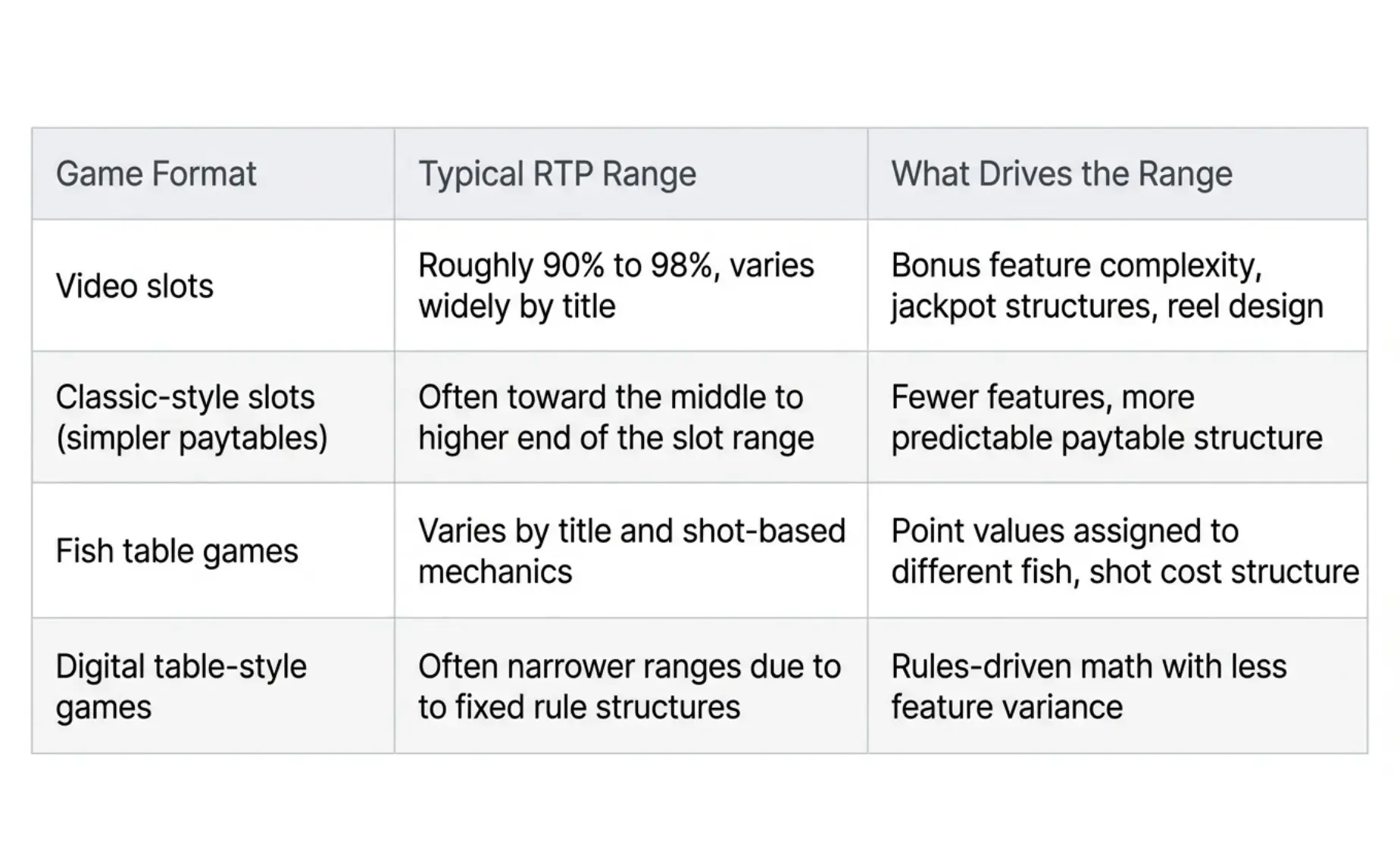
These ranges are general orientation points, not promises about any specific title. The only figure that matters for a game you're actually considering is the one disclosed on that game's own information screen. Broader averages are useful for calibrating expectations across a catalog, but they shouldn't substitute for checking the actual number in front of you.
It's also worth noting that RTP ranges can shift over time as game studios release new titles with different design philosophies, so treating any published "typical range" as fixed forever isn't accurate either. The individual game's disclosed figure is always the authoritative source.
Using Return to Player as a Comparison Tool
The single most practical use of RTP is comparing similar games against each other, not trying to extract a prediction from one game in isolation.
Say you're choosing between three slot titles with a similar theme and similar bet range. If one discloses an RTP of 92%, another 95.5%, and a third 97%, that spread tells you something concrete about the relative long-run math of each, even though it says nothing about what will happen in your next session on any of them. Over enough play, the 97% title is mathematically designed to return a larger share of total wagers than the 92% title.
Where this gets more useful is combining it with volatility data. A game with a high RTP but very high volatility might be a poor fit if you prefer a steady, extended session over a chance at a rare big hit. A game with a slightly lower RTP but low volatility might actually suit your preferences better, even though the raw RTP number looks less impressive on paper. Neither choice is "wrong." They're different trade-offs, and RTP alone doesn't tell you which trade-off fits how you like to play.
A practical habit worth building: before settling into a new game, spend thirty seconds checking its info screen for both RTP and volatility rating. That combination gives you a far more realistic sense of what to expect than either figure alone.
Ready to put that into practice? Explore Golden Dragon and browse the available games.
What Return to Player Cannot Tell You
It's worth being direct about the limits of this number, because overestimating what RTP can predict is where most confusion starts.
RTP cannot tell you whether your next spin wins or loses. It cannot tell you how a specific session of any length will go. It cannot account for the fact that outcomes are independent events with no memory, meaning a game "underperforming" its RTP over your last twenty rounds says nothing about the next twenty. And it cannot substitute for a personal budget or a clear sense of how much time and money you're comfortable spending on entertainment.
This is the same statistical logic that applies to any long-run average. Knowing that a coin is fair and lands heads roughly 50% of the time over a million flips tells you nothing useful about whether your next single flip will be heads. RTP works the same way, just with more moving parts in the underlying math.
Treating RTP as a responsible-play tool rather than a strategy tool is the healthiest way to use it. It's genuinely helpful for setting realistic expectations and comparing options. It's not a system for beating a game's underlying math, because no such system exists for properly certified RNG-based games.
Curious how each outcome is generated? Learn how RNG works in games.
A Simple Framework for Reading Return to Player Data
When you're looking at a new game's information screen, here's a practical order to work through the disclosed figures:
- Check the RTP figure first. This gives you the baseline long-run payback percentage.
- Check the volatility or variance rating. This tells you how that payback is likely to be distributed: steady and frequent, or rare and larger.
- Look at bonus feature frequency, if disclosed. Some games break out how often key features trigger, which adds useful texture beyond the two headline numbers.
- Confirm which configuration you're viewing. If a title exists in multiple RTP versions, make sure the figure you're reading matches the version actually available on the platform you're using.
- Set your own session parameters separately. None of the above figures should be doing the job of a personal budget or time limit. Those are decisions you make independently, informed by but not dictated by the game's math.
This isn't a complicated process, but going through it deliberately, rather than skimming past the numbers, is the difference between using RTP as a genuinely useful reference and just knowing the definition without applying it.
How to Spot an Untrustworthy RTP Claim
Most disclosed RTP figures are accurate, because they've gone through independent certification before reaching a player-facing screen. But it's still worth knowing what a weak or untrustworthy claim looks like, since not every platform holds itself to the same standard.
A few warning signs worth watching for. First, a platform that advertises an unusually high, round RTP figure (something suspiciously clean like "99% RTP guaranteed") without any reference to independent testing or a specific verifying lab. Genuine RTP figures are typically precise to a decimal point, because they come from actual simulation data, not marketing copy. Second, a platform where RTP information simply isn't available anywhere, not on the game screen, not on a dedicated info page, not in the terms. If a number is being withheld rather than disclosed, that's a legitimate reason for caution. Third, claims that a platform's games have "better odds" than the same titles offered elsewhere, without any explanation of how that would even work given that RTP is typically set by the game studio, not the platform itself, for a given certified configuration.
None of this means every platform without a polished info page is untrustworthy. Smaller or newer operators sometimes present information less clearly even when the underlying certification is solid. But when you can't find any trail back to an independent testing process at all, that's worth treating as a gap worth asking about rather than assuming away.
Building Your Own RTP Checklist
If you want a repeatable way to evaluate games going forward, here's a short checklist worth keeping in mind rather than re-deriving each time.
Start by confirming the game discloses an RTP figure at all, ideally to at least one decimal place. Then check whether a volatility or variance rating sits alongside it, since RTP without volatility context is only half the picture. Next, see whether the platform or game studio references independent testing or certification anywhere in their compliance materials; this is usually easy to find if it exists and conspicuously absent if it doesn't. If you're comparing the same game name across two different platforms, take a moment to confirm you're looking at the same configuration, since multi-configuration titles are common enough to cause confusion. Finally, treat the whole exercise as informational rather than predictive. The goal of this checklist is to help you choose games that match your preferences and to set realistic expectations, not to find an edge that doesn't exist in a properly certified, RNG-based game.
Running through this once per new game you try takes less than a minute, and it builds a habit of engaging with the actual math behind a game rather than going purely on how the visuals and sound design feel.
How Return to Player Fits the Broader Sweepstakes Structure
It's worth restating clearly, because it's easy to blur the two: return to player describes game math, and the sweepstakes model describes the legal and entry framework a platform like GoldenDragon.Casino operates under. These are separate systems that happen to coexist on the same platform.
The game math side (RNG, RTP, volatility) is governed by independent testing and applies identically no matter which currency you're using in a given round. Gold Coins are a play-for-fun currency with no cash value, used purely for entertainment. Sweeps Coins are the promotional currency tied to the sweepstakes structure, obtainable through no-purchase-necessary methods consistent with sweepstakes law, and potentially redeemable for prizes under the platform's official rules.
The sweepstakes side (how Sweeps Coins are earned, used, and redeemed) is governed by an entirely different body of law: sweepstakes regulation, not gambling regulation. That distinction is the whole reason platforms operating this way describe themselves as sweepstakes casinos rather than real-money gambling operators. A game's RTP doesn't change based on which framework a specific coin type falls under, but understanding both systems separately gives you a much clearer picture of how the whole platform actually works. For the specifics of your obligations and eligibility, always check the platform's current terms, conditions, and official sweepstakes rules directly, since these can vary and are updated by the operator.
If you’re ready to explore Golden Dragon for yourself, you can also save on your first experience with promo code DRAGON20, which gives you 20% off. The code is limited to one use per user and remains valid until January 1, 2030.
Common Return-to-Player Misconceptions Worth Retiring
A few beliefs about RTP persist despite not holding up mathematically. Most trace back to the same instinct: looking for a pattern or an edge in a system that's specifically designed, tested, and certified to not have one.
- "A game is overdue to hit its RTP." RTP converges over an enormous sample size, not within any observable window a single player could realistically track. There's no mechanism by which a game "catches up" to its stated RTP after a cold stretch. Each round remains an independent event.
- "Higher RTP means better odds of winning any individual round." RTP describes aggregate payback, not the odds of a specific outcome. A high-RTP game can still have a low probability of hitting its biggest prize; that prize simply contributes proportionally to the long-run average alongside more frequent, smaller wins.
- "RTP is adjustable by the platform in real time." For properly certified games, RTP is fixed to the specific, tested configuration in use. A platform changing that on the fly, outside of switching to a different certified configuration entirely, would break certification and, in regulated contexts, break the law. This is one of the most persistent myths in online gaming, and it's simply not how certified systems are built.
- "You can estimate a game's true RTP by tracking your own sessions." Individual play, even across dozens of sessions, is a statistically small sample relative to what's needed for RTP to converge meaningfully. The disclosed, certified figure is a far more reliable source than personal tracking.
Frequently Asked Questions
1. How does sweepstake casino work?
A sweepstakes casino operates under a no-purchase-necessary promotional model rather than real-money gambling law. Players can typically access two currencies: a play-for-fun coin with no cash value, and a promotional coin obtainable without a purchase that can potentially be redeemed for prizes under the platform's official sweepstakes rules. Game outcomes within that structure are still governed by standard RNG and RTP principles, independent of the entry model.
2. What is the difference between a sweepstakes casino and a casino?
The core difference is the legal framework and entry model, not the games themselves. A real-money casino requires wagering actual currency under gambling law. A sweepstakes casino operates under sweepstakes law, offering no-purchase-necessary entry and a promotional currency for potential prize redemption. The underlying game technology, including RNG and RTP, can be functionally similar across both formats, but the legal structure governing how you participate is fundamentally different.
3. Do sweepstakes casinos pay real money?
Some sweepstakes platforms offer prize redemption tied to their promotional currency, subject to the platform's official rules, eligibility requirements, and applicable law. This is different from wagering real money directly, since entry doesn't require a purchase. Specifics vary by platform and by jurisdiction, so always check the current official rules and terms for accurate details on redemption.
4. What are sweepstake slots?
Sweepstake slots are RNG-based slot games offered on a sweepstakes platform, typically playable with both a no-cash-value play currency and a promotional currency. Mechanically, they function like standard digital slots, with the same reliance on certified RNG and disclosed RTP figures, but they sit within the sweepstakes legal framework rather than direct real-money wagering.
5. Why does RTP sometimes look different for the "same" game on different platforms?
Some game titles are released in multiple RTP configurations, and it's up to each operator which configuration to offer. If you notice a discrepancy, it usually reflects a genuinely different, separately certified version of the game rather than an error, but it's worth confirming which configuration is disclosed on the platform you're actually using.
6. Is tracking my own win/loss history a good way to judge a game's fairness?
Personal tracking can be interesting to look back on, but it's not a statistically reliable way to evaluate whether a game's certified RTP is accurate. The sample size from individual play is almost always too small. Independent lab certification remains the more trustworthy source for verifying a game's actual math.
The Bottom Line
Return to player is more useful once you move past the definition and into how to actually apply it: as a comparison tool between similar games, paired with volatility data, read alongside a budget you set independently of what any info screen tells you. It's a long-run statistic, not a session forecast, and understanding that distinction is what separates using RTP well from just knowing what the letters stand for.
For a deeper look at the mechanics generating each outcome in the first place, our guide on how RNG works in games walks through the technology underneath every RTP figure. If you want a more focused breakdown of RTP as a standalone statistic, including exactly how theoretical and actual RTP are calculated, our companion guide covers that in depth. And if you're still getting familiar with the sweepstakes format itself, our guide on how sweepstakes casinos work is a solid starting point.