Blog
How Do Slot Machines Work? RNG, RTP & Volatility Explained
Casino
- Key Takeaways
- A Quick History: From Mechanical Reels to Digital RNGs
- What Is an RNG (Random Number Generator) and How Does It Actually Work?
- Why Each Spin Is an Independent Event
- Who Certifies Slot RNGs? Independent Testing Explained
- Reels, Paylines, and Paytables: Slot Machine Terminology Explained
- Virtual Reels vs. Physical Reels
- Fixed vs. Adjustable Paylines
- How the Paytable Determines Value
- What Is RTP (Return to Player) and How Is It Calculated?
- What Is Slot Volatility (and Why It's Different from RTP)
- Common Slot Machine Myths, Debunked
- How Sweepstakes Slots Work at GoldenDragon.Casino
- FAQ
- What is an RNG game?
- How is RTP calculated on a slot machine?
- Does slot volatility affect my odds of winning?
- Can a slot machine be "due" for a jackpot?
- How does a sweepstakes casino work?
- What is the difference between a sweepstakes casino and a casino?
- Learn More About the Sweepstakes Model
Press the spin button and something happens in a fraction of a second that most players never stop to think about. Symbols blur, the reels click into place, and either a payline lights up or it doesn't. It feels random because it is, but random doesn't mean mysterious. Underneath every modern slot, whether it's a cabinet on a casino floor or a game running in a browser tab, sits a specific, testable, heavily audited piece of math.
This guide walks through what actually happens between the moment you spin and the moment a result appears: the random number generator that decides the outcome, the RTP figure that describes long-run payback, the volatility rating that describes how smooth or choppy that payback feels along the way, and the terminology printed on every paytable. We'll also look at where the most common slot myths come from and why they don't survive contact with how the math really works. And because GoldenDragon.Casino runs as a sweepstakes platform rather than a real-money casino, we'll cover how these same mechanical concepts show up inside a Gold Coins and Sweeps Coins model.
None of this is a strategy for beating the odds. There isn't one. This is simply how the machines work.
Key Takeaways
- Every legitimate slot machine, physical or digital, uses a random number generator (RNG) to decide outcomes independently of any spin that came before it.
- RTP (return to player) is a theoretical long-run average calculated over millions of simulated spins. It isn't a promise about any single session.
- Volatility describes how payouts are distributed over time. It's a separate concept from RTP, and two games can share the same RTP while feeling completely different to play.
- Independent labs, including GLI, iTech Labs, eCOGRA, and BMM Testlabs, test and certify slot RNGs and RTP claims before games launch, then re-check them periodically afterward.
- Popular slot myths, like "hot and cold machines," "due" jackpots, and meaningful near-misses, don't match how RNGs actually function.
- GoldenDragon.Casino operates under the sweepstakes model, using Gold Coins for casual, non-redeemable play and Sweeps Coins as a promotional entry method, separate from real-money gambling.
A Quick History: From Mechanical Reels to Digital RNGs
The slot machine's basic shape hasn't changed much in well over a century, even though almost everything happening inside it has. Charles Fey built the Liberty Bell in San Francisco in 1895: three spinning reels, a small set of symbols, and a purely mechanical linkage that decided where the reels stopped. There was no math to audit because the randomness was just physics springs, gears, and friction. A mechanic who understood the machine well enough could, in theory, predict its behavior.
That started to change through the 20th century as machines added more reels and symbols, and then added electromechanical parts in the 1960s that let manufacturers control payout frequency more precisely through weighted reel stops. The real turning point came in the early 1980s, when manufacturers began building microprocessors into slot cabinets. That's the moment the "reels" a player sees stopped being the thing that actually determined the outcome.
Once a chip was making the decision, engineers could map a random number to a virtual reel strip that didn't have to match the physical reel strip at all. That single change, separating what the player sees from what actually generates the result, is the foundation of every modern slot machine, whether it's standing on a casino floor or running as a game in a browser. Everything else in this guide follows from that shift.
What Is an RNG (Random Number Generator) and How Does It Actually Work?
An RNG is software running a mathematical algorithm that continuously generates streams of numbers, even when nobody is playing. In a digital slot, that algorithm is almost always a pseudorandom number generator, or PRNG. It's called "pseudo" because the numbers come from a deterministic formula rather than a truly physical random process like radioactive decay, but the output is statistically indistinguishable from randomness for any practical purpose. A well-built PRNG is seeded with a constantly changing value, often drawn from system clock data or hardware entropy, so its output can't be predicted or reverse-engineered from outside.
For a deeper explanation of how random number generators work in casino games, read our guide on what RNG is in casino games.
Here's the part that catches a lot of players off guard: the RNG isn't sitting idle, waiting for someone to press spin. It's running continuously, cycling through thousands of numbers per second. The instant a player hits the button, whatever number the generator has landed on at that exact millisecond is the one that gets used. Two people spinning the same game seconds apart, or even the same person spinning twice in a row, get unrelated outcomes because the number drawn depends on the precise timing of the click, not on any pattern in the game.
Why Each Spin Is an Independent Event
This is the single most important mechanical fact about slot machines, and it's the one most myths ignore. Each spin is a statistically independent event. The RNG has no memory. It doesn't track how many spins happened before, how much has been wagered, whether the last ten spins lost, or whether a jackpot is somehow "closer" than it was an hour ago. Mathematically, it's the same principle behind flipping a fair coin: five tails in a row doesn't make heads more likely on the sixth flip. The coin doesn't remember, and neither does the RNG.
Once the RNG produces a number, the game software runs that number through the game's mathematical model, its reel configuration, symbol weighting, and paytable and translates it into a visible result. The RNG itself never decides to produce a cherry or a wild symbol. It produces a number, and the software layer beneath the graphics converts that number into a position on a virtual reel strip. What appears spinning on screen is, essentially, a visual representation of a number that was already chosen before the animation started playing.
Who Certifies Slot RNGs? Independent Testing Explained
An RNG can't be verified just by looking at it, so the gaming industry relies on independent, third-party testing laboratories that audit the underlying code and the statistical output before a game is approved, and periodically afterwards. This is one of the more overlooked parts of how slots work, though it might be the most important one for trust: a game's fairness claims are only as good as the lab that checked them.
Four labs handle the bulk of this work in North America and internationally:
- GLI (Gaming Laboratories International) is one of the oldest and largest independent testing bodies in the industry, with labs across multiple continents. GLI evaluates RNG randomness, verifies that a game's actual math matches its stated RTP, and tests security controls against tampering.
- iTech Labs specializes in RNG certification and game fairness testing for the online gaming sector, issuing certificates confirming a generator's output passes recognized statistical randomness tests.
- eCOGRA, founded in 2003, reviews RNG performance and game payout accuracy and runs ongoing monitoring of operators. Its "Safe and Fair" seal is one of the more recognized fairness marks in online gaming.
- BMM Testlabs is one of the longest-operating testing laboratories in the industry, covering RNG certification, game mathematics verification, and compliance testing across many regulatory jurisdictions.
The testing process usually runs in two directions. On the supplier side, labs confirm that the RTP and randomness a game studio claims for a title match what the code actually produces, typically by running the RNG through billions of simulated outcomes and applying statistical tests that check for detectable patterns or bias. On the operator side, labs periodically re-verify that a game hasn't been altered after certification, since a game that was fair at launch needs to stay fair through every update that follows. That's also why certification seals or "provably fair" language tend to show up near a game's information panel. It's shorthand for "an outside lab checked this math."
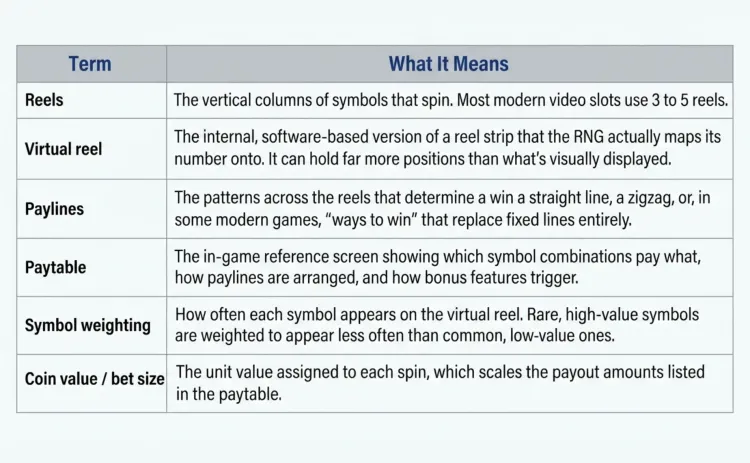
Reels, Paylines, and Paytables: Slot Machine Terminology Explained
Virtual Reels vs. Physical Reels
This distinction explains a common point of confusion. On a physical cabinet, a reel might show 20 visible symbol positions, but the virtual reel behind it, the one the RNG actually selects from, can have 60, 128, or more positions, most of which map to blank or low-value outcomes. That's how a jackpot symbol can appear right above or below the payline without the near-miss meaning anything statistically. The physical symbol strip is a display. The virtual reel is the math.
Fixed vs. Adjustable Paylines
Older, simpler slots typically use a fixed number of paylines that stay active at all times. Many modern video slots let players choose how many paylines to activate, while "ways to win" formats do away with fixed lines entirely, paying instead for matching symbols that appear anywhere on adjacent reels. None of these formats change the underlying randomness. They just change how a given RNG outcome gets scored against the paytable.
How the Paytable Determines Value
Once the RNG output has been mapped to a set of symbols across the reels, the paytable converts that symbol combination into an actual payout multiplier. This table is fixed and built into the game's math model. It doesn't shift based on play history, time of day, or how much has been wagered previously.
What Is RTP (Return to Player) and How Is It Calculated?
RTP stands for return to player, and it's the most-quoted statistic in the slots world, as well as the most misunderstood. RTP is a theoretical percentage representing how much of all money wagered on a game is mathematically expected to be paid back over a very large number of spins. A game with a 96% RTP is built so that, averaged across millions of spins, it returns $96 for every $100 wagered, with the remaining $4 representing the built-in house edge.
The key word is theoretical. RTP figures aren't measured after the fact from a handful of sessions. They're calculated during game development by running the RNG-driven math model through enormous numbers of simulated spins, often hundreds of millions to billions, to work out the statistical expected value of every possible outcome. Independent testing labs then verify that this simulated figure matches what the live game actually produces once it's deployed, which is part of what GLI, iTech Labs, eCOGRA, and BMM Testlabs are checking for when they certify a title.
What RTP doesn't tell you is what will happen in any single session. Averaged over millions of spins, a 96% RTP game behaves close to its stated figure. Over 50 or 100 spins, results can swing hard in either direction, and that's normal statistical variance, not a malfunction or evidence the math is being adjusted behind the scenes. Short sessions are simply too small a sample for the long-run average to show up reliably, in the same way flipping a coin 10 times won't always land at exactly 5 heads and 5 tails.
What Is Slot Volatility (and Why It's Different from RTP)
If RTP tells you how much a game pays back over the long run, volatility, sometimes called variance, tells you how that payback gets distributed along the way. It's a completely separate dimension of the math.
Picture two slot games with an identical 96% RTP.
- Game A (low volatility) pays out small, frequent wins. Sessions tend to feel smoother, with fewer long dry stretches, but the biggest possible win stays comparatively modest.
- Game B (high volatility) pays out rarely, but the wins that do land can be dramatically larger. Sessions on this game often include long stretches with no win at all, punctuated by an occasional big hit.
Both games can be mathematically identical in long-run RTP while feeling completely different to play, because volatility governs the shape of the payout distribution, the statistical variance around that long-run average, rather than the average itself. A useful way to think about it: RTP is the destination on a very long road trip, and volatility is whether the road is smooth or full of potholes along the way. Game providers typically rate volatility as low, medium, or high, though the exact math behind that label (standard deviation of payouts relative to bet size) runs deeper than the label alone suggests.
Common Slot Machine Myths, Debunked
A lot of slot folklore comes from applying logic that works for physical, mechanical systems to a piece of certified software that doesn't behave the same way. Here are the myths that come up most often, and the mechanical reason each one falls apart.
- "This machine is hot or cold." Because every spin is an independent RNG event, a machine has no streak state to be in. A string of wins or losses is just the visible tail of ordinary statistical variance, not evidence the machine's behavior has changed.
- "This jackpot is due." RNGs don't track how long it's been since a jackpot hit, and they don't adjust probability to compensate. A jackpot combination is exactly as likely on the millionth spin after the last jackpot as it was on the first.
- "That near-miss meant something." A jackpot symbol landing just above or below the payline feels significant, but it's a byproduct of how virtual reels map far more positions than are visibly displayed. The RNG selected a losing outcome, and the near-miss appearance on screen is incidental to how that outcome was drawn.
- "Machines pay better or worse at certain times of day." Payout behavior is governed by the certified math model, not a clock. Platforms don't adjust RNG-driven payout rates by time of day; doing so would violate the certification the game was tested and approved under in the first place.
- "You can spot a loose or tight machine by looking at it." There's no visible tell for a game's RTP or volatility setting from the outside. These are internal math parameters set during development and verified by testing labs, not something you can read from cabinet placement, lighting, or how "due" a machine looks.
How Sweepstakes Slots Work at GoldenDragon.Casino
Everything above describes the general mechanics behind slot games. The same RNG, RTP, and volatility principles apply whether a slot-style game appears on a casino floor, inside a real-money online casino, or on a sweepstakes platform like GoldenDragon.Casino. What's different at GoldenDragon isn't the math behind the reels. It's the legal and structural model the platform operates under.
GoldenDragon.Casino runs under the sweepstakes model, which is governed by sweepstakes law rather than gambling law. In practice, that means two separate types of virtual coins:
- Gold Coins are the platform's standard virtual coins, used for casual, play-for-fun gameplay. Gold Coins have no cash value and cannot be redeemed for money or prizes. They exist purely for entertainment.
- Sweeps Coins are a separate, promotional currency. They can be obtained through methods that include a no-purchase-necessary path, consistent with how sweepstakes promotions have worked in the U.S. for decades think mail-in sweepstakes entries, adapted for an online platform. Sweeps Coins may be redeemable for prizes according to the platform's published rules and terms.
Because these are two distinct systems, the mechanics covered in this guide RNG-driven outcomes, an RTP baked into the game's math model, a volatility profile describing how wins are distributed apply to the underlying slot-style games themselves, independent of which coin type is in play. The sweepstakes structure governs how coins are obtained, used, and, in the case of Sweeps Coins, potentially redeemed. It doesn't change how the reels, paylines, or random number generation function underneath.
This structure is why sweepstakes casinos are legally and functionally distinct from real-money gambling platforms, even when the games on screen look similar. Understanding that distinction matters more than any myth about "beating" a slot machine, because the framework a player is operating under determines what the coins actually represent, not the outcome of any individual spin.
If you’re ready to explore Golden Dragon for yourself, you can also save on your first experience with promo code DRAGON20, which gives you 20% off. The code is limited to one use per user and remains valid until January 1, 2030.
FAQ
What is an RNG game?
An RNG game is any game, including virtually all modern slot machines, where outcomes are determined by a random number generator rather than a fixed mechanical process or a live dealer. The RNG produces a number continuously in the background, and whichever number lands at the moment of a spin gets translated by the game software into the visible result.
How is RTP calculated on a slot machine?
RTP is calculated during game development by running the game's math model through an enormous number of simulated spins, often hundreds of millions or more, to determine the statistical expected payback percentage. Independent testing labs, such as GLI, iTech Labs, eCOGRA, or BMM Testlabs, then verify that the live version of the game matches the RTP the developer claims.
Does slot volatility affect my odds of winning?
Volatility doesn't change a game's long-run RTP, but it changes how wins are distributed along the way. Low-volatility games tend to produce smaller, more frequent wins, while high-volatility games produce rarer but potentially larger wins. Two games can share the same RTP and still feel very different session to session because of volatility.
Can a slot machine be "due" for a jackpot?
No. Because each spin is an independent RNG event with no memory of past outcomes, the probability of hitting a jackpot combination stays the same on every spin, regardless of how long it's been since the last one landed.
How does a sweepstakes casino work?
A sweepstakes casino like GoldenDragon.Casino operates under sweepstakes law rather than gambling law. Players typically use Gold Coins for casual, non-redeemable play, while Sweeps Coins function as a promotional currency that can be obtained through a no-purchase-necessary method and may be redeemable for prizes according to the platform's rules.
What is the difference between a sweepstakes casino and a casino?
A traditional online or land-based casino involves real-money wagering governed by gambling law. A sweepstakes casino uses a dual-currency system, non-redeemable Gold Coins and promotional Sweeps Coins, governed by sweepstakes law, with entry methods that include a no-purchase-necessary path.
Learn More About the Sweepstakes Model
Slot mechanics RNGs, RTP, paylines, and volatility are the same certified, audited math whether they show up on a casino floor or inside a sweepstakes platform. What changes is the framework around them. To see exactly how Gold Coins, Sweeps Coins, and no-purchase-necessary entry work at GoldenDragon.Casino, the platform's blog page lays out the full terms in plain language.
Purchase Securely With