Blog
Online Slots for Beginners: Complete Guide | Golden Dragon
Casino
- Key takeaways
- What makes online slots different from other casino games
- Sweepstakes slots vs. traditional real-money slots
- How online slots actually work
- Reels and paylines, explained simply
- The Random Number Generator (RNG)
- Return to Player (RTP), and why it’s a long-run number
- Volatility, briefly
- Understanding the sweepstakes model
- What are sweepstake slots?
- Gold Coins vs. Sweeps Coins
- How does a sweepstakes casino work?
- “No purchase necessary” and why it matters
- Is a sweepstakes casino the same as a regular casino?
- Are sweepstakes the same as gambling?
- How can I get free Sweeps Coins?
- Getting started: your first session as a beginner
- 1. Pick a game with a clear paytable and a volatility rating you understand
- 2. Try the demo or Gold Coin version first
- 3. Set a coin budget and a time limit before you start, not during
- 4. Start with smaller bet sizes while you’re learning a new game
- 5. Read any bonus feature explanations before they trigger, not during
- 6. Know your platform’s redemption rules before you ever need them
- Common mistakes beginners make
- Is there a strategy to slots?
- Playing responsibly, even in a free-to-play model
- Frequently asked questions
- 1. What are sweepstake slots?
- 2. What is sweepstakes casino slots, exactly?
- 3. How does a sweepstakes casino work?
- 4. What is the difference between a sweepstakes casino and a casino?
- 5. Are sweepstakes the same as gambling?
- 6. How can I get free Sweeps Coins?
- 7. What do reels and paylines mean?
- 8. Is there a strategy to slots?
- 9. What’s the difference between RTP and volatility?
- The bottom line
If you’ve never spun a digital reel before, the first thing you notice is how little you actually understand about what’s happening on screen. Symbols drop, lines light up, numbers change, and somehow a win gets declared. That gap between “I clicked a button” and “I understand why that happened” is exactly where most beginners get stuck, and it’s usually the reason people either overthink a game that’s mostly luck or underestimate the small amount of skill that does exist (mainly in game selection and money management, not in predicting outcomes).
This guide is written for someone who has never played an online slot, or who has played casually without ever really knowing what reels, paylines, RTP, or RNG mean. It also covers something a lot of beginner guides skip entirely: the difference between a real-money slot and a sweepstakes-style slot, since that distinction changes what you’re actually doing when you play. By the end, you should be able to open a slot, read its paytable, understand what you’re looking at, and know what questions to ask before you ever press spin.
Two related topics get their own deeper treatment elsewhere and are only touched on briefly here: how volatility affects the rhythm of a session, and the mechanics of actually playing a round from start to finish. If those are what you’re after specifically, this piece will still get you oriented first.
Key takeaways
- Online slots run on a Random Number Generator (RNG), an algorithm that produces an independent, unpredictable result for every spin. No spin is “due” based on past spins.
- Return to Player (RTP) is a theoretical average calculated over millions of spins, not a promise about any single session.
- Reels are the spinning columns; paylines (or “ways to win”) are the patterns that determine whether matching symbols count as a win.
- Sweepstakes casinos use two currencies: Gold Coins (play-for-fun, no cash value) and Sweeps Coins (promotional, potentially redeemable for prizes under sweepstakes rules).
- The sweepstakes model relies on a no-purchase-necessary entry method, which is what keeps it governed by promotional sweepstakes law rather than gambling law.
There’s no strategy that changes the odds of an individual spin, but there is real strategy in choosing games, reading paytables, and managing your coin balance.
What makes online slots different from other casino games
Table games like blackjack or poker involve decisions that change your odds from one hand to the next: how you bet, when you hit or stand, which cards you hold. Slots don’t work that way. Every spin is a fresh, independent event. Nothing you did on the last spin, and nothing you do on this one beyond picking your bet size and the game itself, changes what symbols land.
That’s not a flaw. It’s the entire appeal for a lot of players: no card counting, no reading opponents, no pressure to make the “correct” play. You pick a game, set a bet, and watch. The tradeoff is that there’s no decision-making skill that improves your results spin to spin, which is worth knowing upfront so you don’t go looking for a system that doesn’t exist.
Sweepstakes slots vs. traditional real-money slots
A traditional real-money online slot involves depositing cash, wagering it directly, and withdrawing winnings, which is why it’s regulated as gambling and restricted to jurisdictions that license it. A sweepstakes-style slot, like the ones on GoldenDragon.Casino, works on a different legal structure entirely. Instead of wagering deposited cash, players use two types of virtual coins: one for entertainment only, and one that’s distributed as part of a promotional sweepstakes and can potentially be redeemed under specific rules. No purchase is required to receive either type of coin. That single structural difference is what separates a sweepstakes casino from a traditional online casino, even though the slot games themselves can look and feel similar on screen.
How online slots actually work
Underneath the animations, every online slot is built on the same handful of mechanical concepts. Once you understand these, every game, no matter how different the theme, starts to look familiar.
Reels and paylines, explained simply
A reel is a vertical column of symbols that spins when you press play. Most modern video slots display five reels, though three-reel “classic” style games still exist. Each reel stops on a symbol, and the combination across all reels is what determines the outcome.
A payline is a specific pattern across the reels (traditionally a straight line, though older games also used zigzags and diagonals) where matching symbols need to land for a win to register. A simple slot might have 9 or 20 fixed paylines. Many newer titles have moved away from fixed paylines entirely and use a “ways to win” system instead, where matching symbols pay out regardless of exact position as long as they’re adjacent across connected reels. Megaways-style mechanics take this further, changing the number of symbols per reel on every spin, which means the number of ways to win can shift from a few hundred to over a hundred thousand from one spin to the next.
None of this is guesswork on the game’s part: every slot publishes a paytable showing exactly which symbol combinations pay, and on how many lines or ways. Reading the paytable before you play is the single most useful five-minute habit a beginner can build, because it tells you what you’re actually watching for.
The Random Number Generator (RNG)
The RNG is the piece of software responsible for deciding what happens on each spin. It continuously generates numbers, and the exact number generated at the moment you press spin gets translated into where each reel lands. Critically, this happens independently of every previous spin. There’s no internal memory tracking that a machine is “overdue” for a win or “due for a cold streak.” Each spin is a fresh, statistically independent event, which is why the popular idea of a slot running “hot” or “cold” doesn’t reflect how the underlying math actually works.
Reputable game developers have their RNGs tested and certified by independent testing laboratories rather than self-certifying. Organisations such as eCOGRA, Gaming Laboratories International (GLI), and iTech Labs run statistical audits on the RNG and the published payout rates, checking that outcomes really are random and that the game pays out at the rate it claims to over a large enough sample of spins. When you see a “certified fair” or “RNG tested” mark referencing one of these labs, that’s what it’s confirming: not that you’ll win, but that the game isn’t rigged beyond its stated odds.
Return to Player (RTP), and why it’s a long-run number
RTP is expressed as a percentage and represents the theoretical amount a game returns to players over an extremely large number of spins, typically calculated across millions of rounds in testing. A game with a 96% RTP is mathematically built to return, on average, $96 for every $100 wagered across its entire lifetime of play, with the remaining 4% representing the game’s built-in edge.
Here’s the part beginners misread most often: RTP says nothing about what happens in any single session, or even in a thousand spins. It’s a long-run average, similar to how a coin is “50/50” even though you can flip five heads in a row without that being unusual in the statistical sense. Two players can play the identical 96% RTP game on the same night and have completely opposite experiences purely from normal variance. RTP is useful for comparing games against each other, not for predicting a specific outcome.
Volatility, briefly
Volatility (sometimes called variance) describes how a game’s wins are distributed rather than how often it pays overall. A low-volatility slot tends to produce smaller, more frequent wins, which keeps a coin balance more stable over a session. A high-volatility slot pays less often but with bigger potential swings when it does hit. Two games can share the same RTP and still feel completely different to play because of this. Volatility is a big enough topic that it deserves its own dedicated look, but as a beginner, the practical takeaway is simple: check a game’s stated volatility rating before you start, and pick one that matches how long you actually want a session to last.
Understanding the sweepstakes model
This is the part of online slots that generic gambling guides tend to skip, and it’s arguably the most important thing for a beginner on a sweepstakes platform to understand clearly.
What are sweepstake slots?
Sweepstakes slots are slot games offered through a sweepstakes promotion structure instead of a real-money wagering structure. They run on the same underlying game mechanics (reels, paylines, RNG, RTP), but the currency used to play isn’t purchased cash. It’s virtual coins distributed as part of a promotional giveaway, similar in legal concept to a fast-food chain’s peel-to-win game piece or a radio station’s call-in sweepstakes, just built around slot-style gameplay instead of a scratch card.
Gold Coins vs. Sweeps Coins
Sweepstakes platforms typically run on two separate currencies, and understanding what each one is (and isn’t) for is the whole key to understanding the model.
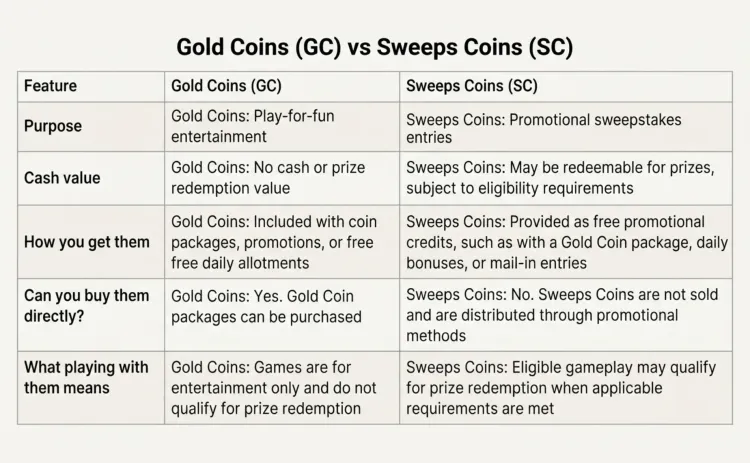
The reason operators can’t simply sell Sweeps Coins is the legal foundation of the entire model. The moment a company sells the exact currency used to win a prize, that starts to look like a wager, which pulls the activity into gambling law rather than sweepstakes law.
New to GoldenDragon.Casino? Use code DRAGON20 for 20% off. Limited to one use per user, valid through January 1, 2030.
How does a sweepstakes casino work?
A sweepstakes casino sells Gold Coins as a form of entertainment product, similar to buying credits in a mobile game. As a promotional bonus attached to that purchase, or through a separate free method that requires no purchase at all, the platform also distributes Sweeps Coins. Players can then play the same slot games using either currency. Play with Gold Coins is purely for fun. Play with Sweeps Coins can, depending on the game and the platform’s published rules, result in additional Sweeps Coins that may later be eligible for redemption once minimum thresholds, identity verification, and any applicable playthrough requirements are met.
“No purchase necessary” and why it matters
By law, a sweepstakes has to offer a free method of entry that doesn’t require spending any money, otherwise it isn’t legally a sweepstakes; it’s an unlicensed wager. That’s why legitimate sweepstakes casinos always publish an Alternative Method of Entry (AMOE), commonly a free daily coin claim, a social media giveaway, or a mail-in request form. If a platform only lets you obtain its prize-eligible currency by paying for it, that’s a signal something is off about how it’s structured, since it removes the “no purchase necessary” foundation the entire legal model depends on.
Is a sweepstakes casino the same as a regular casino?
No, and the difference isn’t cosmetic. A traditional online casino requires you to deposit real money that you’re then wagering directly, which is why it operates under state and international gambling licenses. A sweepstakes casino sells entertainment coins with no cash value and separately gives away promotional coins that carry no purchase requirement, which is why it operates under sweepstakes and prize promotion law instead. The games can look nearly identical on screen (same reels, same animations, same paytables), but the legal and financial relationship between the player and the platform is fundamentally different.
Are sweepstakes the same as gambling?
Legally, no. That’s the entire basis for how these platforms are permitted to operate in most U.S. states where traditional online real-money gambling isn’t licensed. Sweepstakes promotions have existed in U.S. law for well over a century, covering everything from cereal box contests to fast-food game pieces, and the “no purchase necessary” principle is the thread connecting all of them, slot-themed or not. That said, the model isn’t accepted everywhere. A small number of states, including Washington, have interpreted their gambling statutes broadly enough to restrict sweepstakes-style platforms, so availability does vary by location.
How can I get free Sweeps Coins?
This depends entirely on the individual platform’s published promotions, so always check the specific site’s official rules rather than assuming. Common methods across the industry include a free coin allotment on signup, daily login bonuses, email or social media giveaways, and a mail-in alternative entry method as required by sweepstakes law. None of these should ever require a purchase. If a method claims to be “free” but has a purchase attached, it isn’t actually a no-purchase entry method.
Getting started: your first session as a beginner
Once the mechanics make sense, actually starting is straightforward. Here’s a reasonable first-session approach.
1. Pick a game with a clear paytable and a volatility rating you understand
Look for the info or “i” icon on the game screen; it opens the paytable, RTP, and often the volatility rating. If a game doesn’t disclose this information clearly, that’s worth noting.
2. Try the demo or Gold Coin version first
Before touching Sweeps Coins, play the same game with Gold Coins so you understand its rhythm, bonus features, and how often it triggers anything, without any prize eligibility on the line.
3. Set a coin budget and a time limit before you start, not during
Decide in advance how many coins you’re willing to use in this session and roughly how long you want to play. Deciding mid-session, after a few wins or losses, tends to produce less rational decisions than deciding beforehand.
4. Start with smaller bet sizes while you’re learning a new game
A smaller bet stretches your coin balance further while you get a feel for how often features trigger and how the volatility actually plays out, rather than burning through your session in the first few minutes.
5. Read any bonus feature explanations before they trigger, not during
Free spins rounds, multipliers, and pick-a-prize bonuses often have their own rules buried in the paytable. Knowing what a bonus does before it starts means you’re not guessing while it’s happening.
6. Know your platform’s redemption rules before you ever need them
If you’re playing with Sweeps Coins, check the minimum redemption threshold, verification requirements, and any playthrough conditions in advance, on the platform’s official rules page, not from a third-party summary.
If you want a deeper, click-by-click walkthrough of an actual spin, including how bet size, bonus rounds, and autoplay settings interact, that’s covered in more depth in a separate guide focused specifically on how to play online slots.
Common mistakes beginners make
Chasing losses by increasing bet size: Raising your bet after a losing streak doesn’t make a win more likely; the RNG has no memory of what just happened. It just burns through your coin balance faster.
- Assuming a high RTP guarantees a good session: RTP is a long-run average. A 97% RTP game can still produce a rough short session, and a 92% RTP game can produce a great one. Over a single sitting, volatility usually matters more to your actual experience than the RTP number does.
- Ignoring the paytable: Skipping straight to spinning without checking what symbols and features actually pay means playing a game you don’t fully understand, which makes it much harder to judge whether a session is going normally or not.
- Not distinguishing between Gold Coins and Sweeps Coins: Confusing which currency is in play changes what a session actually means: one is purely for fun, the other may carry prize eligibility. Always check which balance you’re using before you start spinning.
- Playing every game the same way regardless of volatility: Treating a high-volatility game like a low-volatility one (or vice versa) usually leads to a session that either ends faster than expected or drags on without the payoff you were expecting. Matching the game to how long you actually want to play helps.
- Skipping the platform’s official rules page: Redemption thresholds, verification steps, and promotional terms vary by platform and can change. Relying on a general impression instead of the actual current rules is one of the most avoidable mistakes a beginner makes.
Is there a strategy to slots?
Not in the sense of changing the odds of an individual spin. There isn’t a betting pattern, timing trick, or system that alters what the RNG produces. Anyone claiming otherwise is either mistaken or selling something. What does count as legitimate strategy is entirely about decisions made around the spin, not during it:
- Choosing games with volatility that matches your session length and goals
- Reading the paytable so you understand what you’re actually watching for
- Setting a coin budget and time limit in advance and sticking to it
- Comparing RTP across similar games when a platform discloses it
- Understanding bonus features before they trigger, so you’re not making decisions mid-feature without context
That’s a modest list, and it should be: slots are built as a game of chance first. The strategy that exists is really about playing more informed and more intentionally, not about beating math that isn’t beatable.
Playing responsibly, even in a free-to-play model
Because Gold Coins carry no cash value and Sweeps Coins require no purchase, it’s easy to assume there’s nothing to manage. That’s only partly true. Time and attention are still real resources, and the same session habits that matter in any gaming context (setting limits in advance, taking breaks, not playing when you’re trying to recover a loss emotionally rather than for entertainment) apply here too. Reputable sweepstakes platforms typically offer account controls like session reminders, deposit limits on Gold Coin purchases, and self-exclusion options. If a platform doesn’t make those tools easy to find, treat that as a red flag rather than an oversight.
Frequently asked questions
1. What are sweepstake slots?
Sweepstake slots are slot games offered under a promotional sweepstakes structure rather than real-money wagering. Players use free or purchased entertainment coins (with no cash value) alongside promotional coins distributed at no cost, and the games themselves use the same reel, payline, and RNG mechanics as any other online slot.
2. What is sweepstakes casino slots, exactly?
It’s the umbrella term for the slot games available on a sweepstakes casino platform. The games look and play like standard online slots, but access to them runs through the dual-currency, no-purchase-necessary sweepstakes model rather than a real-money deposit system.
3. How does a sweepstakes casino work?
A sweepstakes casino sells entertainment-only Gold Coins and separately distributes promotional Sweeps Coins, either bundled with a Gold Coin purchase or through a free alternative entry method. Sweeps Coins won during play may be eligible for redemption once the platform’s published requirements, such as minimum thresholds and identity verification, are met.
4. What is the difference between a sweepstakes casino and a casino?
A traditional casino requires depositing and wagering real money directly, which is regulated as gambling. A sweepstakes casino uses entertainment coins with no cash value plus separately distributed promotional coins that require no purchase, which places it under sweepstakes and prize promotion law instead.
5. Are sweepstakes the same as gambling?
No. Sweepstakes promotions are legally distinct from gambling because they don’t require any purchase to participate or to be eligible for a prize. This is the same legal category that covers non-casino promotions like mail-in contests, and it’s why sweepstakes casinos can operate in states where real-money online casino gambling isn’t licensed. Availability still varies by state.
6. How can I get free Sweeps Coins?
Through the platform’s published promotions: typically a signup bonus, daily login claim, social media giveaway, or mail-in alternative entry method. Always confirm the current offer on the platform’s official rules page, since promotions and amounts change over time.
7. What do reels and paylines mean?
Reels are the vertical columns of symbols that spin on each round. Paylines are the specific patterns across those reels where matching symbols need to land for a win. Many modern slots use “ways to win” instead of fixed paylines, paying for adjacent matching symbols regardless of exact position.
8. Is there a strategy to slots?
Not one that changes the odds of a single spin, since outcomes are generated by an independent RNG. Real strategy is limited to choosing games that match your goals, understanding volatility and paytables, and managing your coin budget and session time.
9. What’s the difference between RTP and volatility?
RTP measures how much a game returns on average over a very large number of spins. Volatility measures how that return is distributed: frequent small wins versus rarer, larger ones. Two games can share an RTP and still feel completely different because of volatility.
The bottom line
Online slots run on an independently tested RNG, and RTP is a long-run average rather than a session guarantee. Nothing about past spins predicts future ones. Reels and paylines (or “ways to win”) determine how wins register, and volatility determines how those wins feel to play through. On a sweepstakes platform specifically, Gold Coins are for entertainment only, Sweeps Coins are promotional and potentially redeemable, and the entire model depends on a genuine no-purchase-necessary entry method. None of this requires memorizing a system. It just means knowing what you’re looking at before you press spin.
If you want to understand exactly how the Gold Coin and Sweeps Coin system works on this platform, including eligibility requirements and how the no-purchase entry method works, GoldenDragon.Casino’s official sweepstakes rules page has the full, current details. It’s worth reading in full before you play your first round, not as a formality, but because it’s genuinely the fastest way to understand what you’re doing and why.
Purchase Securely With