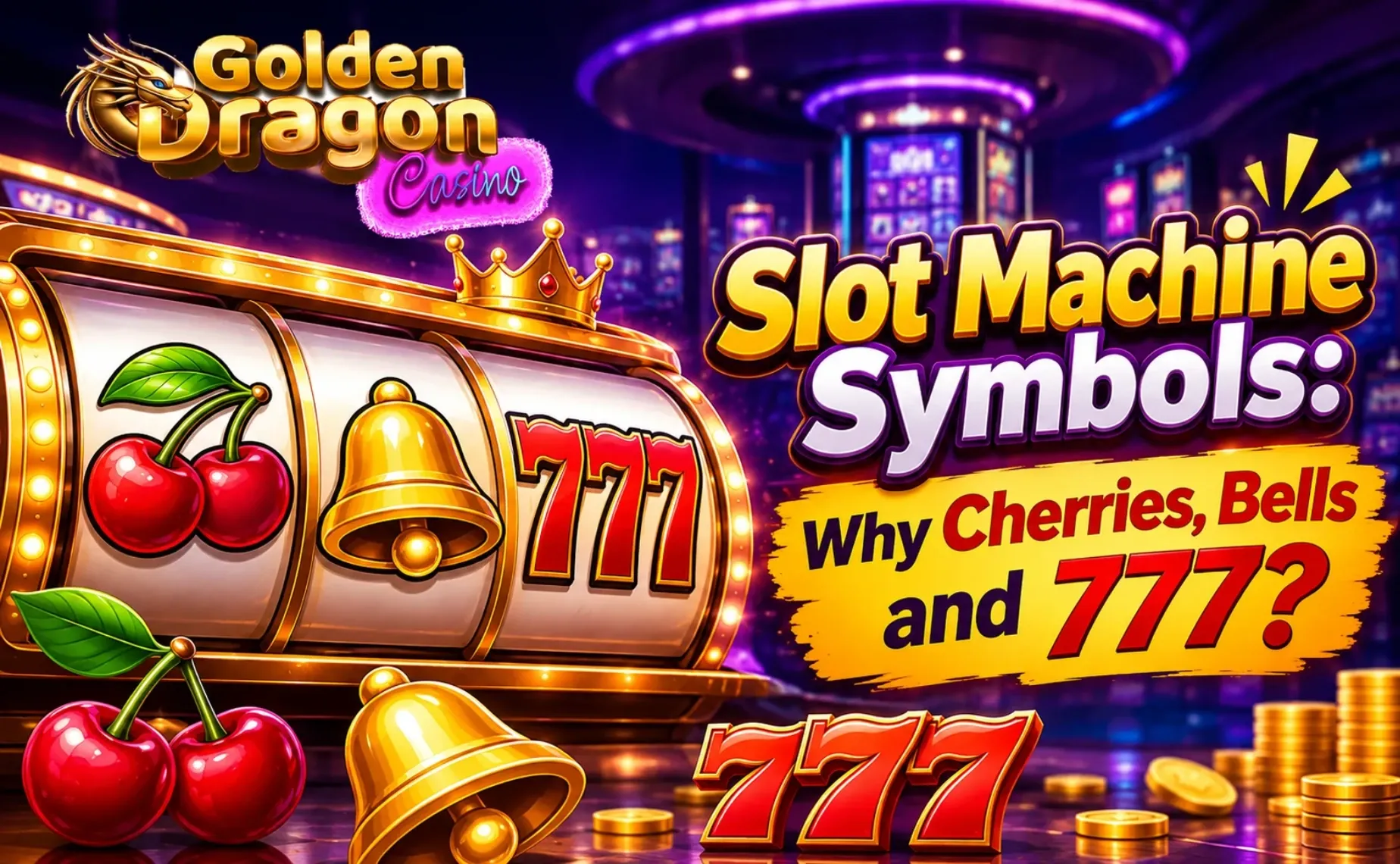
Why Cherries, Bells, and 777? The Stories Behind Familiar Slot Machine Symbols
Published Nov 5, 2026
Casino
Open almost any slot game, old or new, and you will probably spot a cherry, a bell, a bright red seven, or a chunky BAR. Nobody sat down and designed that set from scratch. Slot machine symbols are leftovers from a century of workarounds, brand tie-ins, legal quirks and mechanical limits, and each one has a specific reason for being there.
This guide walks through those reasons in plain language. We cover where the classic symbols came from, how the reels behind them actually work today, what modern symbols such as wilds and scatters do, and why a symbol's look tells you nothing about what the next spin will do. Near the end there is a short explainer on how sweepstakes casinos fit into all this, since that is the model GoldenDragon.Casino operates under.
One note on sourcing before we start. Slot history is murky in places. Early manufacturers did not keep tidy records, and a lot of the stories repeat from book to book. Where a detail is widely accepted we state it. Where it is more of a folk account, we say so.
Key takeaways
- The earliest gambling machines used playing card faces. Charles Fey's Liberty Bell, built in San Francisco in the mid 1890s, swapped those for a smaller set: horseshoes, diamonds, spades, hearts and a bell.
- Fruit symbols are usually traced to early 20th century machines that paid out in chewing gum flavors, a setup meant to look like a vending machine rather than a cash-paying device.
- The BAR symbol is commonly linked to the logo of a gum company, and 7s took on their lucky reputation from the wider culture, not from a single inventor.
- Modern video slots run on a random number generator. The picture on a reel is a display of a result that was already decided, so symbols have no memory and no "due" date.
- Independent test labs check randomness and published return-to-player figures for many licensed games. Ask any platform which studios and testing bodies stand behind its titles.
- At sweepstakes casinos, Gold Coins are for entertainment only, while Sweeps Coins are promotional and can be redeemed for prizes under the official rules. No purchase is necessary to participate.
Where slot machine symbols came from
Start with the first machines, because they explain why the symbols look the way they do.
The card machine era
In 1891, a New York company, Sittman and Pitt of Brooklyn, built a machine that is often described as an ancestor of the slot. It had five drums carrying playing card faces, and the goal was to line up poker hands. There was no automatic payout. If you landed a good hand, the bartender handed you a prize, typically a drink or a cigar, from behind the bar. The details vary by source, but the basic picture is consistent: cards on drums, a human settling the result.
Poker hands were awkward on a machine. Judging a winning hand mechanically was fiddly, and a human usually had to step in. Builders wanted something simpler that a machine could judge on its own.
Charles Fey and the three reel idea
That simpler design is usually credited to Charles Fey, a mechanic in San Francisco. Around 1895 (sources differ by a year or so) he built the Liberty Bell. It had three reels instead of five drums, a coin slot, and a mechanism that could pay coins out automatically without an attendant.
Fey cut the symbol set down to five: horseshoes, diamonds, spades, hearts and the bell. Three bells in a row paid the top prize. Several reasons made this smart. Fewer symbols meant fewer winning combinations, which made the payout mechanism much easier to build. Three reels kept the machine compact. And the card suits were already familiar to anyone who walked into a saloon.
Notice that three of those five symbols (diamonds, spades, hearts) are just card suits carried over from the poker drums. The machine kept the visual language of cards and dropped the poker logic.
Why a bell? The Liberty Bell symbol
The bell was Fey's signature, and it gave the machine its name. The reference is to the Liberty Bell, the famous cracked bell in Philadelphia. In late 19th century America it was a well-known national symbol, so putting it on the top prize line made the machine feel familiar and a little patriotic.
The bell also had a practical purpose. A big winning line deserved a distinct sound and image, and a bell does both. Players learned to associate the ring with a payout. That link between sound and win is still alive. Modern slot games use chimes and bells for wins, even though nothing mechanical is ringing anymore.
Fey's design was copied heavily, and other companies, including Chicago's Mills Novelty Company, produced their own bell machines. "Bell" became a generic nickname for slot machines for decades. Some older venues and collectors still call them one-armed bandits or bells interchangeably.
For the bigger picture of how these machines evolved, see our casino game history guide.
Cherries, lemons and plums: the fruit machine story
Fruit is the part of this history that surprises people most, because fruit has nothing obvious to do with gambling.
The chewing gum connection
The story most often told goes like this. In the early 1900s, many places in the United States restricted or banned machines that paid cash. Manufacturers responded by changing what the machine paid. Instead of coins, a winning spin delivered packs of chewing gum, and the symbols on the reels were drawn from gum flavors: cherry, lemon, orange, plum, and others. A machine that dispensed gum looked more like a vending machine than a gambling device, at least on paper.
Mills Novelty Company is the name most often attached to this, with machines sold under a "Bell-Fruit Gum" banner. How well this worked as a legal shield varied a great deal by place and time, and we do not want to overstate it. Authorities in many areas were not fooled. But the visual idea stuck. Even after cash payouts came back in some regions, the fruit stayed on the reels.
Some details are hazier. You will read that the lemon was chosen because it was a "bad" symbol, or that each fruit matched a specific flavor of gum. The flavor link is widely repeated and plausible. The more elaborate claims about individual fruits are harder to verify, so treat them as colorful rather than certain.
Why cherries became the default low-end symbol
Ever notice that the cherry is almost never the symbol you’re hoping for? There’s a reason for that, and it’s a bit of a quiet accident.
In a lot of older games, a single cherry anywhere on the payline paid a small amount. Other fruit needed matching lines to pay anything. So cherries turned up constantly and paid a little, and a generation of players learned that a cherry means a small, frequent return. It’s the coin-in-the-couch of slot symbols.
Design probably had a say too. A cherry is small, round and red, so you can read it at a glance, even while the reel is blurring past. That mattered on a mechanical machine with a tiny window. A cherry on a stem works better there than, say, a pineapple, which turns into a smear the moment it moves. Constraints like that explain symbol choices better than any grand story does.
Now picture the rest of the fruit as a ladder, with the cherry on the bottom rung. The lemon isn’t far above it. Most of these fruits trace back to gum flavors, so a lemon win stayed small. Oranges sit a step higher, somewhere between low and mid value. Plums and grapes land in the middle. The watermelon is the odd one out. It tends to show up in later fruit games and pays mid to higher, so it works as the fancy fruit of the set.
Don’t treat that ladder as gospel, though. Every game sets its own paytable, and a watermelon in one title might pay less than a plum in another. Check the one in front of you.
The BAR symbol
The BAR symbol, usually a black bar with the word BAR in it (and sometimes stacked as double or triple BAR), is another gum-era leftover. It is commonly traced to the logo or packaging of the Bell-Fruit Gum brand, which used a bar-shaped design. The shape stayed on the reels even after the gum prizes disappeared, and it settled into a role as a mid-ranking symbol that sits above fruit and below sevens in many classic paytables.
It is a weird survival when you think about it. A word that began as a piece of packaging became a standard game symbol that people recognize without knowing why it exists. Plenty of people assume it refers to a drinking bar, which is a reasonable guess and one that the saloon heritage of early slots makes believable, but the gum connection is the explanation most often given.
Lucky 7s and the triple seven
If there is one slot symbol everyone knows, it is the red seven. Triple sevens (777) are shorthand for a jackpot in popular culture, and several games and logos use the number directly.
Here is the honest answer on where it came from: there is no single agreed origin. What we can say with confidence is that seven has been treated as a lucky number across many Western traditions for a long time, and that gave slot designers a ready-made symbol for their top prize. Machines after Fey's time added sevens to their reels, and the symbol became the natural headline act of the classic three reel layout.
A few supporting facts help explain why seven fits so well:
- With two standard six-sided dice, seven is the most common total, because six of the 36 possible combinations add up to it. Players who knew dice knew seven as the number that comes up most.
- Seven shows up in religious and folk traditions in many cultures, from the days of the week to well-known sayings. That broad familiarity does the marketing for free.
- Visually, a 7 is a simple, bold shape that reads well when a reel is spinning.
You will see sevens in red, blue, white, gold and sometimes mixed colors. In some classic games, a mixed-color seven pays less than a matching triple, a small design detail that lets a manufacturer add another tier to a short symbol list.
Horseshoes, diamonds, stars and other classic symbols
Besides bells, fruit and sevens, a handful of other symbols show up again and again.
- Horseshoes: One of Fey's original five. Horseshoes are a long-standing good luck charm, usually hung with the ends pointing up. They fit a lucky-themed machine naturally.
- Card suits: Hearts, diamonds, spades and clubs came straight from the poker drum days. Some games still use them as lower-value symbols, partly out of habit and partly because they are simple to draw.
- Diamonds and gems: Diamonds were on Fey's reels as a card suit, but they also read as wealth. As themes broadened, designers added emeralds, rubies and sapphires, which give a game a higher-value tier that looks distinct from fruit.
- Stars and clovers: Stars, four-leaf clovers and similar charms are decorative luck symbols. They have no single documented origin, but they tap into the same shared idea as horseshoes: luck, visibly stated.
- Crowns, coins and treasure: Common in newer games as high-value icons. They signal "valuable" immediately without needing explanation.
The pattern is that nearly every classic symbol answers one of two questions. Is it recognizable at a glance, and does it feel lucky or valuable? Those are the filters behind most of what you see.
From brass reels to code: how symbols work on today's slots
Here is where the story changes, and it is the part that matters most for understanding what a symbol actually does.
Mechanical and electromechanical machines
On the old machines, the reels were physical. Each reel had a fixed number of stops, and each stop held one symbol. A reel with 20 stops, for example, had 20 possible positions. The number of times a symbol appeared on a reel set the odds of landing it. The more cherries on the strip, the more often a cherry showed up.
Manufacturers soon found a limit. A physical reel can only hold so many stops, which capped how rare a top symbol could be and how big a jackpot could realistically get. If the jackpot symbol appears once on a 20-stop reel, and you need it on three reels, that is a particular, modest probability. You cannot easily make it much rarer without making the reel enormous.
The first fully electromechanical machine that is often named is Bally's Money Honey from 1963, which introduced an automatic payout hopper that could pay out larger sums of coins. The reels were still mechanical, but electronics now ran the machine.
Virtual reels and the first video slots
The next shift was in the logic. Microprocessors allowed a machine to hold a virtual reel in its software, with many more stops than the physical reel could display. Each virtual stop maps to a physical position. A symbol could now occupy one physical stop but appear on many virtual stops, or just a few. A patent often cited in this story, by Inge Telnaes, was granted in the early 1980s and described using a random number generator to select reel stop positions. The principle is the one in use today: the machine picks a number, the number maps to a stop, and the display shows it.
Around the same time came video slots. A machine from the Fortune Coin Company in the 1970s is often credited as the first. With a screen replacing the metal reels, there were no physical limits left at all. A game could have five reels, 243 ways to win, or a grid.
What happens on a spin now
On a modern slot, whether in a casino or online, the process is roughly the same:
- A random number generator (RNG) is running continuously, producing numbers many times per second.
- When you start a spin, the game takes the current numbers and converts them into a result, meaning which symbol lands on which position.
- The animation then plays out that result. The spinning reels are a presentation, nothing more.
The key point is step 3. By the time the reels start moving, the outcome is already fixed. The near-miss where two sevens land and the third stops just above the line is a visual effect of a result that was settled before the animation began. It does not mean you were close in any meaningful sense, and the game did not "almost" do anything.
Modern slot machine symbols and what they do
Classic symbols mostly just pay when they line up. Newer games layered on special symbols with their own rules. These are the ones you will see most often.
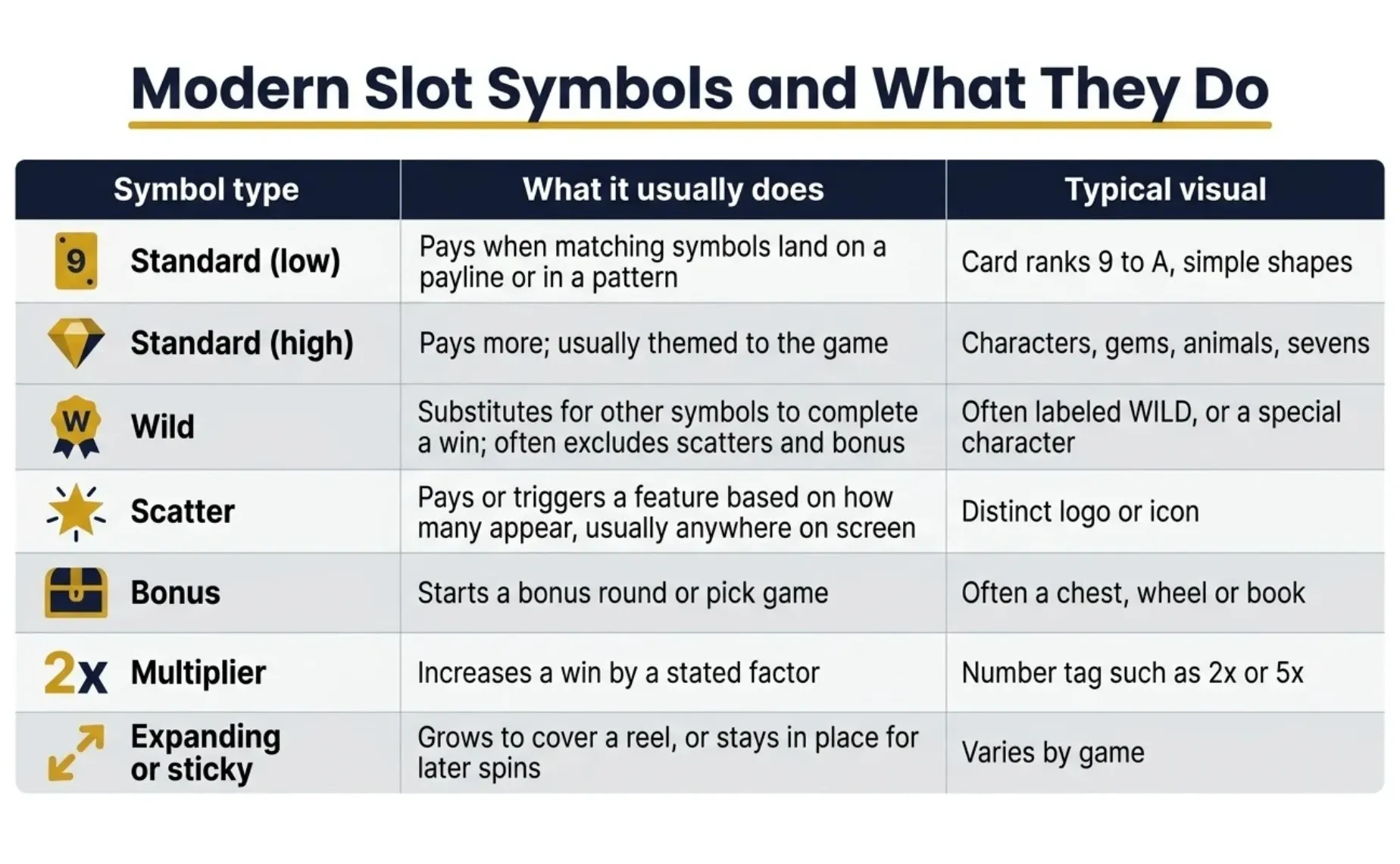
A few clarifications worth making:
- Wilds are not all identical. Some only appear on certain reels, some can only substitute for standard symbols, and some carry multipliers. The rules are in the game's information screen.
- Scatters matter because their position does not. A payline game normally needs symbols to land in a line, while scatters can pay from anywhere. That is the main reason they are used to trigger free spins.
- Free spins, a common bonus, are usually triggered by a set number of scatter or bonus symbols. The feature itself plays out through the same random process as a normal spin.
Because rules differ from game to game, the same-looking icon can behave differently in two titles. The paytable is the only reliable source.
Do slot machine symbols affect your odds?
This is the question underneath a lot of searches on this topic, so it deserves a direct answer.
The look of a symbol does not change anything. What changes the odds is how often that symbol is placed on the reel strips or in the game's weighting, and that is a math design choice made by the game's developer. A shiny gold seven and a plain cherry are just two entries in a table of probabilities. The game knows how often each should appear. You cannot read that from the artwork.
Symbols have no memory
Each spin is independent. A symbol that has not appeared for 200 spins is not "due." One that has appeared three times in a row is not "hot." The RNG does not remember anything. This is the classic gambler's fallacy, and it applies to slots the same way it applies to a coin toss. If a fair coin lands heads five times, the next toss is still 50-50.
What RTP actually means
RTP stands for return to player. It is a theoretical percentage showing how much of the total amount wagered a game is designed to return over a very large number of spins. If a game lists an RTP of 96 percent, that means that across an enormous number of plays, the long-run average return is 96 percent of the amount staked. It does not mean any given session returns 96 percent. A short session can land far above or far below. RTP is a long-run average, and the word "theoretical" matters.
Variance (sometimes called volatility) is the other half. A low variance game pays small amounts often. A high variance game pays less often but in larger amounts. Two games with the same RTP can feel completely different to play, because the symbol weighting behind them is different.
How RNG and RTP get checked
For licensed games, randomness and published return figures are usually verified by independent testing laboratories. Names you may come across include Gaming Laboratories International, BMM Testlabs, eCOGRA and iTech Labs. These labs test the random number generator for statistical randomness and check that the game's actual math matches the figures the developer documents. They typically issue certificates that regulators or operators can review.
Two cautions. First, the presence of a lab name is not a guarantee about every title on every site, so look for specifics, such as the game studio's published information and the platform's own help pages. Second, we are describing how independent testing generally works across the industry. We are not making claims about any one game, and if a platform does not explain who tests its games, that is a reasonable question to ask its support team.
Slot symbols on sweepstakes casino platforms
Sweepstakes slots look and feel like other online slots. The reels, the paylines, the wilds and scatters, the cherries and bells and sevens are all familiar. The differences are in what the credits mean and the legal framework around them, which the next section covers.
From a symbol perspective, you will find the same full range: retro three reel games built on fruit and sevens, five reel video slots with themed characters, and feature-heavy titles with wilds, scatters and multipliers. Many of those games are supplied by established game studios, and each game has its own paytable that spells out what every symbol is worth.
What this means for a reader trying to understand symbols is simple. Learn the classic ones, learn the special-symbol types in the table above, and use each game's information screen for the actual rules. The principles in this article apply the same way on any slot, regardless of platform.
How the sweepstakes model works
Because this site is a sweepstakes casino, it is worth a clear and accurate explanation of what that means and what it does not mean.
It is not a real-money casino: Sweepstakes casinos use a promotional sweepstakes structure and are not set up as traditional gambling operations. They generally rely on sweepstakes law rather than gambling law. The core idea behind that legal approach is that a sweepstakes needs a prize and an element of chance, but it cannot require payment to enter. Remove the payment requirement and the arrangement is treated differently from gambling in the places where this model is permitted.
No purchase necessary: The central rule is that every participant must have a free way to take part. That is often called an alternative method of entry, and it is described in the platform's official rules. A purchase is not required to participate or to have a chance at a prize, and a purchase does not improve your chances.
Two types of virtual currency.
- Gold Coins are for play only. They are for entertainment, they have no cash value, and they cannot be redeemed for prizes.
- Sweeps Coins are promotional. They are how the sweepstakes element works, and eligible Sweeps Coins can be redeemed for prizes, subject to the platform's terms. Those terms commonly include identity verification, minimum thresholds and other conditions, so read the official rules before assuming anything.
Eligibility varies: Age and location requirements apply, and they differ. Some US states restrict or prohibit sweepstakes casinos, and the rules in this area have been changing, so check current requirements for your location and the platform's own terms instead of relying on a general article.
Nothing is guaranteed: Outcomes are determined by chance. Playing does not guarantee prizes, and Sweeps Coins are not a way to earn money. Treat any such platform as entertainment, set your own limits, and stop if it ever stops being fun. If you are worried about your play, free help is available through national problem gambling helplines and similar services in your area.
If you want the longer version, we publish a separate explainer on how the sweepstakes model works in detail.
How to read a slot paytable
Everything in this article comes down to one practical habit: read the paytable. Most slots have an information button, often shown as an "i" or three lines, that opens it. Here is a quick way to approach it.
- Find the symbol values. The paytable lists what each symbol pays for 3, 4 or 5 matches, or for the pattern the game uses.
- Look for special symbols. Wild, scatter and bonus symbols are normally listed separately, with a rule for each.
- Check how wins are counted. Some games pay left to right on set lines. Others pay "ways," where symbols just need to be on adjacent reels. Some pay clusters of matching symbols on a grid.
- Note the stated RTP. Many games publish it in the information screen or on the studio's site. If it is not listed, that is useful to know too.
- Read the feature rules. Free spins and bonus rounds often have their own multipliers, retriggers or limits.
Five minutes with a paytable tells you more about a game than any amount of watching reels spin. It also resets expectations. A symbol that looks impressive might pay very little, and an unremarkable one might be the engine of the whole game.
Common myths about slot machine symbols
"A seven is always the top symbol." In classic games it often is. In modern ones, the highest-paying symbol might be a character, a gem, or a special icon. Check the paytable.
"Near misses mean a win is close." The near miss is a display of a result. As covered above, the outcome was fixed before the reels moved.
"Machines run in cycles of hot and cold." With an RNG, every spin is independent. Cycles are a pattern people see in randomness, not something the game does.
"More colorful symbols are rarer." Rarity is set by weighting in the math model, not by artwork. A plain symbol can be the rare one.
"Old machines were more honest." Mechanical machines had their own odds set by reel strips, and the player had no more insight into those than they do into a modern RNG. Today's regulated games, by contrast, can be independently tested, which is a form of external checking that early machines did not get.
FAQs
1. What do the symbols on a slot machine mean?
Most classic slot machine symbols are borrowed from earlier traditions. Cherries, lemons and other fruit come from the era of gum-paying machines, bells come from Charles Fey's Liberty Bell, BAR is commonly linked to a gum company's logo, and the lucky seven draws on the number's long reputation for luck. In a modern game, each symbol's meaning is whatever the game's paytable says it is.
2. Why are there cherries on slot machines?
Cherries are most often explained through the chewing gum story. Early 20th century machines paid in gum flavors, and cherry was one of them. Cherries also work well visually on a small spinning reel, and in many classic games a single cherry paid a small amount, so they became the familiar low-end symbol.
3. Why is 777 the jackpot symbol?
There is no single documented origin. Seven has been regarded as a lucky number in many cultures, and it is the most common total with two dice. Early manufacturers used that familiarity for their top combination, and three sevens became shorthand for a big win.
4. Are sweepstakes the same as gambling?
No, they are treated differently under the law in places where the model is allowed. A sweepstakes cannot require payment for entry, so it includes a free method of participation. Gambling generally involves paying for a chance to win. Sweepstakes casinos operate under sweepstakes law with a no purchase necessary structure. Rules differ by location, so check what applies where you live.
5. Do sweepstakes casinos pay real money?
They do not pay out as a traditional casino does. Gold Coins are play-for-fun and cannot be redeemed. Sweeps Coins are promotional and may be redeemable for prizes, such as gift cards or cash equivalents, under the platform's official rules and verification steps. Nothing is guaranteed, and results depend on chance.
6. What are sweepstakes slots?
Sweepstakes slots are slot games offered on sweepstakes casino platforms. They look like regular online slots, with the same reels, symbols and features, but they run on Gold Coins and Sweeps Coins rather than cash deposits. The sweepstakes rules govern how prizes can be obtained.
7. What is the difference between a sweepstakes casino and a casino?
A traditional casino takes real-money wagers under gambling regulations. A sweepstakes casino uses virtual currencies within a sweepstakes framework, with a free way to participate and promotional coins that can be redeemed for prizes. The games can look similar, but the legal structure, the currencies and the rules for obtaining prizes are different.
Where to go from here
Slot machine symbols are a compact history lesson: playing cards, a cracked bell, a stick of gum, a number people think is lucky. Knowing that history will not change how a spin turns out, but it does make the game screen easier to read, and it helps you separate what a symbol means from what people assume it means.
If you want to understand more, start with the explainer on how the sweepstakes model works, then look at our guides to Gold Coins and Sweeps Coins and to RNG and RTP. Age and location rules apply to participation, and entertainment should stay entertainment.
New to GoldenDragon.Casino? Use code DRAGON20 for 20% off when eligible. Limited to one use per user, valid through January 1, 2030.
Written by the GoldenDragon.Casino editorial team. Last updated October 29, 2026. This article is educational and not legal or financial advice. Historical details reflect commonly cited accounts, and where sources disagree we have said so.