
Casino Game History: From Mechanical Reels to Mobile Screens
Published Oct 31, 2026
Casino
By the GoldenDragon.Casino editorial team. This guide is educational. It describes how casino-style games developed and how the sweepstakes model relates to that history. It is not an invitation to play, and it makes no promise of any outcome. Where a date is approximate, we say so.
The first thing worth knowing about casino game history is that the games people think of as "modern" are mostly old ideas in new housings. A slot machine is a lever, a few spinning symbols and a payout rule. Roulette is a wheel and a ball. Blackjack is a card total and a decision. What changed over the last 130 years or so is the machinery underneath, the rules around who can offer the games, and, more recently, whether anyone has to be in a casino to experience them at all.
This guide follows that thread from the early mechanical slot machines of the 1890s to the phone-based, social, free-to-play games of the 2010s and 2020s. It also explains where sweepstakes casinos fit in, because their structure makes more sense once you see the history that produced it.
Key takeaways
- The slot machine as most people picture it traces back to Charles Fey's Liberty Bell in San Francisco, around 1895. It had three reels and a simple automatic payout mechanism.
- Electromechanical machines arrived in the 1960s. Video slots and computer-controlled outcomes followed in the 1970s and 1980s, which is when the random number generator (RNG) became central.
- Online casinos began appearing in the mid-1990s, once secure internet payments and licensing frameworks existed in a few jurisdictions.
- Social casino apps on Facebook and mobile in the late 2000s and 2010s separated the look and feel of casino games from wagering money. Players used virtual currency with no cash value.
- Sweepstakes casinos combine that free-to-play tradition with a promotional sweepstakes, built on a no-purchase-necessary entry route. They operate under sweepstakes law, not gambling law, and the legal picture varies by location.
- Every era of casino game history comes with the same two lessons: check who is allowed to offer a game, and treat any game as entertainment, not income.
Before the machines: dice, cards and the first gambling houses
Games of chance are far older than casinos. Archaeologists have found dice and dice-like objects at sites thousands of years old, and card games spread through trade routes over many centuries. None of this required a purpose-built venue. People gambled in taverns, at fairs and in private homes.
The idea of a dedicated gambling house is more recent. A frequently cited early example is the Ridotto in Venice, which opened around 1638 as a government-sanctioned venue for gaming during carnival season. Regulation arrived almost immediately with the venue, which is worth noticing. From the start, "who may run a game, and under what rules" was part of the story, not an afterthought.
The table games we know today took shape in Europe over the following two centuries. Roulette developed in France in the 18th century. A single-zero version, which lowered the house edge compared with the double-zero layout, is generally credited to a pair of brothers working in the German spa town of Bad Homburg around the 1840s. Blackjack's ancestors, such as the French game vingt-et-un, are murkier. Historians disagree on exactly where and when the modern rules settled, so any single "invented in" claim deserves some suspicion.
The point for our purposes is that table games were social by default. You sat at a table with other people and a dealer. That detail matters later, because the slot machine, the next big development, pulled casino play in a much more solitary direction.
Charles Fey and the Liberty Bell: the first recognizable slot machine
The story of the slot machine usually starts in San Francisco. Charles Fey, a mechanic, built a machine around 1895 that became known as the Liberty Bell. It had three reels, and the symbols included horseshoes, diamonds, spades, hearts and a bell. Three bells in a row produced the top result.
Fey was not the first person to build a coin-operated gambling device. Machines based on poker hands, produced by the Brooklyn company Sittman and Pitt around 1891, came earlier. But those were hard to pay out automatically because of the number of card combinations. Fey's design simplified the outcomes enough that a mechanism could detect a winning combination and release coins by itself. That automatic payout is what made unattended operation practical. A bar owner could put a machine in a corner and leave it.
The Liberty Bell's three-reel layout set a template that lasted for the better part of a century. Bells and card suits eventually gave way, in many machines, to fruit symbols. A commonly told version of the story connects the fruit imagery to machines that paid out in chewing gum flavors, a workaround in places where cash payouts were restricted. The details vary in the retelling, and we would not lean on any specific number or date for that part, but the general pattern is well documented: where rules limited machines, manufacturers adapted the product to the rules.
That adaptation habit shows up again in this guide. It is one of the most consistent features of casino game history.
Why the mechanical era feels so different
A mechanical slot machine was a physical object with physical limits. The reels were real wheels. The number of symbols on each one was small, because the wheel could only be so large. This put a hard cap on how many combinations the machine could produce, and so on the size of any top result.
There was also no way to hide the mechanism completely. People could see the reels stop. The sound of the lever and the coins was part of the experience, which is one reason sound design in slot games, even on a phone today, still imitates mechanical clicks and falling coins.
Regulation shaped the games as much as invention did
It is tempting to tell this history as a series of clever inventions. Rules deserve equal billing.
Slot machines were banned, restricted or taxed in many US places in the early 20th century. Nevada legalized most forms of gambling in 1931, and it later became the center of the licensed casino industry in the United States. Over the following decades, other jurisdictions created their own licensing systems, and the question of which games were permitted, and where, became a matter of local law.
This patchwork is the reason casino game history is not a single timeline. Something legal and common in one place could be prohibited a short drive away. When we get to online and social play, this same patchwork returns in a new form.
The electromechanical shift of the 1960s
For roughly the first 60 years of slot machine history, the internal workings were purely mechanical: springs, gears and levers. The 1960s brought a change. Bally's Money Honey, introduced in 1963, is widely cited as the first fully electromechanical slot machine, with a bottomless hopper that could pay out large results automatically. Before that, a big payout often meant calling an attendant.
Electromechanical designs kept the spinning reels but used electrical components to control payouts and detect results. This allowed larger payouts, more features and, importantly, a path toward the next step, which was to stop relying on physical reels to decide anything at all.
Electromechanical machines also pushed slots onto casino floors in greater numbers. Table games had been the main attraction, and slots had been something closer to a side amusement. As machines became more reliable and more varied, the balance shifted. In many casinos today, machines take up more floor space than tables.
Video slots, microprocessors and the random number generator
The next change was invisible to most players but changed everything: computers.
Around the mid-1970s, the first video slot machines appeared. A frequently cited early example, built by Fortune Coin Company and shown in Las Vegas around 1976, replaced physical reels with a screen. Early versions met with suspicion. A screen made some players wonder whether the game was honest, because a picture of a reel does not prove a reel is turning. Operators reportedly reinforced trust by adding features such as a small display of the sequence or familiar visual cues, though the details of what each early machine did are not something we can cite precisely.
The key technical piece is the random number generator. In a video or computer-controlled slot, a program produces a rapid stream of numbers, and the moment a player presses the button picks which number counts. The symbols on the screen are a display of that result, not the cause of it. This is different from a mechanical machine, where the physical wheel positions were the outcome.
In the 1980s, developments in how microprocessors mapped random numbers to symbols meant that the number of virtual positions on a reel could exceed the number of symbols visible, which let designers offer much larger top results than a physical reel allowed. A patent filed in the mid-1980s by the engineer Inge Telnaes is often cited in this context. Designers could now adjust how often each symbol appeared with a precision that mechanical reels never allowed.
What does this mean for someone reading about the history?
- Outcomes in a modern machine are set by software and by the rules programmed into it, not by what the screen shows.
- Independent testing and regulation of RNGs became an important part of how licensed jurisdictions build trust.
- "Hot" and "cold" machines, a belief that survived from the mechanical era, have no basis when each spin is independent. We come back to that in the myths section below.
Video technology also reshaped other games. Video poker became popular in the late 1970s and 1980s, using the logic of five-card draw poker with a machine as the opponent. Bonus rounds, animated characters and licensed themes arrived as screens became cheaper and richer. A slot machine stopped being a pure chance device and became a small piece of interactive entertainment.
Mid-1990s: online casinos arrive
The internet reached homes widely in the 1990s, and the casino industry was among the early commercial adopters. In 1994, Antigua and Barbuda passed legislation creating a framework for licensing online gaming, and the software company Microgaming was founded the same year. A handful of online casinos launched in the following couple of years. Exact "first" claims vary by source, so treat any single claim of "the first online casino" with caution. What is solid is the broad time frame: the mid-1990s.
Three things had to come together for online casinos to work. Secure encryption for web payments, reliable home internet and software that could run casino games in a browser or downloadable client. Early graphics were basic by today's standards. Dial-up speeds made rich animation impractical, so the early games were simple.
Online play changed several things at once.
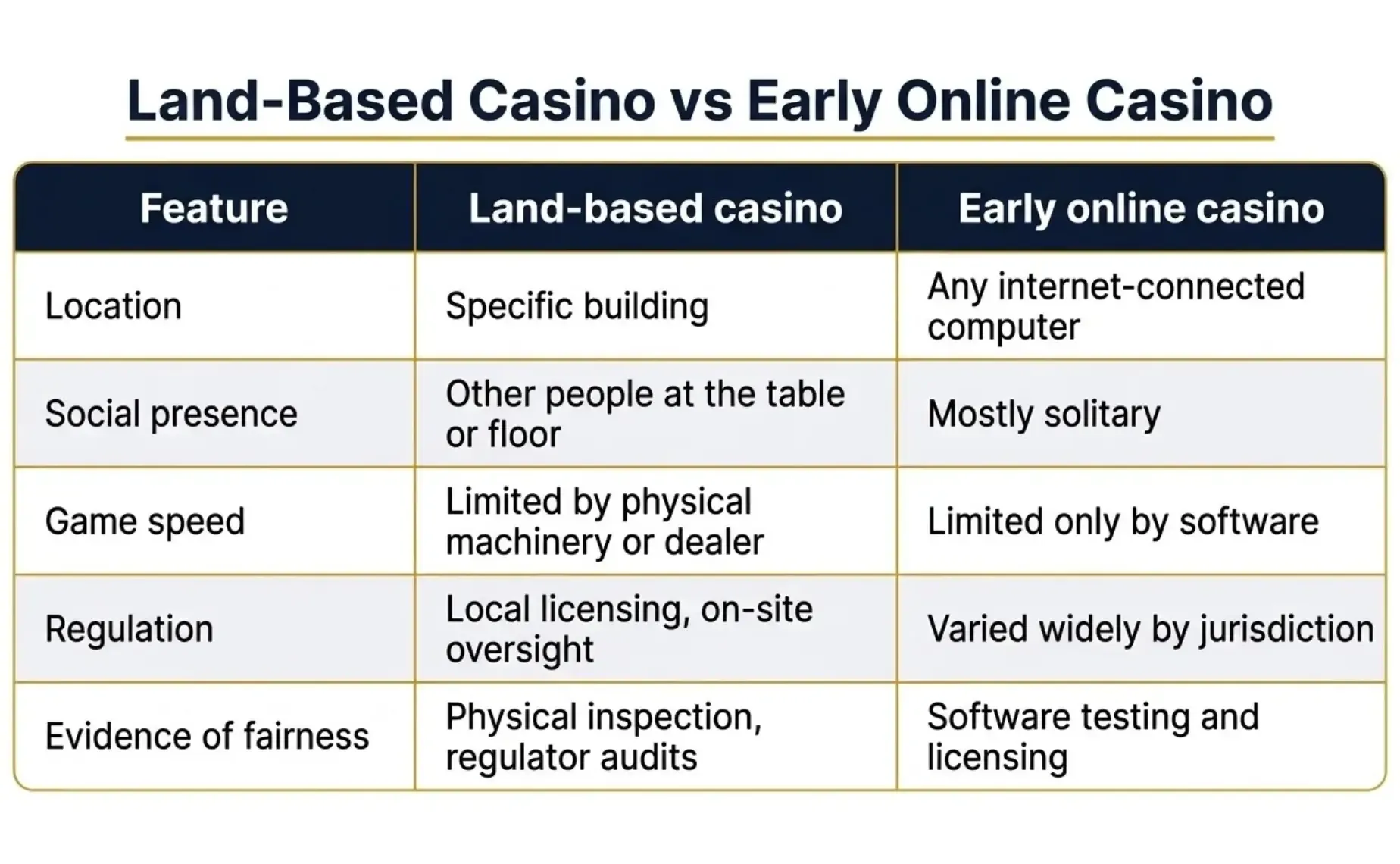
The last two rows are the interesting ones. Regulation of online gambling was uneven, and players in many places were not sure which operators could be trusted. Independent testing organizations and licensing bodies grew in importance as a result. In the United States, the legal position of online real-money gambling developed state by state, and it still differs significantly between states today.
Live dealer games, streamed from studios, appeared in the early 2000s. They tried to bring back something the first online games had lost: a human face and the rhythm of a real table.
2007 to 2012: casino games without the wagering
The next change went in a different direction. Instead of making real-money play more convenient, a new group of companies asked whether the game part of casino games could stand alone.
Facebook opened its platform to outside developers in 2007, and games spread quickly. Zynga Poker, launched in 2007, became one of the best-known early examples of a casino-style game on a social network. Players used virtual chips with no cash value, played against friends and strangers, and could send gifts or compete on leaderboards. Slot-style apps followed. Companies such as Playtika, with its Slotomania game around 2010, and others built large audiences on Facebook and then on mobile.
The release of the iPhone in 2007 and the App Store in 2008 meant these games could reach phones, and touchscreens suited slots well. Tapping or swiping a reel is a natural gesture. The real change was in how people used them: in short sessions, on a commute or on a couch, rather than during a trip to a casino.
What "social casino" means
The term describes games that borrow the format of casino games, such as slots, poker, blackjack, roulette and bingo, but where the virtual currency cannot be cashed out for money. Revenue for these companies generally comes from players choosing to buy additional virtual currency, from advertising, or both.
There are some features that tend to be common:
- Virtual coins or chips that have no cash value.
- Free daily or hourly allowances of those coins.
- Friends lists, gifting, clubs or chat.
- Leaderboards and collection features.
- Frequent themed content and events.
The social layer is the part that returns casino gaming to its roots. Early table games were communal. Slots in the 20th century were mostly private. Social apps put a crowd back around the machine, even if the crowd is an online friends list.
Social casino games have also been a topic of public debate. Consumer groups and regulators in several places have discussed whether the mechanics of in-app purchases and virtual currency deserve closer oversight, and some court cases in the US and elsewhere have looked at how these games should be classified. We are not going to summarize specific outcomes here, because the situation changes and we would rather point you to primary sources than risk a misstatement. The takeaway is simply that "free-to-play" does not mean "unregulated" or "without consequences."
Browser technology moves on
One practical piece of history that gets little attention: a lot of early online casino and social casino content ran on Adobe Flash. Adobe ended support for Flash at the end of 2020, and browsers removed it. Game studios converted their libraries to HTML5, which works across desktop and mobile browsers without a plug-in.
This matters for how casino-style games look and feel today. A single game can now run on a laptop, a phone and a tablet from the same codebase. Developers can update content continuously. The distance between "a casino game" and "an app" has narrowed to almost nothing.
Where sweepstakes casinos fit in
Sweepstakes casinos developed from two older ideas that happened to meet: free-to-play casino-style games, and promotional sweepstakes.
The promotional sweepstakes tradition
Promotional sweepstakes have been a marketing tool for decades. A company offers prizes, and people can enter. In general terms, US law treats a lottery as having three elements: a prize, chance and consideration, meaning a payment or something of value in exchange for the chance. Remove any of the three and the activity is not a lottery in that sense. Legitimate sweepstakes remove the third element by offering a free way to enter, which is why you see the phrase "no purchase necessary" on so many promotions.
Companies that run sweepstakes provide what is often called an alternative method of entry, or AMOE, so that people who do not buy anything have the same opportunity to take part. Rules and enforcement differ by state, and some states restrict or prohibit certain sweepstakes models.
How the model works on a sweepstakes casino
A sweepstakes casino applies that framework to casino-style games. Here is how the main pieces generally work, and what they mean:
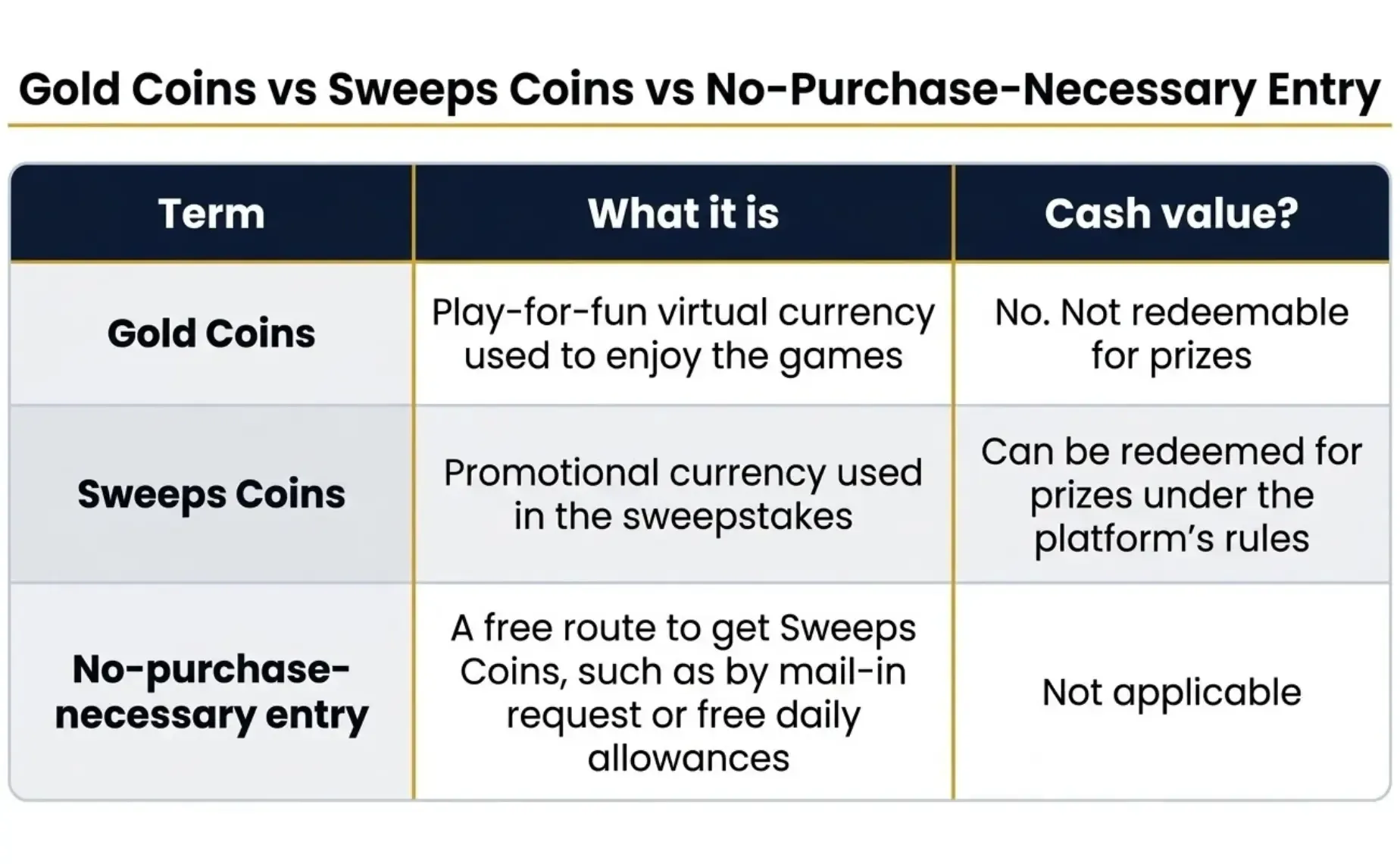
Here is the point that most often confuses people. Gold Coins exist so you can play the games for entertainment. They have no redemption value. Sweeps Coins are promotional and tied to the sweepstakes. Where a platform offers Gold Coin packages for sale, Sweeps Coins are typically provided as a free promotional addition, and they can also be obtained without any purchase. The legal reasoning rests on the fact that no one has to pay for a chance to win a prize, which removes the "consideration" element.
Some honest caveats follow from that.
- Redemption has rules: Platforms generally require identity verification and may set minimum thresholds and processing times before prizes are issued. Read the official rules before you rely on anything.
- Location matters: Sweepstakes casinos are not available everywhere. Some US states have restricted or prohibited them, and the legal position continues to evolve. Eligibility also depends on age, and the minimum age differs by place.
- It is not a guaranteed anything: Games are based on chance. There is no strategy that guarantees a prize, and nothing about the sweepstakes structure changes that.
If you want to understand how a particular platform handles these points, its official rules, terms and responsible-play pages are the primary sources. Look for plain-language statements on entry methods, redemption steps and age and location limits. If those pages are hard to find or hard to understand, treat that as information.
Why the history makes the model make sense
Looking at the timeline, the sweepstakes model is a reasonable extension of patterns we have already seen. Manufacturers in the 1900s adapted machines to local rules. Social casino developers in the 2010s separated casino-style play from wagering. Sweepstakes platforms add a promotional layer that is built on existing sweepstakes law. Each step reflects the same dynamic: the format of the game stays recognizable, and the legal structure around it is what changes.
That also explains why the debate around the model is not settled. Regulators, courts and lawmakers are still working out how existing sweepstakes and gambling statutes apply to a product that sits between categories. Anyone reading about this should expect the picture to keep changing.
Myths that survived every technology change
Some beliefs have outlasted the machines that supposedly justified them.
"A machine is due." In a mechanical slot, the physical state could in theory affect outcomes. In an RNG-driven game, each result is independent of the last. A long run without a particular symbol does not make it more likely next time.
"Loose and tight machines are placed in certain spots." This idea is a staple of casino folklore. The outcome frequency in a regulated game is set by its programmed rules, not by its location on a floor or the time of day.
"Free-to-play means risk-free." Social and sweepstakes games can be played without paying, but spending is still possible, and time is also a cost. Setting a time and spending limit in advance, and sticking to it, is sensible regardless of the model.
"Skill beats the machine." Skill matters in games such as poker or blackjack, where decisions change expected results. In slots, there is no skill element in the outcome.
What the pattern of casino game history tells us
If you step back from the dates, a few themes keep repeating.
- Technology removes constraints. Reels were limited by physics, then by electronics, then by nothing but software. Each step allowed larger variety.\
- Rules shape products. Fruit symbols and gum, free-to-play virtual coins, and sweepstakes entry routes are all responses to legal environments.
- Trust is a feature. Early video slots had to convince players they were fair. Online casinos needed licensing and testing. Sweepstakes platforms depend on clear rules and transparent redemption terms.
- Social context keeps coming back. Table games were communal, slots were solitary, and social apps restored the crowd.
- Entertainment is the honest framing. Nothing in 130 years of history suggests casino games are a reliable source of income. The sustainable way to think about them is as paid or free entertainment, with a clear limit on time and money.
Reading list and sources worth checking
We have tried to stick to widely documented history and to flag where details are disputed. If you want to verify or go deeper, these kinds of sources are a good starting point:
- University gaming research archives, such as the UNLV Center for Gaming Research, which maintains materials on the history of casinos and gaming in Nevada.
- State gaming regulators' public websites, for current rules on licensed games.
- The official rules and terms pages of any sweepstakes or social platform you are considering.
- Consumer protection agencies in your state or country, for current guidance on promotions and online games.
- Responsible gambling organizations, such as national problem gambling helplines, if gaming starts to feel like more than a pastime.
Where this article gives approximate dates, such as the early video slot or the first online casinos, we use words like "around" because sources disagree. If you are citing any of this yourself, check a primary source.
Frequently asked questions
1. Who invented the first slot machine?
The best-known early slot machine is the Liberty Bell, built by Charles Fey in San Francisco around 1895. It had three reels and an automatic payout mechanism. Earlier coin-operated gambling machines existed, including poker-style machines from around 1891, but Fey's simpler design made automatic payouts practical and set the template for later slots.
2. When did video slots and random number generators arrive?
Video slots began appearing around the mid-1970s, and computer-controlled outcomes became standard through the 1980s. In a modern machine, a random number generator picks the result and the screen displays it. This made it possible to program outcomes more precisely than mechanical reels allowed, and it is why independent testing of RNGs matters in regulated markets.
3. When did online casinos begin?
Online casinos began appearing in the mid-1990s. Antigua and Barbuda introduced a licensing framework for online gaming in 1994, and early operators launched in the years that followed. Claims about the single "first" online casino vary by source, so it is safer to say the mid-1990s than to name one date.
4. What are social casino games?
Social casino games are casino-style games, such as slots and poker, played with virtual currency that has no cash value. They became popular on Facebook in the late 2000s and then on mobile devices in the 2010s. Typical features include free coin allowances, friend interactions and leaderboards.
5. How is a sweepstakes casino different from a regular online casino?
A regulated real-money online casino requires players to wager money. A sweepstakes casino uses two virtual currencies: Gold Coins for play-for-fun with no redemption value, and Sweeps Coins as promotional entries that can be redeemed for prizes under the official rules. It operates under sweepstakes law and offers a no-purchase-necessary way to enter. Availability and legal status vary by location.
6. Can you win anything on a sweepstakes casino?
Prizes are possible in principle, because Sweeps Coins can be redeemed under the platform's rules, usually after verification and subject to minimum thresholds. But outcomes are based on chance, and no one can guarantee a result. Treat the games as entertainment, set limits in advance, and read the official rules before taking part.
7. Are sweepstakes casinos legal everywhere?
No. Rules differ by state and country, and some places restrict or prohibit sweepstakes casino models. Age limits also vary. Check the platform's eligibility terms and your local laws, and confirm the current position with an official source, since this area keeps changing.
A short, practical closing
Casino game history is mostly a story about adaptation. Charles Fey's machine made automatic payouts possible. Electronics and software removed the limits of physical reels. The internet moved games off the casino floor. Social apps removed money from the picture and put friends back in. Sweepstakes platforms then built a promotional structure on top of that free-to-play tradition.
If this guide leaves you with one habit, let it be reading the rules before anything else. Who is offering the game, what each currency is, how entries work and where it is permitted all matter more than how a game looks. And if play ever stops feeling like entertainment, support is available from national problem gambling helplines and local health services.
New to GoldenDragon.Casino? Use code DRAGON20 for 20% off when eligible. Limited to one use per user, valid through January 1, 2030.
Disclosure: GoldenDragon.Casino is a sweepstakes casino. This article is general education about casino game history and the sweepstakes model. It is not legal advice, and it does not guarantee any outcome. Availability, eligibility and rules vary by location. Please play only if you meet the minimum age requirement where you live, and only for entertainment.