

What Is RTP in Slots? Return to Player Explained
Published Sep 11, 2026
If you’ve spent any time browsing online slot games, you’ve probably noticed a small percentage sitting next to the title, something like “96.5% RTP” tucked into the game info or paytable. Most players scroll right past it. A few assume it’s marketing fluff. It isn’t.
RTP, or Return to Player, is one of the few numbers in online gaming that’s grounded in actual math rather than hype. It tells you how a slot is designed to behave over a very long stretch of play. Knowing your RTP won’t tell you what happens on your next spin (nothing can predict that), but it does explain why some games feel different to play than others, and why “the house always wins” is really a statement about averages, not about any one session.
This guide covers what RTP actually means, how it’s calculated, how independent labs verify it, and how the concept applies when you’re playing with Gold Coins or Sweeps Coins rather than real-money wagers. No jargon for the sake of jargon, and no promises about what you’ll personally walk away with. Just a straight explanation of how the mechanics work.
What Does RTP Stand For?
RTP stands for Return to Player. It’s a percentage representing the average amount a slot game is programmed to pay back to players over an extremely large number of spins, typically millions, sometimes tens of millions, run through simulation during game development.
If a game has a 96% RTP, the math says that for every unit wagered across that massive sample, 96% of it comes back to players as payouts, and the remaining 4% is the built-in margin that keeps the game economically viable for the operator to offer. That 4% is sometimes called the “house edge.” RTP plus house edge equals 100%.
The key word in that definition is average. RTP isn’t a promise, a guarantee, or a prediction of what happens to you personally in the next ten minutes. It’s a statistical property of the game itself, calculated the same way an actuary calculates insurance risk: by looking at enormous volume, not individual outcomes.
How RTP Is Calculated
Game studios don’t figure out RTP by watching real players. They calculate it mathematically, based on the game’s paytable, symbol weightings, and the probability of each outcome, then confirm that math by running the game through millions of simulated spins before it reaches a live platform.
Here’s a simplified way to picture it. Imagine a game had exactly two outcomes on every spin: a win that returns 2x your wager, and a loss that returns nothing, with the win landing 48% of the time. Run that across 10,000 spins and you’d expect roughly 4,800 wins paying out 2x each. Add that up, divide by the total wagered, and you land on a return figure close to 96%. Real slot games are far more complex, with dozens of symbols, multiple paylines, bonus features, and variable multipliers, but the underlying principle is the same. Sum every possible outcome, weight it by its probability, and you get the long-run payback percentage.
This is why RTP figures get published to one or two decimal places instead of rounded off. A game showing 96.08% RTP isn’t an approximation. It’s the output of a precise probability calculation that a developer, and later an independent testing lab, has verified against the game’s actual code.
In a sweepstakes environment, this same math governs how Gold Coins and Sweeps Coins behave during gameplay. What differs is the purpose of the coins themselves. Gold Coins are for entertainment and carry no cash value, while Sweeps Coins are the promotional entry mechanism that may be redeemable for prizes under the sweepstakes model. The underlying game engine and its published RTP work the same way regardless of which coin type is active. Fair math doesn’t change based on what you call the credits.
Theoretical RTP vs. Actual RTP
A lot of confusion creeps in here, so it’s worth slowing down. There are technically two versions of RTP floating around, and they’re not identical.
Theoretical RTP is the number calculated at the design stage, the long-run mathematical average described above. It’s the figure published in a game’s info screen or paytable.
Actual RTP, sometimes called realised or observed RTP, is what a specific game returns during a specific window of real play, across real player sessions. Because actual play volume is always smaller than the millions-of-spins sample used to calculate the theoretical figure, actual RTP drifts above or below the published number, sometimes by a noticeable margin, especially over shorter timeframes.
Think about it the way a statistician thinks about a coin flip. A fair coin has a theoretical 50% chance of landing heads. Flip it four times and get three heads, and you haven’t broken the coin, you’ve just seen a small sample where variance dominates. Flip it four million times and you’ll land extremely close to 50%. Slots work the same way. The published RTP is the four-million-flip version of the truth, and any short session you personally play is closer to the four-flip version, where randomness has far more room to swing the result either way.
That’s why no legitimate source should ever frame RTP as a prediction of what you’ll experience in a single session. It’s a long-run design property, nothing more.
RTP vs. Odds of Winning: Why They’re Not the Same Thing
Here’s a mistake that shows up constantly, even in articles that otherwise explain RTP reasonably well: treating RTP as the same thing as your odds of winning on any given spin. It isn’t, and the distinction matters.
RTP describes the payback percentage across total money wagered over the long run. Your odds of winning on a single spin, the probability that spin produces any payout at all, is a separate figure called the “hit frequency” or “hit rate.”
A game can have a high RTP and a low hit frequency, meaning it pays out rarely but generously when it does. Another can have a lower RTP but a high hit frequency, paying out often in small amounts. Neither structure is objectively better. They just produce a different playing experience, which is what the next section, on volatility, gets into.
So when you see a slot advertised with 97% RTP, that number tells you nothing directly about how often you’ll see a winning combination land. It describes the payback ratio across the total amount wagered over an enormous sample size, not the frequency of individual wins.
Typical RTP Ranges for Slot Games
RTP varies from title to title and provider to provider. It helps to have a general sense of where most games fall so a number in isolation actually means something.
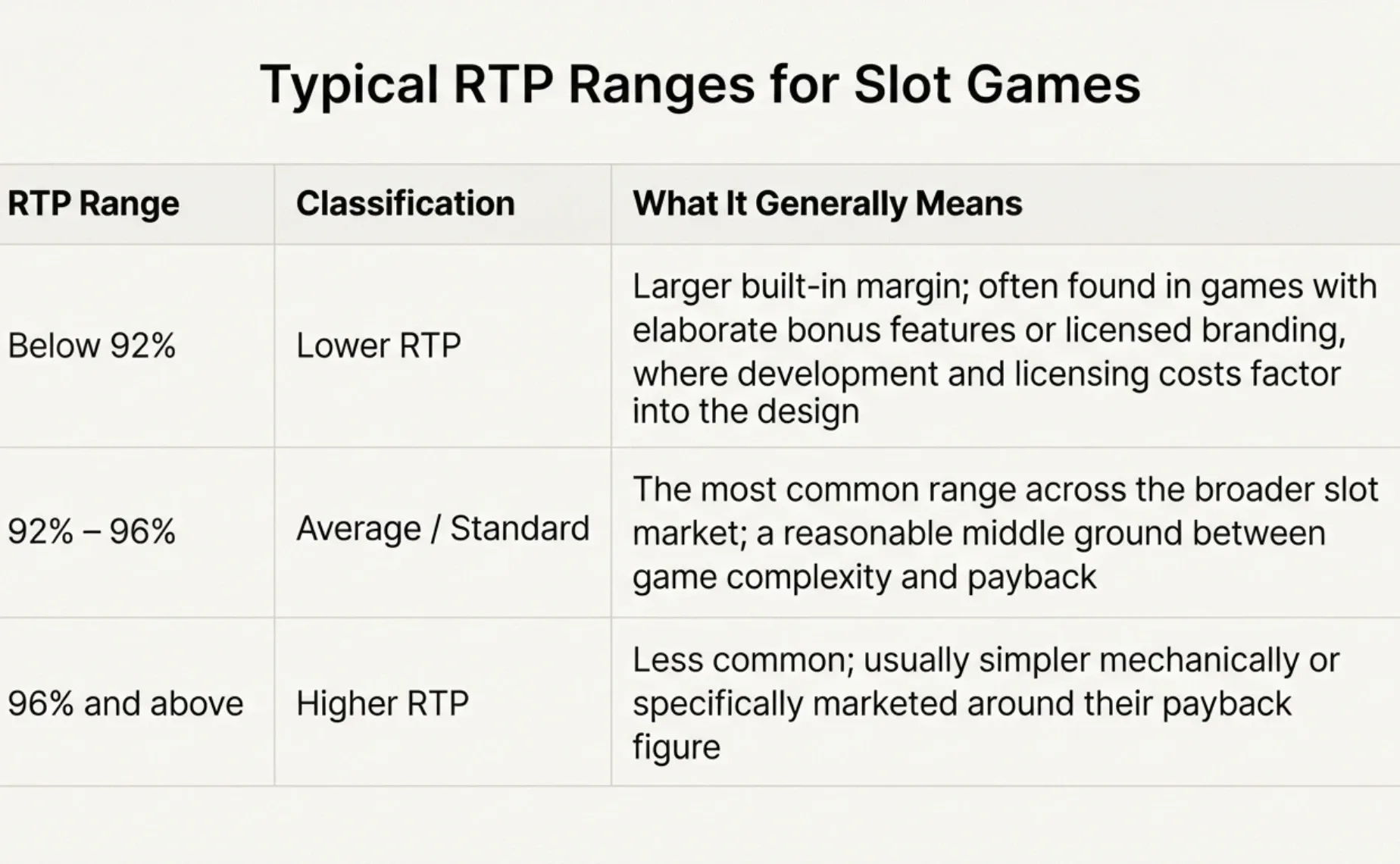
Two caveats here. These ranges reflect general industry patterns, not a rule any specific platform must follow, so always check a game’s own info screen for its actual published RTP rather than assuming based on category. And RTP alone doesn’t tell you everything about how a game will feel to play, which brings us to volatility.
How RTP Is Tested and Verified
Anyone can print a percentage next to a game’s name. What separates a credible figure from a marketing claim is independent verification, and this is genuinely one of the more reassuring parts of how the modern gaming industry operates.
Reputable game studios submit their software to independent testing laboratories before it goes live, and again periodically afterward. These labs specialize in auditing random number generators (RNGs) and confirming that a game’s real-world behavior matches its published RTP. A few of the most recognized names in this space:
- eCOGRA (eCommerce Online Gaming Regulation and Assurance) combines technical RNG testing with broader player-protection standards and dispute resolution work.
- GLI (Gaming Laboratories International) operates more like a pure engineering and compliance lab, testing gaming systems across both online and land-based environments.
- iTech Labs focuses heavily on RNG certification and game fairness testing specifically for online platforms.
The testing process typically runs a game through an enormous number of simulated outcomes, often tens of millions of rounds, then statistically compares the results against the game’s published RTP and the expected behavior of its RNG. Auditors check two separate things: that the random number generator produces genuinely unpredictable, unbiased outcomes rather than any exploitable pattern, and that the long-run payback of those outcomes lines up with what the game claims. Games typically get re-audited after any update that touches game logic, and platforms are monitored on an ongoing basis rather than certified once and left alone.
That’s the actual mechanism behind the phrase “independently tested for fairness,” which shows up so often in gaming marketing that it’s easy to gloss over. It isn’t a slogan. It’s a description of a real audit process performed by third-party labs with no financial stake in the outcome.
RTP and Volatility: Why the Full Picture Matters
RTP tells you how much, on average, comes back over the long run. Volatility (sometimes called variance) tells you how that return tends to arrive: steadily in smaller amounts, or unevenly in occasional larger bursts.
A low-volatility game tends to produce frequent, modest payouts, which can make a session feel more consistent and less streaky. A high-volatility game pays out less often, but when it does, the payouts tend to be larger relative to the wager. Two games can share nearly identical RTP figures, say, both around 95.5%, and still feel completely different to play, purely because of how their volatility is structured.
Neither low nor high volatility is inherently the right choice. It genuinely comes down to what kind of session you find more enjoyable: steady and predictable, or a slower build with bigger spikes. RTP and volatility are two separate dials, not one combined setting, and keeping that straight explains why games in the same RTP neighborhood can play out so differently.
Common Mistakes People Make When Judging RTP
A handful of misconceptions come up often enough that they deserve a direct answer.
The first is assuming RTP predicts a single session. If someone tells you a game “should” pay back 96% of what you put in during a 20-minute session, they’re misapplying a number that only holds true across a sample size you’d never personally reach. Twenty minutes of spins is a rounding error compared to the millions used to calculate the figure.
The second is comparing RTP across different game types as if they’re interchangeable. A 95% RTP slot and a 95% RTP table game don’t necessarily feel the same to play, because the underlying structure, how often outcomes occur, how big individual payouts can be, how much skill or strategy factors in, varies enormously between game categories. RTP is one input, not the whole picture.
The third is treating a slightly higher RTP as a meaningfully different experience. The difference between a 95.0% RTP game and a 96.5% RTP game is real mathematically, but at the scale of an individual playing session, that 1.5-point gap gets swamped by ordinary variance. It matters more over enormous volume than it does game-to-game for a casual player deciding what to try next.
The fourth is not checking where the RTP figure actually comes from. Any platform can print a number. What actually matters is whether that number has been through independent verification, the kind of testing described above. A published RTP with no auditing trail behind it isn’t the same as one certified by a recognized lab.
How to Check a Game’s RTP Before Playing
If you want to look up a specific game’s RTP rather than relying on general ranges, there are a few reliable places to check.
Most modern slot titles display their RTP directly in the game’s information screen, usually accessible through an “i” icon or a paytable button within the game itself. That’s the fastest and most direct source, since it comes straight from the game’s own published specifications.
Game providers, the studios that actually build the titles, as opposed to the platforms that host them, also frequently publish RTP figures on their own websites or in press materials when a new game launches. If you’re curious about a specific developer’s approach to game design, their official site is usually a dependable source.
Some games get released with multiple configurable RTP versions, where the platform hosting the game selects which version to offer. When that’s the case, reputable platforms disclose which configuration is live rather than leaving players to guess. If a game’s info screen doesn’t show a clear RTP figure, that’s a fair thing to ask a platform’s support team about directly. A transparent operator should be able to point you to it.
How RTP Applies to Sweepstakes-Style Play
Everything above describes RTP as a general concept in game design, but it’s worth being specific about how it fits into a sweepstakes casino model like Golden Dragon’s, since that context tends to get left out of generic RTP explainers.
Golden Dragon operates under sweepstakes law rather than traditional gambling law, and no purchase is ever necessary to participate. Games are played using two types of coins that serve different purposes:
- Gold Coins are used for entertainment-only play. They have no cash value and cannot be redeemed for prizes. They exist purely so players can enjoy the games.
- Sweeps Coins are the promotional entry mechanism at the center of the sweepstakes model. They can be obtained through methods including free promotional giveaways, and depending on the platform’s rules, may be eligible for redemption for prizes once minimum thresholds and verification requirements are met.
Here’s how it connects back to everything above: the RNG and RTP mechanics underneath the games don’t change based on which coin type is active. The same tested, audited game engine determines outcomes whether Gold Coins or Sweeps Coins are in play. Understanding RTP, RNG certification, and volatility gives you a genuinely useful framework for how these games are designed to behave, it’s just applied within a no-purchase-necessary, sweepstakes-based structure rather than a real-money wagering one.
This distinction matters for a simple reason. A lot of RTP content online is written exclusively with real-money gambling in mind, which can confuse players engaging with a sweepstakes platform for the first time. The math and the testing standards are the same. The legal and financial framework around them is not.
If you’re ready to explore Golden Dragon for yourself, you can also save on your first experience with promo code DRAGON20, which gives you 20% off. The code is limited to one use per user and remains valid until January 1, 2030.
Key Takeaways
- RTP (Return to Player) is the long-run average percentage a game is designed to pay back across millions of simulated spins, not a prediction for any single session.
- Theoretical RTP (published, calculated) and actual RTP (observed during real play over a shorter window) can differ, especially over small sample sizes, due to normal statistical variance.
- RTP is not the same as your odds of winning on a given spin. That’s a separate metric called hit frequency.
- Most slot RTPs fall somewhere between roughly 92% and 96%, though this varies by title and provider.
- Independent labs such as eCOGRA, GLI, and iTech Labs test RNGs and verify that real game behavior matches published RTP figures.
- Volatility describes how RTP gets distributed over time (frequent small wins vs. occasional larger ones) and is a separate concept from RTP itself.
- In a sweepstakes model, the same tested RTP and RNG mechanics apply whether you’re playing with Gold Coins (entertainment-only) or Sweeps Coins (the promotional, potentially redeemable entry mechanism).
Frequently Asked Questions
1. What is an RNG game?
An RNG game is any game, including virtually all online slots, that determines its outcomes using a Random Number Generator: software designed to produce statistically unpredictable, unbiased results for every spin or round, independent of any previous outcome.
2. How does RNG work in games?
An RNG continuously generates streams of random values using an algorithm. When you spin a slot, the outcome is determined by the value generated at that exact moment, which maps to a specific combination of symbols or results. Independent labs test this process to confirm outcomes are genuinely random and not predictable or manipulable.
3. What is RTP in casino games generally, not just slots?
RTP applies to most casino-style games, not only slots, though the number gets calculated differently depending on the game’s rules and structure. In every case, it represents the same core idea: the long-run percentage of wagered value that’s returned to players.
4. How do sweepstakes casino games work with RTP?
Sweepstakes casino games run on the same tested game engines and published RTP figures as the broader online gaming industry. The difference is structural, not mathematical. Play happens with Gold Coins (entertainment-only) or Sweeps Coins (the promotional entry mechanism), under sweepstakes law, with no purchase necessary to participate.
5. Is a higher RTP always better?
Generally, a higher RTP means a smaller theoretical house margin, but RTP alone doesn’t capture the full playing experience. Volatility, bonus features, and personal preference all factor into whether a particular game is enjoyable, regardless of its exact RTP figure.
6. Do sweepstakes casinos pay real money?
Sweeps Coins earned through play may, depending on the platform’s specific rules, be eligible for redemption once minimum requirements are met, while Gold Coins are strictly for entertainment and are not redeemable. This structure is what allows sweepstakes platforms to operate under sweepstakes law with no purchase necessary, rather than under traditional gambling regulations.
7. What is the difference between a sweepstakes casino and a casino?
A traditional casino involves real-money wagering under gambling law. A sweepstakes casino operates under a different legal framework, using a no-purchase-necessary promotional model built around Gold Coins and Sweeps Coins rather than direct real-money bets.
If you’re new to how the sweepstakes model works more broadly, including the difference between Gold Coins and Sweeps Coins and how redemption works, Golden Dragon’s Sweepstakes Policy and FAQ pages walk through the rules in full.