Blog
Slot Machine Terminology: The Complete Player Glossary
Casino
- Key Takeaways
- How Slot Machines Actually Work (Core Mechanics)
- Symbols You'll See on the Reels
- Bonus Features and Game Mechanics Glossary
- Payline vs. Ways-to-Win vs. Cluster Pays
- Payout and Paytable Terms
- Common Misunderstandings About Slot Terminology
- Slot Terminology in the Sweepstakes Casino Model
- A Quick Note for GoldenDragon.Casino Players
- Frequently Asked Questions
- What is RNG in a slot game?
- What is RTP (return to player)?
- What is volatility in slot machines?
- What are paylines?
- What's the difference between a wild symbol and a scatter symbol?
- What are Sweeps Coins and Gold Coins?
- What are sweepstakes slots?
- What is hit frequency?
- What is a progressive jackpot?
- Learning the Language Before You Play
Open any slot game and you'll hit a wall of unfamiliar words within seconds: RTP, volatility, scatter, wild, cascading reels, hold and win. None of it gets explained on the reels themselves. Most players either guess at what these terms mean or skip past them entirely, which is a shame, because slot machine terminology isn't just industry jargon. It's the vocabulary that describes how a game actually behaves, what you're looking at on screen, and how the underlying math works.
This glossary works through that vocabulary in plain language, grouped by category so it reads like a guide instead of a dictionary. It covers the mechanics that drive every spin, the symbols you'll spot on the reels, the bonus features built into modern games, and the payout language printed inside a paytable. Because this matters specifically on a platform like GoldenDragon.Casino, it also covers how these same terms apply inside the sweepstakes model, where Gold Coins and Sweeps Coins work differently than a typical casino chip.
Key Takeaways
- Every legitimate slot game runs on an RNG (random number generator), which means outcomes are independent and unpredictable from spin to spin. There's no pattern, no "due" jackpot, no way to time a win.
- RTP (return to player) and volatility describe two different things. RTP is a long-run statistical average across millions of spins, while volatility describes how choppy or smooth the ride feels in the short term.
- Paylines and ways-to-win determine how matching symbols turn into a payout, and the two systems work differently enough that it's worth knowing which one a given game uses.
- Symbols like wilds and scatters aren't decorative. They're functional pieces that unlock specific outcomes, and knowing the difference changes how you read a screen.
- On GoldenDragon.Casino, this same slot terminology applies to gameplay mechanics, but the currency runs on the sweepstakes model: Gold Coins for entertainment play, and Sweeps Coins as the promotional entry currency, available for free and without any purchase required.
How Slot Machines Actually Work (Core Mechanics)
Before any symbol lands anywhere, a slot game has already made its decision. Understanding the mechanics underneath the graphics is the fastest way to make sense of everything else in this glossary.
- RNG (random number generator): This is the engine at the center of every digital slot: a piece of software that continuously generates strings of numbers, even when nobody is spinning. Each number corresponds to a specific outcome on the reels. The instant you hit spin, the RNG locks in a value, and that value determines exactly what lands where. There's no mechanical arm, no physical reel with worn-down stops, no way for a previous spin to influence the next one. Every spin is mathematically independent. That's also why the idea of a machine being "hot," "cold," or "due for a hit" doesn't hold up technically. The RNG has no memory.
- Reels: These are the vertical (or occasionally horizontal) columns that spin and display symbols. Classic mechanical slots had three physical reels. Most modern video slots use five, though grid-style and cluster games sometimes drop fixed reels entirely in favor of a symbol matrix.
- Paylines: A payline is a specific pattern across the reels, traditionally a straight or zigzag line, where matching symbols need to land to trigger a payout. Older machines might run a single payline. Plenty of modern video slots run 20, 25, or several hundred.
- Ways-to-win: This is a different payout structure than paylines. Instead of requiring symbols to land on a fixed line, a ways-to-win game (often labeled 243 Ways or 1024 Ways) pays out for matching symbols landing anywhere on adjacent reels, left to right. It's a subtle distinction, but it changes how often you'll see a payout register, since there's no need for exact line alignment.
- RTP (return to player): RTP is expressed as a percentage and represents the theoretical amount a game returns to players over an extremely large number of spins, typically calculated across millions of rounds during game testing rather than any single session. A game with a 96% RTP theoretically returns 96 units for every 100 wagered, averaged out over that huge sample. It says nothing about what happens over your next ten spins, and it's not a guarantee for any individual player. It's a long-run mathematical property of the game itself, closer to an actuarial table than a promise.
- Volatility (also called variance): While RTP tells you how much a game pays back over time, volatility tells you how it pays that amount out. A low-volatility game tends to produce smaller, more frequent payouts, which feels smoother and steadier. A high-volatility game pays out less often but can produce much larger results when it hits, which makes for a choppier, more unpredictable rhythm. Medium-volatility games sit between the two. Neither type is "better." They simply produce a different playing experience, and knowing which one you're looking at helps set realistic expectations for a session.
- House edge: This is the mathematical counterpart to RTP. If a game has a 96% RTP, the house edge is the remaining 4%, the built-in statistical advantage that keeps any probability-based game operationally sustainable over time. It's a standard part of how these games are designed, and it's baked into the math regardless of what currency or format a given game uses.
- Hit frequency: This measures how often a spin produces any winning combination at all, regardless of size. A game can have relatively high hit frequency but low volatility (frequent small wins), or low hit frequency with high volatility (rare but larger wins).
- Symbol weighting: Not every symbol on a reel has an equal chance of appearing. Developers assign different weights to different symbols, a mechanism that shapes both RTP and volatility. A jackpot symbol might be weighted to appear far less often than a low-value symbol, which is exactly why the big payouts feel rare. That's not an accident of luck; it's a design decision.
- Near-miss design: This describes the visual effect where symbols land just one position away from completing a winning combination. It's a well-documented design element in slot games, and understanding it as a scripted visual pattern, rather than a signal that a win is close, helps separate what you're seeing on screen from what the RNG actually determined.
Symbols You'll See on the Reels
Every symbol on a slot machine serves a purpose. A handful of specific symbol types show up across nearly every game, regardless of theme.
- Wild symbol: A wild substitutes for other symbols to help complete a winning combination, functioning much like a wild card in a card game. If a payline needs three matching symbols and a wild lands in the right spot, it fills in for whichever symbol is needed.
- Sticky wild: A variation that stays locked in place for one or more additional spins after it lands, instead of disappearing after a single round. It's built specifically to extend a favorable outcome across multiple spins.
- Expanding wild: Another wild variation, this one grows to cover an entire reel once it lands, rather than occupying a single position. Because it fills a whole column, it substitutes across every payline that crosses that reel.
- Scatter symbol: Unlike most symbols, scatters typically don't need to land on a specific payline or in a specific order. Landing a certain number of scatters anywhere on the reels is usually what triggers a bonus feature, most often free spins. This is one of the more important distinctions worth learning early, since it's easy to confuse scatters with wilds when you're new to a game.
- Multiplier symbol: A symbol that multiplies the value of a win by a set amount, 2x, 3x, or higher, when it's part of a winning combination or appears during a bonus round.
- Bonus symbol: A dedicated symbol whose only job is triggering a bonus round or mini-game once enough of them appear, separate from the game's regular paytable symbols.
- Low-pay and high-pay symbols: Most slot games organize their symbol set into tiers. Low-pay symbols, often card suits or simple shapes, appear frequently and pay modestly. High-pay symbols, usually tied to the game's theme, appear less often because of their symbol weighting, and pay significantly more when they land.
- Stacked symbols: Symbols printed multiple times in a vertical stack on a single reel position, rather than one symbol per row. Because a stack can fill several rows on one reel at once, stacked symbols raise the odds of landing multiple matching symbols from a single spin, which is why you'll see them more often on higher-volatility titles.
- Colossal (or mega) symbols: An oversized symbol that spans multiple reels and rows at once, taking up a block of the grid instead of a single cell. When a colossal symbol lands, it counts as that symbol in every position it covers, which can trigger several winning combinations from one spin.
Learning this symbol vocabulary matters beyond simple recognition. It's what lets you read a game's bonus mechanics correctly instead of guessing at what actually triggered a round.
Bonus Features and Game Mechanics Glossary
Beyond the base game, most modern slots layer in secondary mechanics designed to add variety and depth to a session.
- Bonus round: A separate feature, sometimes a mini-game, sometimes an enhanced version of the base spin, triggered by a specific combination of symbols, usually scatters or dedicated bonus symbols.
- Free spins: A set number of spins awarded at no additional cost to the player's balance, frequently triggered by scatter symbols. Free spins rounds often include extra modifiers, like an increased multiplier or an expanded symbol set, that aren't present in the base game.
- Cascading reels (also called tumbling reels): Instead of the reels resetting after every spin, winning symbols disappear and new symbols drop in to fill the gaps, all within the same spin. This can chain several consecutive wins from a single spin, often with an increasing multiplier attached to each cascade.
- Hold and win: A feature, usually appearing in a dedicated bonus round, where certain symbols (often coins or jackpot markers) lock into place and the player gets a limited number of re-spins to add more matching symbols before the round ends and the total gets tallied.
- Cluster pays: Instead of relying on paylines or ways-to-win, cluster pays games reward groups of matching symbols that sit adjacent to each other, vertically or horizontally, anywhere on the grid rather than in a straight line.
- Variable-reel mechanics: A category of games that changes the number of symbol positions on each reel from spin to spin, which changes the total number of ways to win on the fly, sometimes into the thousands. It's a newer evolution of the fixed-reel format and tends to produce more volatile, higher-ceiling outcomes.
- Anticipation animation: A visual and audio effect, reels slowing down, sound building, symbols highlighting, that plays when the game detects a partial bonus trigger already on the reels, with one more matching symbol needed to complete it. It's a design choice meant to build tension, similar in spirit to near-miss design, and it's worth recognizing as a scripted animation rather than a signal about what's coming next.
- Feature buy: An option in some games that lets a player pay a set cost to jump directly into a bonus round instead of waiting for it to trigger naturally through play. Not every game offers this, and where it exists, it's typically framed as an alternate entry point into the same round that could otherwise occur organically.
- Retrigger: When a bonus round or free spins feature activates again while it's already running, extending the round with additional spins or value, based on the same trigger condition that started it.
Payline vs. Ways-to-Win vs. Cluster Pays
These three payout structures get confused constantly, mostly because they all answer the same question, "how do matching symbols turn into a win," with different rules. Here's how they compare side by side:
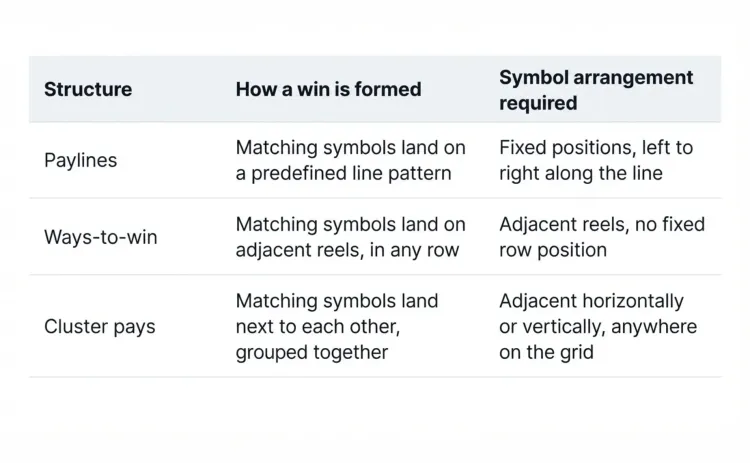
The practical point here is that the payout structure a game uses changes how you should read a near-win. A missed payline result and a missed cluster result look different on screen, even though both can feel like "almost."
Payout and Paytable Terms
The paytable is the reference document built into every slot game, and being able to read it is one of the more practical skills a player can pick up.
- Paytable: A built-in menu, accessible from within the game, that lists every symbol, its payout value at different combination sizes, the rules for any bonus features, and, importantly, the game's RTP. It's the single best source of accurate information about how a specific game is built. Worth checking before you spend much time on any new title.
- Coin value: The monetary or coin denomination assigned to each unit of a bet, which determines how the total stake gets calculated across active paylines or ways-to-win.
- Bet max (max bet): A single control that sets the wager to the highest available amount in one action, activating every payline and the maximum coin value at once. Some bonus features or progressive jackpots are only accessible at max bet, which is worth checking in the paytable before assuming a feature is available at any wager level.
- Progressive jackpot: A jackpot that grows over time, typically funded by a small percentage of every wager placed across the game, and sometimes across a network of linked games, until it's won and resets to a starting value.
- Jackpot seed: The reset value a progressive jackpot returns to after it's been won. This is the baseline the jackpot starts climbing from again.
- Fixed jackpot: The opposite of a progressive jackpot: a set, unchanging top prize amount defined in the paytable that doesn't grow based on play volume.
- Multiplier: A value that increases a payout by a set factor. Multipliers can be fixed (always 2x, for example) or progressive, increasing with each consecutive win in features like cascading reels.
- Autoplay: A setting that automatically runs a set number of spins in sequence without requiring the player to manually press spin each time, typically with customizable stop conditions like a balance threshold or a win amount.
Common Misunderstandings About Slot Terminology
A few myths follow slot terminology around no matter how many times they get corrected, and most of them trace back to misreading one of the terms already covered above.
- "The machine is due for a hit." This treats a slot like it's keeping score, when the RNG has no memory of past spins at all. Every spin is an independent event. A long stretch without a win doesn't raise the odds of the next spin, and a recent win doesn't lower them either.
- "Autoplay changes the odds." Autoplay is a convenience setting that automates pressing spin. It runs the exact same RNG process as a manual spin, with the same RTP and volatility profile. It doesn't adjust the math in either direction, no matter how it feels while it's running.
- "A near-miss means the game is building up to something." As covered under near-miss design and anticipation animation above, these are visual and audio effects layered on top of a result the RNG already determined. They're built for engagement, not as an indicator of what's statistically likely next.
- "Higher volatility always means a better game." Volatility describes payout rhythm, not quality. A high-volatility title suits a player who doesn't mind long quiet stretches between larger results. A low-volatility title suits someone who prefers steadier, smaller outcomes. Neither is objectively correct, and preferring one over the other is really just a matter of taste.
Slot Terminology in the Sweepstakes Casino Model
Everything covered so far describes how a slot game's mechanics and math work, and that layer stays the same regardless of what platform or currency model a game runs on. What changes on a sweepstakes site like GoldenDragon.Casino is the currency structure sitting on top of those mechanics.
GoldenDragon.Casino operates under sweepstakes promotional law, not gambling law, and that's a meaningful structural difference, not a technicality. The platform uses two distinct coin types instead of one wagering currency. Gold Coins function as virtual coins for entertainment play. They let you experience the games, but they hold no redemption value and can't be exchanged for anything. Sweeps Coins are the platform's promotional currency: obtainable through no-purchase-necessary methods, such as free daily allotments or mail-in entry, consistent with standard sweepstakes law, and where eligible, redeemable for prizes. Neither coin type involves placing a real-money wager the way a traditional casino chip does.
It's worth being precise about this distinction, because it's the piece most players get wrong. Casino coins and virtual coins on a sweepstakes platform aren't the same thing as cash bets, even though the games running underneath them use identical slot mechanics: the same RNG, the same RTP calculations, the same paylines and symbol logic described earlier in this glossary. The terminology doesn't change based on which coin type is active in a session. A wild symbol is still a wild symbol, and volatility still describes the same payout rhythm, whether Gold Coins or Sweeps Coins are in play.
That's also why "no purchase necessary" is a standing feature of the sweepstakes model rather than a promotional footnote. It's a legal requirement of how sweepstakes operate, ensuring free entry methods exist alongside any optional coin packages. Understanding this separation, game mechanics as universal slot terminology, currency model as sweepstakes-specific, is genuinely useful context. It's the reason a sweepstakes platform can legally operate in states where traditional online gambling is restricted.
A Quick Note for GoldenDragon.Casino Players
If you're exploring GoldenDragon.Casino, you can also use the DRAGON20 promo code when eligible to receive 20% off. The code can be used once per user and is currently valid through January 1, 2030. Check the applicable promotional terms before using the code.
Frequently Asked Questions
What is RNG in a slot game?
RNG stands for random number generator, the software system that determines every outcome on a slot's reels. It runs continuously and generates a result the instant a spin is triggered, independent of any previous or future spin. This is what makes each spin statistically unrelated to the last one.
What is RTP (return to player)?
RTP is a percentage representing the theoretical amount a slot game pays back to players over a very large number of spins, calculated during game testing across millions of rounds. It's a long-run statistical figure, not a prediction for any single spin or session.
What is volatility in slot machines?
Volatility (or variance) describes how a game distributes its payouts over time. Low-volatility games tend to pay smaller amounts more frequently. High-volatility games pay less often but with larger potential results when they hit. Medium-volatility games fall in between.
What are paylines?
Paylines are the specific patterns across a slot's reels where matching symbols need to land to register a payout. Some games use fixed paylines, while others use a ways-to-win or cluster-based system instead, each with slightly different rules for how a match counts.
What's the difference between a wild symbol and a scatter symbol?
A wild symbol substitutes for other symbols to help complete a winning combination on a payline. A scatter symbol usually doesn't need to land on a payline at all. Instead, landing enough scatters anywhere on the reels typically triggers a bonus feature like free spins.
What are Sweeps Coins and Gold Coins?
These are the two currency types used in the sweepstakes casino model. Gold Coins are used for entertainment-only play and have no redemption value. Sweeps Coins are the promotional currency, available through no-purchase-necessary entry methods, and can be redeemed for prizes where eligible. Both run on top of the same underlying slot mechanics described throughout this glossary.
What are sweepstakes slots?
Sweepstakes slots are slot games offered through the sweepstakes model rather than direct real-money wagering. They use the same core game mechanics, RNG, RTP, paylines, symbols, as traditional slots, but access and prize eligibility are structured through Gold Coins and Sweeps Coins under sweepstakes promotional law instead of a cash-wagering system.
What is hit frequency?
Hit frequency measures how often a spin lands any winning combination at all, regardless of how big or small that win is. It's a separate statistic from RTP and volatility. A game can hit often with small payouts, or hit rarely with larger ones, depending on how its math model is built.
What is a progressive jackpot?
A progressive jackpot is a top prize that grows over time, usually funded by a small share of activity across the game or a linked network of games, until it's won and resets to its starting value, known as the jackpot seed. It's the opposite structure from a fixed jackpot, which stays at one set amount.
Learning the Language Before You Play
Slot machine terminology isn't decoration. It's the actual operating manual for how these games are built and how they behave, from the RNG making split-second decisions behind every spin to the paytable that spells out exactly what each symbol is worth. Knowing the difference between RTP and volatility, or between a wild and a scatter, turns a screen full of unfamiliar words into something you can actually read and evaluate, rather than something you just click through.
If you're getting oriented on GoldenDragon.Casino specifically, it's worth spending a few minutes with our overview of how the sweepstakes model works. Pairing that framework with the terminology in this glossary gives you a genuinely complete picture before you explore any game.
Purchase Securely With