Blog
How the Redemption Process Works: A Step-by-Step Guide to Sweeps Coins
Casino
- Quick Context: Gold Coins vs. Sweeps Coins in Brief
- How the Sweeps Coins Redemption Process Works: Step by Step
- Step 1: Earning and Accumulating Redeemable Sweeps Coins
- Step 2: Meeting the Minimum Redemption Threshold
- Step 3: Completing Identity and Account Verification (KYC)
- Step 4: Submitting the Redemption Request
- Step 5: Processing and Payout
- Common Reasons Redemption Requests Get Delayed or Rejected
- Tips for a Smooth Redemption Experience
- Redemption Methods Typically Offered at Sweepstakes Casinos
- A Note on Tax Reporting for Larger Redemptions
- A Short Checklist Before You Submit a Redemption Request
- How the Redemption Process Differs from Real-Money Gambling Payouts
- Learn More About How the Sweepstakes Model Works
- Key Takeaways
- Frequently Asked Questions
- Do sweepstakes casinos pay real money?
- How long does the redemption process take?
- How can I get free Sweeps Coins?
- Is a sweepstakes casino legit?
- What is the difference between a sweepstakes casino and a casino?
- Why was my redemption request rejected?
Earning Sweeps Coins is the easy part. Figuring out what happens after you’ve accumulated them, how you actually turn them into a prize, is where most people get stuck. Usually the confusion isn’t about the concept itself. It’s about the mechanics: how much do you need, what documents will you be asked for, how long does it take, and why do some requests get sent back instead of processed?
This guide walks through the redemption process from start to finish, using the stages that show up across the sweepstakes casino industry. Treat it as a consumer-education resource rather than a promise of specific outcomes, timelines, or dollar amounts. Those details vary by platform, by state, and by which redemption method you pick.
Quick Context: Gold Coins vs. Sweeps Coins in Brief
One distinction is worth having straight before anything else. Sweepstakes casinos typically run on two currencies. Gold Coins are for entertainment: you can play with them, but they carry no cash value and can’t be redeemed for anything, ever. Sweeps Coins are the promotional currency, redeemable for prizes once certain conditions are met, and they’re usually earned through gameplay, promotions, or a free no-purchase-necessary entry method rather than bought outright as a wager.
That’s as much as you need here. If you want the fuller explanation of what Sweeps Coins are and how the dual-currency setup works, that’s really its own topic. This piece stays focused on what happens once you already have Sweeps Coins sitting in your account and you’re ready to cash them out.
How the Sweeps Coins Redemption Process Works: Step by Step
Redemption isn’t one action. It’s a sequence of checkpoints, each one built to confirm eligibility, accuracy, and compliance before a prize actually goes out. Here’s how that sequence typically plays out.
Step 1: Earning and Accumulating Redeemable Sweeps Coins
Sweeps Coins usually land in your account a few ways: through gameplay outcomes, through periodic promotions like daily login rewards or email offers, or through a no-purchase-necessary mail-in or online entry method that most sweepstakes operators are legally required to offer as an alternative to any purchase-linked path. That alternate entry option exists because sweepstakes law requires that no purchase be necessary to participate or win. It’s a foundational piece of what separates this model from gambling.
One detail that trips people up: not every Sweeps Coin in your balance is automatically redeemable. Many platforms require that Sweeps Coins be played through at least once, meaning used in eligible games, before they shift from a pending or bonus status into a redeemable balance. It functions a lot like a wagering requirement, and it exists so the currency can’t be pulled out the moment it’s credited, which keeps the promotional model intact. Check your account’s balance breakdown. Most platforms separate “total SC” from “redeemable SC,” so you can see exactly where you stand.
Step 2: Meeting the Minimum Redemption Threshold
Sweepstakes casinos set a minimum amount of Sweeps Coins you need before you can submit a redemption request. That minimum isn’t random. It keeps the administrative and payment-processing load reasonable for both the operator and the payment networks handling the transaction, and it’s standard practice across the industry.
Going by common industry patterns, cash-equivalent redemptions (bank transfer, PayPal, push-to-card) tend to sit somewhere in the 50-to-100 Sweeps Coin range for a minimum, while gift card redemptions often clear at a lower bar, sometimes as low as 10 to 25 Sweeps Coins. These numbers vary by operator and by method, so check the current minimums on your own redemption page rather than assuming a fixed figure. Thresholds shift over time too, as platforms adjust their promotional terms.
Step 3: Completing Identity and Account Verification (KYC)
This step catches newer users off guard more than any other, but it’s also doing the most work to protect everyone involved. Before releasing a prize, sweepstakes operators need to confirm the person requesting it is a real individual, is of eligible age, lives in an eligible location, and hasn’t already claimed a prize under a separate account.
Typical verification requirements include:
- A government-issued photo ID (driver’s license, state ID, or passport)
- Proof of current address (a recent utility bill, bank statement, or similar document)
- Sometimes a selfie or short liveness check to confirm the ID belongs to the person submitting it
- Confirmation of date of birth and, occasionally, the last four digits of a Social Security number for tax-reporting purposes on larger redemptions
Why go through all this? Two reasons, really. First, it’s tied directly to how sweepstakes law works. Operators have to confirm eligibility, meaning age, location, one entry per person, to keep the promotional model legitimate. Second, it protects the prize pool itself. Without identity checks, someone could open multiple accounts and claim a disproportionate share of promotional prizes, which would shortchange everyone playing by the rules. Verification is normally a one-time process. Once your identity is confirmed, later redemptions tend to move faster because that groundwork is already done.
Step 4: Submitting the Redemption Request
Once your balance clears the minimum and your identity is verified, submitting the request itself is usually the easy part. You pick a redemption method from whatever your account offers, enter the amount of Sweeps Coins you want to redeem, and review a confirmation screen laying out the details before finalizing anything.
Pay attention to that review screen. It’s your last chance to catch a mistake: a wrong amount, an outdated payout address, a mismatched account detail, before the request enters processing. Once submitted, a request usually moves into a queue and can’t always be edited or cancelled on the spot, so a few extra seconds of double-checking here saves real time down the line.
Step 5: Processing and Payout
After submission, your request goes through a review and processing phase before funds or a prize are actually issued. How long that takes depends heavily on the method you chose and the size of the redemption.
Gift cards tend to process fastest, often within 24 to 72 hours, since they skip third-party banking rails entirely. E-wallets and push-to-card payouts, think PayPal, Trustly, or instant debit card transfers, commonly land somewhere in the 1-to-5-business-day range. Bank transfers and physical checks are usually the slowest of the group, sometimes taking 5 to 10 business days depending on your bank’s own processing schedule.
A couple of things affect these windows. Weekends and holidays don’t count as business days, so a request submitted Friday afternoon might not start processing until Monday. Larger redemption amounts are also more likely to trigger an additional manual review step. That’s standard risk-management practice, not a sign that something’s wrong with your specific request.
Common Reasons Redemption Requests Get Delayed or Rejected
Most redemption problems are preventable, and they tend to cluster into a handful of recurring categories.
Mismatched or incomplete personal information causes the most friction. If the name, date of birth, or address on your account doesn’t exactly match your ID documents, verification stalls out. Before requesting a redemption, check that your account profile matches your legal documents down to spelling and middle initials.
Unmet play-through or wagering requirements are another common snag. As covered in Step 1, Sweeps Coins often need to be played through before they count as redeemable. Trying to redeem a balance that includes non-redeemable or pending SC will trigger a rejection or a request for clarification, so check your redeemable balance specifically rather than your total balance.
Duplicate or multiple accounts are treated seriously. Sweepstakes rules generally limit participation to one account per person, and if fraud checks detect a second account tied to the same identity, device, address, or payment method, redemption requests can get frozen pending investigation. That rule exists to keep the prize pool fair for everyone, so it gets enforced strictly.
Exceeding stated request limits can also slow things down. Some platforms cap how much can be redeemed in a single request or within a given time window, whether that’s daily, weekly, or monthly. Going over that cap doesn’t necessarily mean rejection, but it may get your request split, delayed, or bounced back with instructions to resubmit within the limit.
Incorrect payout details are a common, entirely avoidable snag: a misspelled name on a bank transfer, an expired card used for push-to-card, a wrong email tied to a PayPal account. These errors don’t usually cause a permanent rejection, but they add days while support corrects the record.
Being outside an eligible state, or using a VPN to appear as though you are, is another frequent trigger. Sweepstakes promotions are only legally available in states where the operator has confirmed compliance, and most platforms exclude a handful of states by law. Masking your location with a VPN is generally against the terms of service and is one of the more common reasons an account gets flagged during verification.
Blurry, expired, or cropped documents round out the list. ID photos that are hard to read, IDs that have already expired, or documents missing a corner tend to trigger a “resubmit your documents” message. A clear, well-lit photo of the full document on the first try avoids that back-and-forth entirely.
Tips for a Smooth Redemption Experience
A few habits make the whole process noticeably faster and cut down on the odds of running into any of the issues above.
Keep your identification current before you ever reach the redemption stage. If your license is close to expiring, it’s better to know that ahead of time than to discover it mid-verification. Use accurate, consistent information when you first register, since the name and address you enter at signup are what get checked later against your legal documents.
Take a few minutes to understand the play-through conditions attached to Sweeps Coins before assuming your full balance is redeemable. That alone prevents the surprise of a rejected request over non-redeemable funds. Confirm your state of residence is on the platform’s eligible list, and skip location-masking tools, which tend to cause more problems than they solve. If a pending request looks off, contacting support directly with your account details is almost always faster than resubmitting blind. Support teams can usually tell you exactly which checkpoint a request is stuck at.
Redemption Methods Typically Offered at Sweepstakes Casinos
Redemption options vary by platform, but most sweepstakes casinos offer some combination of the following.
Bank transfer, or ACH, moves funds directly into a linked checking or savings account. It’s generally the slower option but a straightforward one for larger amounts. E-wallets such as PayPal or Trustly sit in a reasonable middle ground between speed and convenience. Push-to-card payouts send funds directly to an eligible debit card and are often among the faster cash-equivalent options available. Gift cards, sometimes offered through a marketplace-style selection letting you pick from a range of retailers, typically process the quickest of all since they bypass traditional banking rails. Physical checks, offered by some platforms as a fallback, are generally the slowest method once you factor in mail time.
Not every method shows up on every platform, and some methods carry their own separate minimum thresholds or processing windows, so it’s worth reviewing the specific options on your account rather than assuming a particular one will be available.
Here’s a general comparison of how these methods stack up against each other, based on common industry patterns rather than any single platform’s exact figures.
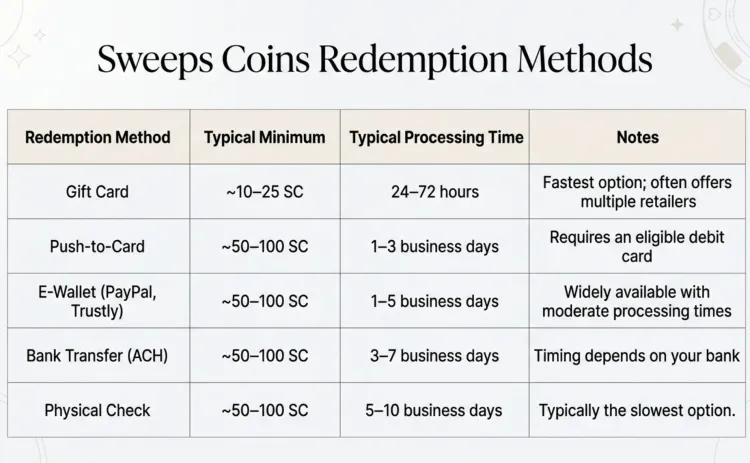
Treat these as general reference ranges rather than guarantees. Always confirm the current thresholds and timelines on your own account before submitting a request.
A Note on Tax Reporting for Larger Redemptions
If a redemption, or cumulative redemptions within a calendar year, crosses certain dollar thresholds, U.S. sweepstakes operators are generally required to collect tax information and may issue a Form 1099-MISC to report the prize to the IRS. This mirrors how other promotional prizes and sweepstakes winnings are treated under federal tax rules. It’s a routine part of running a compliant sweepstakes program, not something unique to any one platform, and it’s part of why larger redemptions sometimes ask for a Social Security number or trigger extra identity confirmation. If you’re unsure how a redemption affects your taxes, talk to a tax professional. This guide covers the redemption mechanics, not personal tax advice.
A Short Checklist Before You Submit a Redemption Request
Having a few things ready before you start tends to shave real time off the process:
- A current, unexpired government-issued photo ID that matches the name on your account exactly
- A recent proof-of-address document (utility bill or bank statement dated within the last few months)
- Confirmation that your redeemable Sweeps Coins balance, not your total balance, meets the platform’s minimum
- Accurate, up-to-date payout details for whichever method you plan to use
- A few minutes of uninterrupted time to fill out the request and confirmation screen carefully
How the Redemption Process Differs from Real-Money Gambling Payouts
This distinction is worth spelling out, because “redemption” can sound a lot like a gambling cashout, and it isn’t the same thing. Sweepstakes casinos operate under sweepstakes and promotional games law, not gambling law, and that difference shapes the entire structure of the redemption process.
In a real-money gambling setup, a player deposits actual money, wagers it, and withdraws winnings tied directly to that stake. At a sweepstakes casino, Gold Coins are obtained for entertainment only and have no redemption value at all, while Sweeps Coins are a promotional currency you can get without any purchase, through free entry methods, and redeem as prizes under sweepstakes rules rather than as gambling winnings. That’s why identity verification, eligibility checks, and no-purchase-necessary entry paths are built into the process. They’re the legal backbone of the sweepstakes model, not optional extras.
That also answers a question a lot of people ask when they first come across this model: no, using a sweepstakes casino isn’t the same as gambling in the traditional sense, and the redemption process reflects that legal difference at every step.
Learn More About How the Sweepstakes Model Works
The redemption process is just one piece of a bigger picture: how Sweeps Coins are earned, why the dual-currency structure exists, and how sweepstakes law shapes the whole experience differently from traditional gambling. If you’re new to this model, or you just want the fuller context before your first redemption, it’s worth reading up on how Sweeps Coins work and what the no-purchase-necessary entry option actually involves. A little context up front makes the whole path, from your first Sweeps Coin to your first redemption, a lot less confusing.
Key Takeaways
- The redemption process generally follows five stages: earning redeemable Sweeps Coins, meeting a minimum threshold, completing identity verification, submitting a request, and waiting for processing and payout.
- Identity verification (KYC) is a standard, one-time requirement meant to confirm you’re a real, eligible person. It’s not a hurdle unique to any single operator.
- Processing times vary by payout method, from about 24 hours for gift cards up to several business days for bank transfers or checks.
- Most delays and rejections trace back to mismatched personal information, unmet play-through requirements, or incomplete documentation, and nearly all of that is avoidable.
- Sweeps Coins redemption operates under sweepstakes promotional law, not gambling law, which is part of why the process looks different from a real-money casino cashout.
Ready for your next game? Join Golden Dragon Casino and play today.
Frequently Asked Questions
Do sweepstakes casinos pay real money?
Sweeps Coins can be redeemed for cash prizes or gift cards once they meet the platform’s redemption threshold and pass identity verification. That happens under sweepstakes law as a prize redemption, not a gambling payout. Gold Coins, the other currency most platforms use, are never redeemable for cash or prizes under any circumstance.
How long does the redemption process take?
It depends on the method. Gift cards are typically the fastest, often clearing in 24 to 72 hours. E-wallets and push-to-card payouts commonly take 1 to 5 business days. Bank transfers and checks tend to be the slowest, sometimes taking 5 to 10 business days. Weekends, holidays, and manual review on larger amounts can extend any of these windows.
How can I get free Sweeps Coins?
Sweeps Coins are typically available through gameplay rewards, ongoing promotions like login bonuses or email offers, and a no-purchase-necessary entry method that most sweepstakes operators provide because the law requires it. That alternate free entry path exists specifically so no purchase is ever necessary to participate or to become eligible for a prize.
Is a sweepstakes casino legit?
Legitimate sweepstakes casinos operate transparently under U.S. sweepstakes and promotional games law, which requires clear terms, a genuine no-purchase-necessary entry option, and identity verification before prizes go out. Having a defined redemption process, with verification steps, stated thresholds, and documented timelines, is itself one of the signs a platform is operating within that legal framework rather than outside it.
What is the difference between a sweepstakes casino and a casino?
A traditional online casino involves depositing real money and wagering it directly for a chance to win more, governed by gambling law and typically restricted to states or jurisdictions that license real-money gambling. A sweepstakes casino runs on a dual-currency model instead: Gold Coins for entertainment only, and Sweeps Coins as a promotional currency you can get without purchase and redeem for prizes under sweepstakes law. The legal framework, not just the games themselves, is what actually separates the two.
Why was my redemption request rejected?
The most common causes are mismatched personal information between your account and your ID documents, trying to redeem Sweeps Coins that haven’t cleared play-through requirements, incomplete or expired identification, or account details that trip a duplicate-account check. The “Common Reasons Redemption Requests Get Delayed or Rejected” section above covers most scenarios, and contacting support directly is the fastest way to sort out a specific case.
Once you understand how redemption works, you may want to explore the process for yourself. At Golden Dragon, you can use promo code DRAGON20 for 20% off. The code can be used once per user and is valid until January 1, 2030.
Purchase Securely With