

Sweepstakes Gaming Explained: How Sweepstakes Casinos Work
Published Oct 17, 2026
Casino
Sweepstakes gaming is an online entertainment model built on a promotional sweepstakes. Players use virtual currencies to play casino-style games, and a separate set of rules decides how a regulated prize entry can be obtained and redeemed.
That sounds like two worlds stitched together, and plenty of readers feel the same way. Most of the questions we get boil down to one: is this gambling or isn't it?
Short answer: it's designed to sit under promotional sweepstakes law, not gambling law. The longer answer involves two currencies, a free method of entry, official rules and a patchwork of state regulations that keep shifting. This guide covers all of it in plain language, so you can judge for yourself what a sweepstakes casino is and which questions to ask before you spend any time or money anywhere.
One note first. GoldenDragon.Casino is a sweepstakes casino, so we have an obvious stake in the topic. This article is educational. It isn't legal advice, it promises no outcome and it doesn't ask you to do anything. Sweepstakes games are for adults of legal age in eligible locations, and a platform's official rules always control.
Key takeaways
- Sweepstakes gaming combines casino-style entertainment with a promotional sweepstakes. It is a different thing from real-money online gambling.
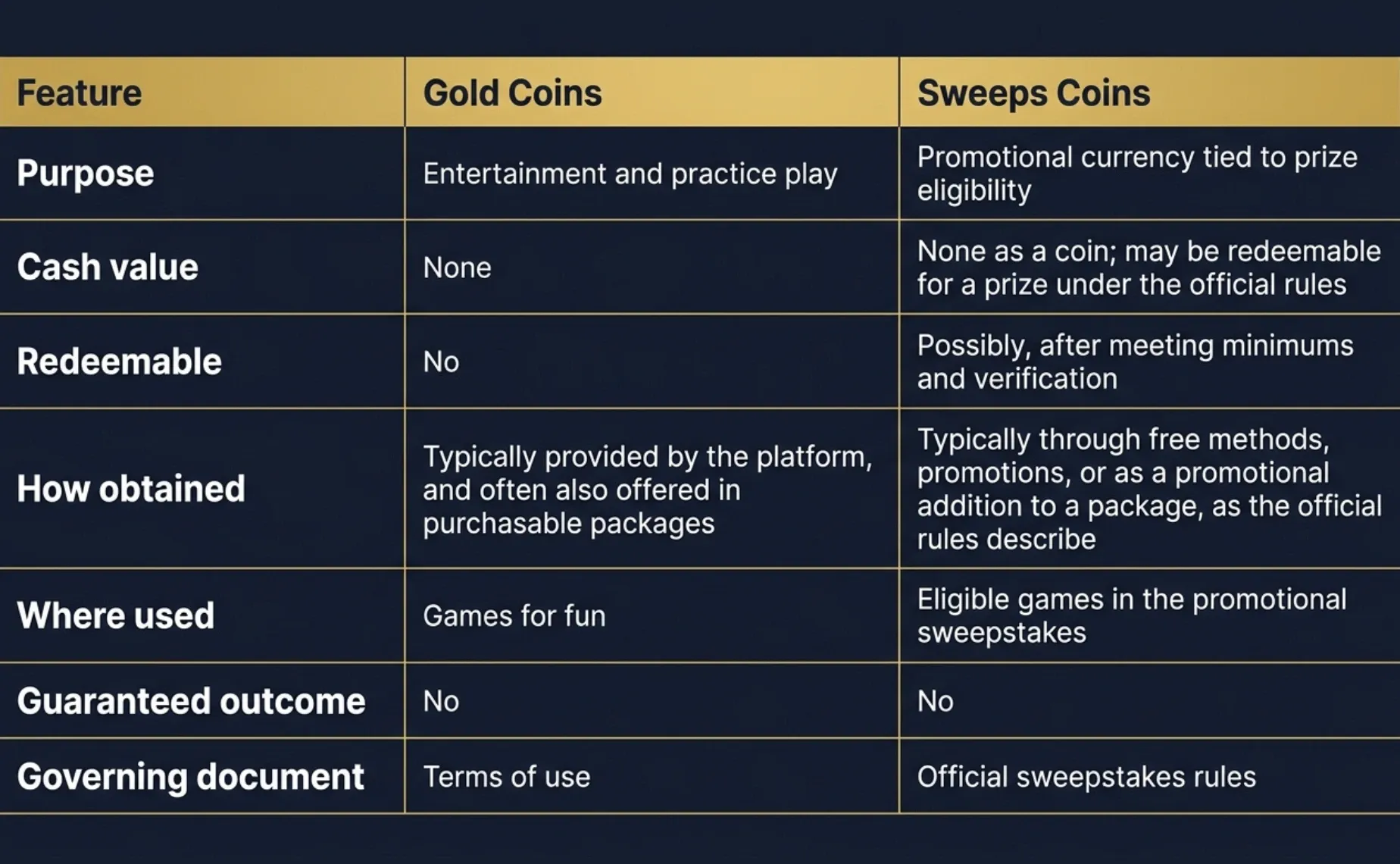
- Most sweepstakes casinos use two virtual currencies. Gold Coins are for play only, have no cash value and can't be redeemed. Sweeps Coins are promotional and may be redeemable for prizes under the official rules.
- The legal logic rests on prize, chance and consideration. A free alternative method of entry is meant to remove consideration, which is why "no purchase necessary" appears everywhere.
- Rules differ by state and can change. Some states restrict or prohibit sweepstakes casinos, and age limits apply.
- Nothing about sweepstakes gaming guarantees winnings. Treat it as entertainment, set limits and read the official rules first.
What is sweepstakes gaming?
Sweepstakes gaming uses a promotional sweepstakes to power an online game experience. The games look familiar: slot-style titles, table-style games and other casino-inspired formats. The economics underneath are different. Players use virtual currency instead of wagering cash for a chance at cash, and any prize opportunity comes through a promotion with its own published rules.
Picture a grocery store giveaway or a bottle-cap promotion. You can usually enter by buying the product, but the law requires a way to enter without buying anything. Sweepstakes gaming applies the same logic to a digital game platform. The game is the experience, and the sweepstakes is the promotion attached to it.
How does a sweepstakes casino work?
Every platform has its own interface and official rules, so details vary. The overall flow looks similar across the category. We keep it general here because specifics belong in each platform's rules, not in a blog post.
Step 1: Account and age check
Players create an account and confirm they're of legal age and in an eligible area. The age threshold depends on the jurisdiction and the platform's rules, and in many places it's 18 or 21. Eligibility is decided by state or region, so platforms often run location checks to avoid offering the promotion where it's restricted.
Step 2: Virtual currency
Players get virtual currency, usually in two types: a play-for-fun currency and a promotional currency that can be tied to prizes. The official rules spell out how each is obtained, whether through a free method, a daily promotion, a mail-in request or inside a package of play-for-fun coins. We cover both currencies below.
Step 3: Playing the games
Players pick casino-style games and use the virtual currency to play them. Chance drives the outcomes, which is one of the three elements that matter legally. On screen it can feel a lot like a conventional casino game, and that resemblance is why consumer education helps here.
Step 4: Redemption, if eligible
If a player ends up with an eligible balance of promotional currency, the official rules usually set a minimum threshold, describe the redemption process and require identity verification before any prize is released. Processing takes time, and prizes arrive by the methods the rules describe. Nothing is automatic, and nothing is guaranteed.
Gold Coins vs Sweeps Coins
The two-currency setup is the central idea in sweepstakes gaming, and the one people get wrong most often. "Gold Coins" and "Sweeps Coins" are the labels many platforms in the category use, so we use them here. Check the platform's own glossary, since naming and mechanics differ.
The legal idea behind sweepstakes games: prize, chance and consideration
Gambling law in most places uses a three-part test. Something counts as gambling when there's a prize, an element of chance and consideration, meaning something of value paid for the chance to win. With all three present, the activity is generally treated as gambling and needs a license. Remove one and you're typically outside the classic definition.
Sweepstakes involve a prize and chance by definition, so the whole question is consideration. That's where "no purchase necessary" comes in. If a participant can enter and get the same chance of winning without paying anything, consideration is absent, and the promotion can be lawful as a sweepstakes. It's why nearly every sweepstakes, from a retail giveaway to an online game platform, includes a free method of entry.
The alternative method of entry
An alternative method of entry, or AMOE, is the free way to take part. Depending on the promotion it might be a mailed request, a form or a scheduled free allotment. The legal requirement is that the free route is genuinely available and treated equally to the paid route. You should be able to find it in the official rules.
We don't describe a specific platform's mechanics here, since those belong in the rules document and can be updated.
Why legal opinions still differ
Here’s the part most explainers skip. The model is lawful in many places and contested in others. Some states have passed laws or issued guidance that restricts or prohibits sweepstakes casino models, and enforcement activity and legislative proposals have been a regular feature of the industry for years.
Courts and legislators don't always agree on whether a virtual currency package paired with promotional coins amounts to hidden consideration. That's a live legal debate, and anyone who calls it fully settled is oversimplifying.
For you, that means eligibility changes. A platform available in your region today may restrict it tomorrow. The official rules list where the promotion is void or unavailable, so recheck them whenever they're updated.
Social casino vs sweepstakes casino vs real-money casino
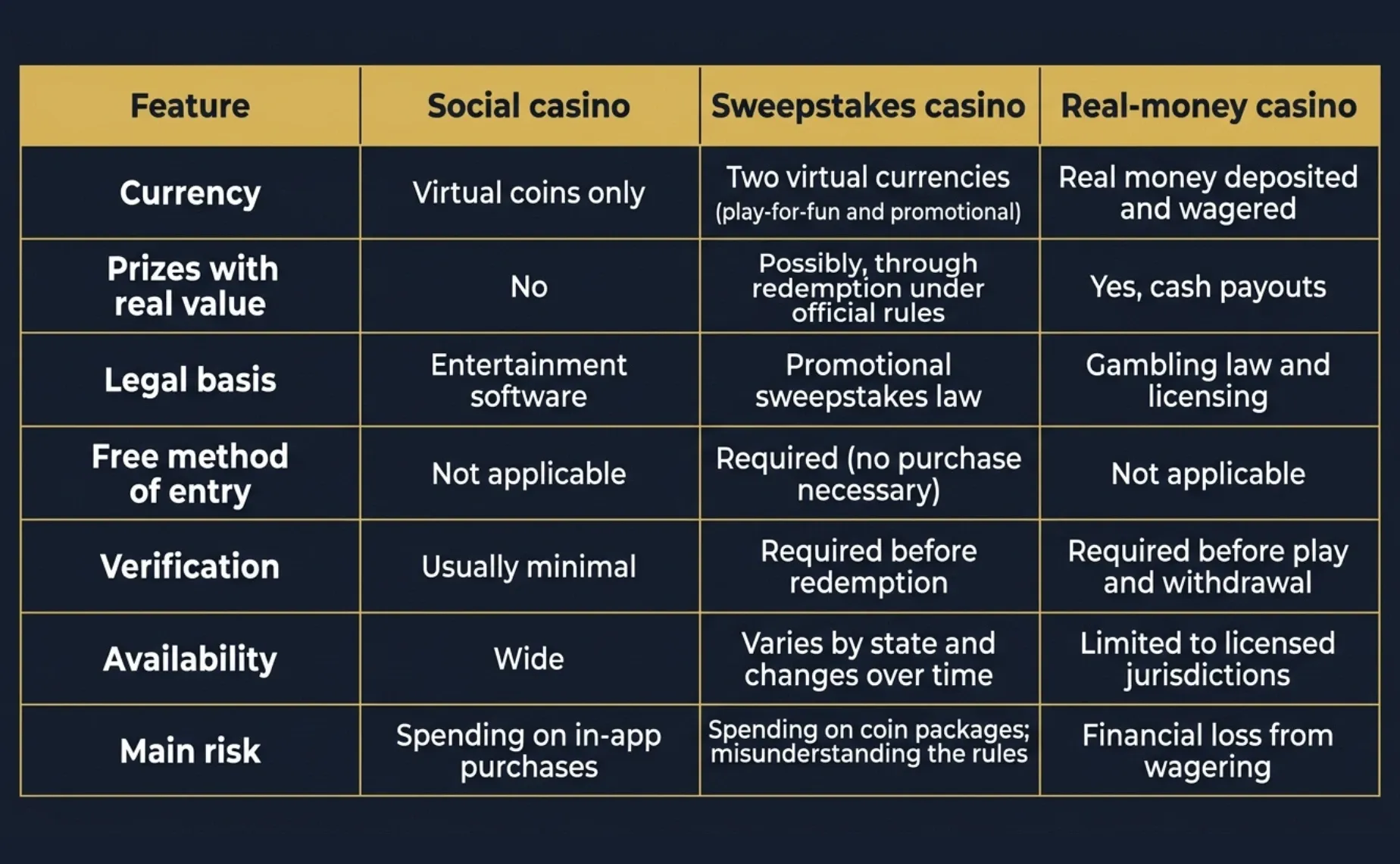
The online casino space has three broad categories, and mixing them up is the most common mistake we see. Here's a side-by-side.
Why people mix them up
Visually, the three look alike. Same slot-style reels, same sound design, same bright interface. The difference sits in the structure behind the screen.
To tell which one you're looking at, read the terms. Do they talk about deposits and wagers, or about virtual currency and official rules? Is there a sweepstakes rules document? Does it mention a free method of entry? A couple of minutes of reading sorts it out.
Promotional sweepstakes: the rules that govern the experience
The most important document on any sweepstakes casino is the official rules, and the home page comes a distant second. Those rules legally define the promotion, and they usually answer questions marketing copy skips.
What official rules usually cover
- Who is eligible, including minimum age and excluded locations
- How to enter, including the free method of entry
- The start and end dates of the promotion, or how it runs on an ongoing basis
- How prizes are determined and delivered
- Redemption thresholds, identity checks and processing times
- The sponsor's name and contact details, and how disputes are handled
- Statements about odds, taxes and limitations of liability
Use this list as a reading checklist. If a platform's rules skip most of these topics, notice that.
Verification before redemption
Verification, often called KYC (know your customer), is when a platform confirms who you are before releasing a prize. It commonly means submitting ID and confirming your address, and it can include rechecking your age and location.
Some players find it slow. It exists to prevent fraud, underage participation and account abuse, and to meet legal obligations. A platform that skipped verification entirely would be the bigger red flag.
Responsible play
Even entertainment can become a problem once it stops feeling like entertainment. Sweepstakes games run on chance, they can be engaging, and virtual currency makes spending feel less concrete than cash. Those are good reasons to build a few habits early.
Practical habits
- Set a time limit before you start, and stop when it ends.
- Decide in advance how much, if anything, you'll spend on coin packages. Treat that money as spent on entertainment, like a movie ticket.
- Remember that play-for-fun coins have no cash value and that promotional balances aren't guaranteed to be redeemable.
- Don't chase a result. A game of chance has no memory, and a past outcome doesn't change the next one.
- Never use money you need for rent, food, bills or savings.
- Take breaks, and notice whether you feel anxious, secretive or irritable about playing.
Where to get support
If playing stops feeling like a choice, talk to someone. In the United States, the National Council on Problem Gambling runs a helpline and chat service, and many states run their own support programs. Even if a product isn't technically gambling, the behaviors can feel the same, and help is available either way.
If you're under the legal age in your area, these games aren't for you.
Frequently asked questions
1. How does a sweepstakes casino work?
A sweepstakes casino offers casino-style games played with virtual currency. One currency, usually called Gold Coins, is for entertainment and has no cash value. The other, usually called Sweeps Coins, is promotional and may be redeemable for prizes if the official rules and verification steps are met. A free method of entry must be available. Details vary by platform, so the official rules are the reference.
2. Why is it called a sweepstake?
The format uses a promotional sweepstakes, which is a marketing promotion where prizes are awarded by chance and no purchase is required to take part. The word comes from older usage describing a contest where stakes were pooled and awarded, but modern law uses it for a promotion with a prize and chance and no consideration. Platforms use the name because that's the legal framework they rely on.
3. Are sweepstakes the same as gambling?
No, though they overlap. Both involve chance and the possibility of a prize. Gambling also requires consideration, meaning something of value paid for the chance. Sweepstakes are designed to remove that element through a free method of entry. Whether a given model actually achieves that is debated, and some states restrict it, so the answer depends on where you live and how the rules are written.
4. Can anyone take part?
No. Participants must be of legal age, which is commonly 18 or 21 depending on the jurisdiction and the rules, and must be located in an eligible area. Residents of excluded states can't participate.
A closing thought
Sweepstakes gaming is entertainment, and it's also a regulated type of promotion with real rules attached. The platforms that take both seriously publish clear terms, explain the free method of entry plainly and give you tools to control your own play.
If this guide raised a question, start with the official rules of whatever platform you're curious about, and read them slowly and in full. For law-specific questions, ask a licensed attorney in your state. If anything feels like it's slipping out of your control, support services exist, and reaching out is a sensible move.
Eligibility, laws and platform terms change, so treat this article as a starting point and check the current rules.
New to GoldenDragon.Casino? Use code DRAGON20 for 20% off when eligible. Limited to one use per user, valid through January 1, 2030.