
Are sweepstakes casinos regulated? Who oversees them
Published Nov 20, 2026
Casino
Key takeaways
- Sweepstakes casinos are not licensed by state gaming commissions the way traditional casinos are. They operate under sweepstakes, promotion and consumer protection law instead, which is a different kind of oversight.
- At the federal level, the FTC polices deceptive and unfair practices, the Telemarketing Sales Rule covers prize promotions sold by phone, and the US Postal Service enforces the Deceptive Mail Prevention and Enforcement Act for mailed sweepstakes.
- State attorneys general and consumer agencies enforce state promotion and gambling laws. Some states also require registration and bonding for larger prize promotions.
- As of November 2026, at least 12 states have banned or blocked the dual-currency sweepstakes casino model by statute or existing law, and enforcement letters have pushed operators out of several more.
Industry trade groups have adopted voluntary standards on age, identity and location checks, but voluntary codes are not the same as government licensing.
This article is general information, not legal advice. Laws change often, so check each platform’s official rules for its current eligible states.
Are sweepstakes casinos regulated? Yes, but not in the way most people picture. There is no single “sweepstakes casino commission” that hands out licenses and audits every operator. Instead, oversight comes from a patchwork: federal consumer protection law, state sweepstakes and promotion statutes, state attorneys general, and, increasingly, state legislatures that have decided the model does not fit their laws at all.
That patchwork confuses a lot of players. Some assume that because a site is not licensed by a gaming regulator, nobody is watching. Others assume the opposite, that a site advertising “no purchase necessary” must have government approval. Neither assumption is right.
This guide explains who actually oversees sweepstakes casinos, which rules apply, how that differs from casino licensing, and what has changed in 2025 and 2026. It is written for consumers who want to understand the system. It is not legal advice.
The short answer: regulated as promotions, not licensed as casinos
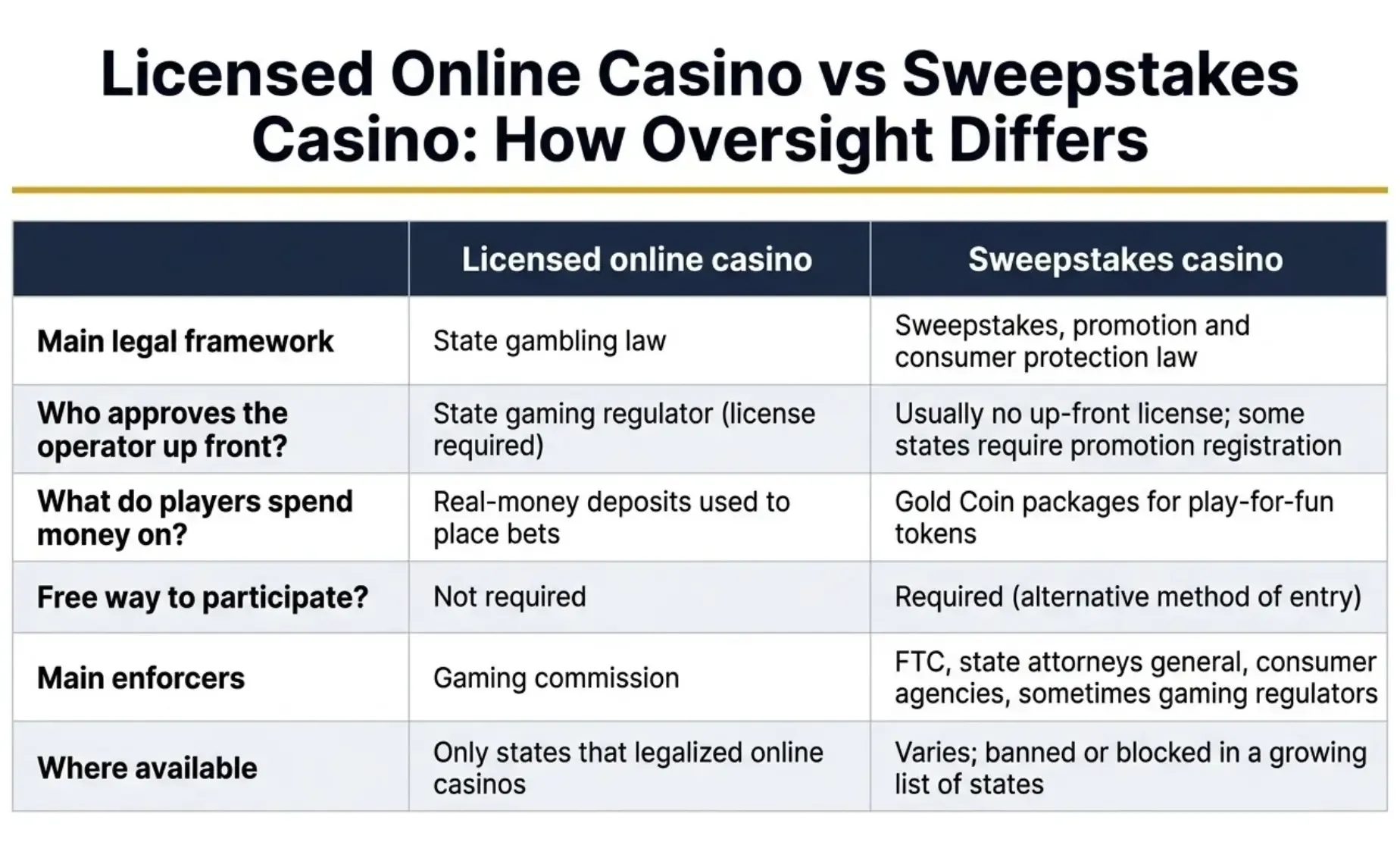
A traditional casino, online or on land, needs a license from a state gaming regulator. That regulator approves the operator, tests the games, collects gaming taxes and can fine or shut down licensees directly.
A sweepstakes casino works under a different legal theory. It offers play-for-fun Gold Coins (no cash value, not redeemable) and gives away Sweeps Coins as free promotional sweepstakes entries. Players can request Sweeps Coins without buying anything through an alternative method of entry, such as a mail-in request, and eligible Sweeps Coin balances may be redeemed for prizes under the operator’s official rules. If you want a full refresher, our guide on how sweepstakes casinos are legal walks through it.
Because the model is built to fit sweepstakes and promotion law, the rules that apply are mostly consumer protection rules. They govern things like disclosures, official rules, free entry, prize delivery and advertising. They are enforced after the fact, through investigations, lawsuits and settlements, rather than through an up-front license.
So when someone asks “are sweepstakes casinos regulated,” the precise answer is: they are subject to regulation, but in most states they are not licensed. That distinction matters a great deal when something goes wrong.
Why sweepstakes law, not gambling law, is the starting point
Almost every US state defines an illegal lottery or gambling game as one with three elements: a prize, chance and consideration. Consideration usually means paying to play. If all three are present and the state has not authorized the game, it is generally illegal.
Promotional sweepstakes stay legal by removing consideration. Attorney David O. Klein of Klein Moynihan Turco summarized it this way in a 2023 explainer: “If the element of consideration is removed, a lottery becomes a legal sweepstakes.” He also notes that people who enter through the free route must have an equal opportunity to win the same prizes as those who purchase.
That is why the free entry method sits at the center of every sweepstakes casino’s official rules. It is the legal hinge. You can read more about how it works in practice in our guide to no purchase necessary sweepstakes casinos.
The catch is that each state decides for itself whether a given promotion truly removes consideration. Some states have concluded that the dual-currency model does not, and have acted on that view. More on that below.
Federal oversight: FTC sweepstakes rules and other federal laws
There is no single federal statute written for sweepstakes casinos. But several federal laws and agencies reach sweepstakes and prize promotions generally, and they apply to online operators where their terms fit.
The FTC and Section 5 of the FTC Act
The Federal Trade Commission enforces the federal ban on “unfair or deceptive acts or practices” in commerce, found in Section 5 of the FTC Act. When people search for “FTC sweepstakes rules,” this is mostly what they are looking for. The FTC does not pre-approve sweepstakes, but it can sue companies whose promotions mislead consumers.
The best recent example is not a casino at all. In 2023 the FTC sued Publishers Clearing House, alleging it used “dark patterns” that made consumers think a purchase was required to enter its sweepstakes or would improve their odds, along with undisclosed shipping and handling fees. In 2025 the FTC sent more than $18 million in refunds to consumers from that case (Hogan Lovells, May 2, 2025). The FTC’s lottery and sweepstakes case page lists this and earlier prize-promotion cases.
The lesson for any sweepstakes operator is clear: if your design or marketing suggests that buying something is required, or that it improves the chances of winning, the FTC may treat that as deception. For players, it means the “no purchase necessary” message should be easy to find and should actually work.
The FTC also publishes consumer guidance on prize offers. Its June 2025 alert puts the core rule bluntly: “Real prizes are free. If there’s a charge, it’s a scam” (FTC consumer alert). That alert is aimed at scams where someone demands fees or “taxes” before releasing a prize, but it is a useful benchmark. Legitimate sweepstakes do not ask you to pay to claim a prize.
The Telemarketing Sales Rule
The FTC’s Telemarketing Sales Rule applies when a prize promotion is pitched by phone. It requires telemarketers to disclose the odds of receiving the prize, “that no purchase or payment is required to win a prize or to participate in a prize promotion,” and how to participate without paying. It also bans misrepresenting the odds, the nature or value of a prize, or “that a purchase or payment is required to win a prize” (16 CFR 310.3, Cornell LII).
Most sweepstakes casinos do not sell by phone, so the rule may not apply directly. But it shows how federal regulators think about prize promotions: clear odds, a real free route, and no false claims about what buying does.
The Deceptive Mail Prevention and Enforcement Act
Signed into law on December 13, 1999, the Deceptive Mail Prevention and Enforcement Act targets sweepstakes sent through the mail. It is enforced by the US Postal Service. According to a summary by law firm Olshan Frome Wolosky (Olshan), the law requires sweepstakes mailings to state clearly that no purchase is necessary and that a purchase will not improve the chances of winning. Those statements must appear in the rules, the entry or order form and the mailing itself. The rules must also disclose the sponsor’s name and address, the odds of winning each prize, and the quantity, estimated retail value and nature of each prize. The Postal Service can seek civil penalties of up to $1 million for a first offense, depending on mailing volume.
The law covers physical mail. It matters to sweepstakes casinos mainly because many of them use mail-in requests as their free entry method, and because its disclosure standards are widely used as a model for official rules generally.
FTC endorsement and advertising rules
Sweepstakes casinos often market through affiliates and social media creators. The FTC’s Endorsement Guides require that material connections between advertisers and endorsers be disclosed. An influencer who is paid to promote a sweepstakes platform, or who receives free Gold Coins or Sweeps Coins for doing so, is expected to say so clearly.
FTC Act Section 5 (FTC): covers unfair or deceptive practices, including misleading claims about purchases, odds, prizes or fees.
Telemarketing Sales Rule (FTC): covers prize promotions sold by phone, with required disclosures and banned misrepresentations.
Deceptive Mail Prevention and Enforcement Act (USPS): covers sweepstakes sent by mail, and serves as a disclosure model for official rules and mail-in entry.
FTC Endorsement Guides: cover paid endorsements and influencers, requiring disclosure of material connections in marketing.
State oversight: where most of the action is
Federal law sets a floor. The states do most of the real regulating, and they do it in several different ways.
State sweepstakes and promotion statutes
Many states have laws that govern promotional games in general. Florida is a common example. Its game promotion statute makes it unlawful “to require an entry fee, payment, or proof of purchase as a condition of entering a game promotion.” For covered promotions with total prizes over $5,000, the operator must file its rules and prize list with the state at least seven days before launch, and keep a trust account or surety bond equal to the total prize value (Fla. Stat. 849.094). Winners of prizes over $25 must be reported to the state within 60 days.
Not every promotion falls under statutes like Florida’s. Its law applies to promotions connected with selling consumer products or services and has several exclusions. Whether a particular sweepstakes casino is covered is a legal question, which is one reason operators employ lawyers who specialize in promotion law. For a broader state-by-state view, see our guide to sweepstakes laws.
State attorneys general and consumer protection
State attorneys general enforce consumer protection and gambling laws, and they have become the most active regulators of sweepstakes casinos.
Tennessee is a good example of how it works. On December 29, 2025, Attorney General Jonathan Skrmetti announced that his office had sent cease-and-desist letters to nearly forty online sweepstakes casinos. The office argued that the dual-currency model is an illegal lottery under the Tennessee Constitution and also violates state gambling and consumer protection laws. Thirty-seven named casinos agreed to disable the relevant features or shut down in the state (Tennessee AG, Dec. 29, 2025).
According to a state-by-state tracker, attorneys general in Minnesota, Illinois and Maryland have also issued cease-and-desist letters, and Louisiana’s attorney general issued an opinion that sweepstakes casinos violate state law (Sweepsy tracker). In New York, the attorney general sent cease-and-desist letters to more than two dozen platforms in June 2025, before the state passed its ban (Covers, Dec. 6, 2025).
These actions do not require a new law. An attorney general can act on existing statutes, which is why the legal map can change without any vote in the legislature.
State tax authorities
Revenue departments have also stepped in. In September 2025, Louisiana’s Department of Revenue sued two sweepstakes operators seeking about $44 million in unpaid sales taxes, interest and penalties (CDC Gaming Reports). Tax cases are a reminder that “not licensed as gambling” does not mean “outside the reach of the state.”
State legislatures and the wave of bans
The biggest regulatory change of the past two years is that legislatures stopped waiting for courts and wrote sweepstakes casinos out of the law.
As of a tracker update on November 16, 2026, these 12 states had banned or blocked the dual-currency model, either through new statutes or existing law (Sweepsy bill tracker):
California: AB 831, effective January 1, 2026
Connecticut: SB 1235, effective October 1, 2025
Idaho: existing constitutional provision
Indiana: HB 1052, effective July 1, 2026
Louisiana: HB 883 and HB 53, effective August 1, 2026
Maine: LD 2007, effective July 29, 2026
Montana: SB 555, effective October 1, 2025
New Jersey: A 5447, effective August 15, 2025
New York: S 5935A, effective December 5, 2025
Oklahoma: SB 1589, effective November 1, 2026
Tennessee: SB 2136, effective May 22, 2026
Washington: existing law (RCW 9.46.240)
The same tracker listed pending proposals in places including Washington, D.C., Ohio, Pennsylvania, Virginia and Wyoming as of its last check. This list will keep changing, so treat it as a snapshot and always check a platform’s official rules for its current eligible states.
Two of these laws show how far the new statutes reach.
California’s AB 831, signed on October 11, 2025, makes it a misdemeanor to operate or support online dual-currency sweepstakes games, with penalties of up to one year in jail and $25,000 per violation. It extends liability to payment processors, geolocation providers, game content suppliers and media affiliates that knowingly and willfully help (ZwillGen). It also preserves ordinary promotional sweepstakes tied to genuine product sales.
New York’s S5935A, signed in December 2025, bans operating or promoting online sweepstakes games and sets fines of $10,000 to $100,000 per violation, with the ban also reaching financial institutions, geolocation providers and media affiliates that support these games (Covers).
The vendor provisions are what make this wave different. Earlier enforcement focused on operators. The newer laws target the businesses around them too, which makes it much harder for an operator to keep serving a state that has banned the model. Our guide on whether sweepstakes casinos are legal covers the state picture in more depth.
How this differs from gaming commission licensing
State gaming commissions regulate licensed gambling: land casinos, sports betting and, in a limited number of states, online casino gaming. In 2024, regulated online casino gaming was legal in only seven states, according to American Gaming Association figures cited by iGaming Business (iGaming Business, June 12, 2025).
A licensed operator in those states goes through background checks, has its games tested and approved, pays gaming taxes, and reports to the regulator on an ongoing basis. The regulator can fine or suspend the license directly.
Sweepstakes casinos do not hold those licenses, and in most states they are not asking for them, because their legal position is that they are not gambling. But that does not keep gaming regulators out of the picture. When a regulator believes a platform is really offering gambling, it can act.
Michigan is the clearest example. In January 2024, the Michigan Gaming Control Board announced cease-and-desist letters to three online companies, including a sweepstakes operator, citing the state’s Lawful Internet Gaming Act, which says “internet gaming may only be offered by a licensed internet gaming operator,” and the state penal code, which “broadly prohibits any form of unauthorized gambling involving consideration, prize, and chance” (MGCB, Jan. 18, 2024). The board sent further letters to other unlicensed online casinos in February 2025, noting that some platforms use “the guise of sweepstakes” (MGCB, Feb. 12, 2025). Under Michigan law, running a gambling operation without a license is a felony.
Gaming regulators in other states have done similar things. Louisiana’s Gaming Control Board and Arizona’s Department of Gaming sent cease-and-desist orders to sweepstakes operators in 2025, according to the same state tracker (Sweepsy).
So the honest framing is this. Gaming commissions do not license sweepstakes casinos, but they can and do treat them as unlicensed gambling when they disagree with the operator’s legal theory.
The practical differences show up in timing and recourse. A gaming commission approves an operator before launch and tests its games, while sweepstakes oversight mostly happens after launch, through enforcement by the FTC, attorneys general, consumer agencies, tax departments, gaming regulators and legislatures. No regulator requires sweepstakes operators to have their games tested, though many use certified random number generator games. If something goes wrong, licensed-casino players complain to the gaming regulator, while sweepstakes players usually start with the operator, then go to a state attorney general or consumer agency, or the FTC. Penalties differ too. A gaming commission can fine, suspend or revoke a license, while sweepstakes enforcement runs through lawsuits, settlements, cease-and-desist orders and, under the new bans, criminal penalties.
Industry self-regulation: trade groups and codes of conduct
Because there is no single regulator, some sweepstakes operators formed trade groups to set shared standards and lobby lawmakers.
The Social and Promotional Games Association (SPGA) launched in September 2024 with a stated focus on “providing stakeholder education and advocating for the responsible operation of social and promotional games” (Legal Sports Report, Sept. 5, 2024). In December 2024 it adopted a code of conduct for operator members built on four pillars: age verification, identity verification, geolocation verification and anti-money laundering policies, including transaction monitoring (SBC Americas, Dec. 13, 2024).
A second group, the Social Gaming Leadership Alliance (SGLA), launched on May 20, 2025. Its stated principles include free-to-play access, responsible social gameplay, financial crime prevention and age-restricted platforms (CasinoBeats, May 21, 2025). In September 2025 the two groups merged, with the SPGA folded into the SGLA (GamblingNews, Sept. 17, 2025).
Voluntary standards are useful. They give players a sense of what responsible operators should be doing, such as verifying age and location before redemptions. But they are not law. A trade group cannot fine a member, cannot compel a non-member to do anything, and is an advocate for the industry rather than a neutral referee. Keep that in mind when you see an operator mention membership.
What regulation means for you as a player
Knowing the answer to “are sweepstakes casinos regulated” is useful mainly because it tells you where to look and who to call.
- Read the official sweepstakes rules. They should name the sponsor, explain the free entry method, describe how Sweeps Coins are awarded and redeemed, list eligible and excluded states, and set out verification requirements. Our guide on sweepstakes rules explained shows what to look for.
- Check your state. With 12 states on the banned or blocked list as of November 2026 and more bills pending, eligibility can change quickly.
- Expect verification. Identity, age and location checks before prize redemption are standard and are a sign of a careful operator, not a red flag.
- Never pay to claim a prize. The FTC’s guidance is that real prizes are free. Fees demanded to release a prize are a classic scam sign.
- Know where to complain. Start with the operator’s support team. If that fails, you can contact your state attorney general’s consumer protection office or report deceptive practices to the FTC at ReportFraud.ftc.gov.
- Play within your limits. Gold Coins have no cash value and purchases are entertainment spending. If play stops being fun, the National Council on Problem Gambling’s helpline is available 24/7 by call or text at 1-800-MY-RESET (1-800-697-3738), with chat at ncpgambling.org.
FAQs
1. Are sweepstakes casinos regulated by the government?
Yes, but mostly through consumer protection and promotion law rather than gaming licenses. The FTC can act against deceptive practices, the Postal Service enforces federal rules for mailed sweepstakes, and state attorneys general enforce state promotion, consumer and gambling laws. Several states have passed laws banning the dual-currency model, and some gaming regulators have issued cease-and-desist letters.
2. What are the FTC sweepstakes rules?
There is no single FTC rule for sweepstakes casinos. The FTC enforces Section 5 of the FTC Act against unfair or deceptive practices, such as implying a purchase is required or improves the odds. Its Telemarketing Sales Rule requires phone-based prize promotions to disclose odds and the free entry method. The FTC Endorsement Guides require paid promoters to disclose their connection.
3. Do sweepstakes casinos need a gambling license?
In most states they do not hold one, because they operate under sweepstakes law rather than gambling law. Gaming regulators may disagree. Michigan’s Gaming Control Board, for example, has sent cease-and-desist letters citing its rule that internet gaming may only be offered by licensed operators. Whether a license is needed depends on each state’s law.
4. Who enforces sweepstakes casino regulations at the state level?
Mainly state attorneys general and consumer protection agencies, plus state tax departments and, in some cases, gaming regulators. In December 2025, Tennessee’s attorney general sent cease-and-desist letters to nearly forty operators. States like Florida also have promotion statutes that require registration and bonding for larger prize promotions.
5. Which states have banned sweepstakes casinos?
As of a November 16, 2026 tracker update, 12 states had banned or blocked the model: California, Connecticut, Idaho, Indiana, Louisiana, Maine, Montana, New Jersey, New York, Oklahoma, Tennessee and Washington. Bills were pending elsewhere. Laws change often, so always check a platform’s official rules for its current eligible states.
6. Is there an industry body for sweepstakes casinos?
Yes. The Social and Promotional Games Association launched in 2024 and adopted a code of conduct covering age, identity and geolocation checks plus anti-money laundering. The Social Gaming Leadership Alliance launched in May 2025, and the two merged in September 2025. These are voluntary trade groups, not government regulators.
7. Is a sweepstakes casino the same as an unregulated offshore casino?
No. Offshore casinos typically take real-money bets without any US license or legal theory for doing so. Sweepstakes casinos sell play-for-fun Gold Coins, give Sweeps Coins away free, offer a no-purchase entry method and operate under sweepstakes law. That said, some states now treat the sweepstakes model itself as illegal, so legality depends on where you live.
8. Where can I report a problem with a sweepstakes casino?
Contact the operator’s support team first and keep records. If the issue is not resolved, you can file a complaint with your state attorney general’s consumer protection office. You can report deceptive practices or prize scams to the FTC at ReportFraud.ftc.gov. Never pay a fee to claim a prize.
Learning more about how sweepstakes oversight works
Are sweepstakes casinos regulated? They are, through a mix of federal consumer protection law, state promotion statutes, attorney general enforcement and, increasingly, outright state bans. What they lack in most states is a dedicated licensing regulator, and that gap is the reason the legal map has shifted so fast since 2025.
If you want to go deeper, our guides on sweepstakes casino laws and what a sweepstakes casino is are good next reads. Before you play anywhere, read the platform’s official sweepstakes rules and terms for current eligibility, verification and redemption details.
New to GoldenDragon.Casino? Use code DRAGON20 for 20% off when eligible. Limited to one use per user, valid through January 1, 2030.
Not legal advice: This article is for general educational purposes only and does not constitute legal advice. Laws differ by state and change frequently. For advice about your situation, consult a licensed attorney in your state.