

Fish Games Explained: How They Work & Where to Play
Published Oct 10, 2026
Casino
Key Takeaways
- Fish games are arcade-style shooting games where players use virtual "weapons" to catch fish of different point values, originally built for physical arcade cabinets in Asia before moving online.
- Unlike slots, fish games reward a mix of timing and aim alongside chance, which is part of why players describe them as feeling more skill-based.
- On a sweepstakes casino, fish games use the same Gold Coin and Sweeps Coin structure as slots, so the no-purchase-necessary sweepstakes model still applies.
- Every shot still runs on a certified random outcome system behind the scenes, even though the gameplay feels more like an arcade shooter than a traditional reel game.
- Fish point values, weapon strength, and special fish (which can trigger bonus multipliers) are the main variables that affect how a session plays out.
If you've spent time in an arcade, a boardwalk game room, or a sweepstakes gaming lounge in the last fifteen years, there's a decent chance you've walked past a table with a cartoonish underwater scene on the screen and a row of players aiming little cannons at swimming fish. That's a fish game, and it has quietly become one of the most popular categories in the sweepstakes and arcade gaming space, often sitting right alongside slots in the same game library without getting nearly as much explanation. Here's what's actually going on under the hood.
Where Fish Games Came From
Fish games, sometimes called fish tables or fish arcade games, trace back to physical arcade cabinets that became popular in parts of Asia in the early 2000s before spreading to arcades, game rooms, and eventually sweepstakes parlors across the United States. The original cabinets were literally built as tables, often with a wide horizontal screen and multiple seats around the edges so a group of players could shoot at the same shared screen of fish at once. Want the full story behind the name? Read what fish table games are.
That multiplayer, shared-screen format is part of what made fish games stand out from slots in the first place. A slot machine is a solitary experience; you spin, you watch your own reels. A fish table is social by design. Everyone at the table sees the same fish, and there's a bit of friendly competition in who lands the big one.
As online and sweepstakes gaming grew, fish games made the jump to digital platforms. The social, shared-table format has mostly given way to single-player or smaller-scale online versions, but the core shooting mechanic, the fish variety, and the visual style carried over directly.
By the mid-2010s, fish tables had become a fixture in game rooms and sweepstakes parlors across states like North Carolina, Florida, and California, often sitting alongside slot-style cabinets. Operators liked them because a single table could seat several paying players at once; players liked them because the shared screen turned a solo gambling-style activity into something closer to a group arcade outing. That social DNA is still visible in how fish games are marketed today, even in their single-player online form, with vibrant underwater scenes, cartoon-style fish, and an arcade sound design that leans more "boardwalk" than "casino floor."
How Fish Games Actually Work
The basic loop in a fish game is straightforward:
- You select a weapon (often a cannon, torpedo, or similar virtual tool) and a bet level, which determines how many coins each shot costs and how much a hit is worth.
- Fish swim across the screen in different sizes, speeds, and patterns. Smaller, faster fish are usually worth less; larger, slower-moving fish are usually worth more.
- You aim and fire at a fish. If your shot "catches" it, based on the game's underlying hit calculation, you're credited with coins equal to that fish's point value multiplied by your bet level.
- Special fish, like a boss fish, a golden fish, or a dragon-style creature depending on the game, often carry bonus multipliers, special effects (such as freezing or lightning that hits multiple fish at once), or trigger a bonus round.
Here's the part that surprises a lot of first-time players: even though it feels like you're aiming and the outcome feels tied to your reflexes, the actual result of whether a shot "catches" a fish is still determined by a random outcome system behind the scenes, similar in spirit to the RNG in a slot machine. Your aim determines whether your shot is even eligible to hit a given fish, but the catch probability for that fish, and the payout if it lands, is governed by the game's programmed odds, not purely by marksmanship. This is why two players shooting at the exact same fish can get different results even with similar timing. Curious how that same random outcome system works behind a slot spin? Our guide on how online slot machines work explains RNG, RTP, and certification step by step.
That said, there is a real skill layer that doesn't exist in slots: target selection. Choosing which fish to aim at, when to save ammunition for a high-value target, and when to spread shots across a school of smaller fish is a decision you're making in real time, which is part of why fish games feel more interactive than spinning a reel and waiting.
Fish Games vs. Slots: What's Actually Different
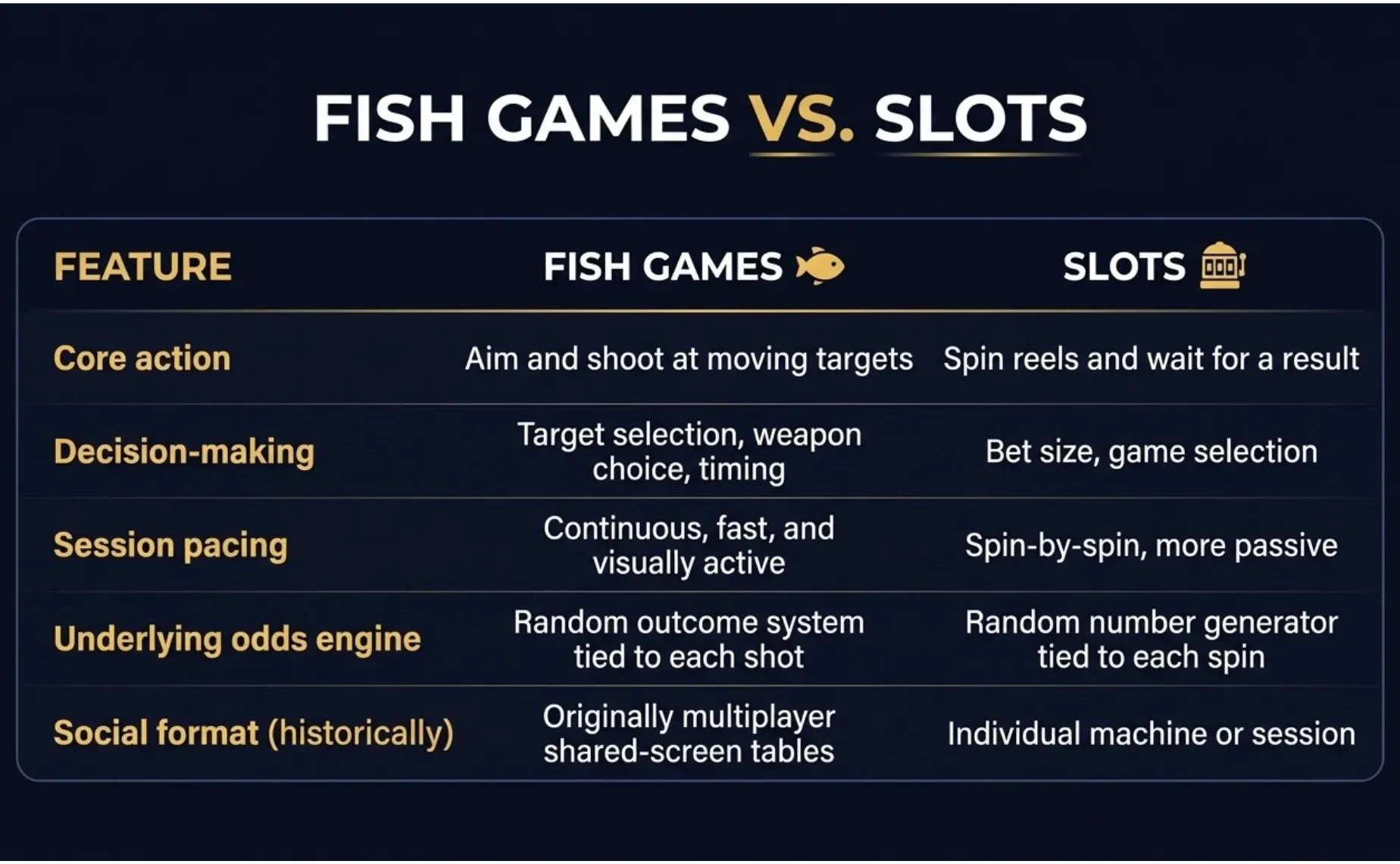
Neither format is inherently "better." Some players find the active aiming of fish games more engaging, while others prefer the simplicity of a slot where you don't need to track moving targets. It largely comes down to personal preference for pacing and interactivity.
How Fish Games Fit Into the Sweepstakes Model
On a sweepstakes casino, fish games sit inside the same Gold Coin and Sweeps Coin structure as every other game in the library. Gold Coins let you play fish games for fun, without any prize element attached. Sweeps Coins, which are distributed through no-purchase-necessary methods, promotions, or as a bonus alongside optional Gold Coin packages, carry the chance at a prize redemption according to the platform's official rules.
This matters because fish games can sometimes feel like a more "serious" or skill-based pursuit given the active gameplay, but the legal structure underneath them is identical to any other game on a sweepstakes platform. No purchase is required to obtain Sweeps Coins or to have a shot at winning, which is the core requirement that keeps sweepstakes gaming distinct from traditional real-money gambling in most states. Not sure what that free-entry rule means? Read our guide to no purchase necessary at sweepstakes casinos.
Understanding Fish Point Values and Weapon Tiers
Most fish games organize their fish into a rough hierarchy, and getting familiar with it helps you make better decisions mid-session:
- Small, fast schooling fish: Low point value individually, but they move in groups, so a wide-area shot can sometimes catch several at once.
- Mid-size fish: Moderate point value, slower movement, generally the most consistent target for steady coin accumulation.
- Large or "boss" fish: High point value, often require multiple hits or a stronger weapon tier to catch, and may carry bonus multipliers.
- Special/bonus creatures: These trigger unique effects such as freezing the screen, chain lightning across multiple fish, or a bonus mini-round, and they tend to appear less frequently.
Weapon tiers typically cost more coins per shot but increase your hit probability and damage against larger fish. Choosing a stronger weapon against small, low-value fish usually isn't an efficient use of coins. Matching your weapon tier to your target is one of the more useful habits to build early.
A Few Practical Observations From Watching How Players Actually Play
A pattern shows up often enough to be worth mentioning: newer players tend to spray shots at anything that moves, while more experienced players wait, track a specific higher-value fish as it crosses the screen, and commit their shots to that window. The second approach tends to make a coin balance last longer, simply because it's not burning ammunition on low-value targets that barely cover the cost of the shot.
Another observation: bonus rounds and special fish events are the moments that swing a session the most. If a game has a visibly building bonus meter or a "boss fish approaching" indicator, it's often worth holding back a bit of your coin balance so you have something left to spend when that moment arrives, rather than running low right before it.
There's also a pacing difference worth noticing between fish games and slots that affects how a coin budget holds up. A slot spin takes a couple of seconds and then waits for your next input, which naturally builds in a pause. A fish game screen is constantly active, with fish swimming across continuously, which can make it easy to keep tapping the fire button almost absentmindedly. Being aware of that tendency, and consciously pausing between bursts of shots rather than firing continuously, tends to stretch a coin balance further and keeps the session feeling like a deliberate choice rather than a reflex.
Bonus Rounds, Multipliers, and Special Events
Most fish games build in some kind of escalating event beyond the base shoot-and-catch loop, and understanding how these work changes how you'd approach a session. A few formats that show up across different titles:
- Boss fish encounters: A large, high-value creature appears periodically, often announced with a visual cue or a timer. It usually absorbs multiple hits before being caught, and the final hit that catches it can pay out to every player who contributed damage in a multiplayer version, or simply to you in a single-player one.
- Multiplier fish: Certain fish, often visually distinct (gold-colored, glowing, or a specific species), apply a multiplier to your next catch or to all catches for a short window.
- Chain or area-effect weapons: Some weapon tiers unlock effects like chain lightning or a freeze zone that can catch multiple fish from one shot, which is useful when a school of smaller fish clusters together.
- Jackpot or progressive events: Less common, but some fish game titles tie a rare catch to a jackpot-style payout that builds over time across many players' sessions.
None of these events are things you can force to happen through particular button-pressing patterns. They're built into the game's event timing and odds, similar to how a slot's bonus round is triggered by a programmed probability rather than anything the player does beyond placing a bet.
Managing Your Coins in a Fish Game Session
The core budgeting advice that applies to slots applies here too, with a couple of fish-game-specific wrinkles. Because you're choosing a weapon tier, your "bet size" isn't fixed the way it is on a single slot spin; it changes shot to shot if you switch weapons. A few habits worth building:
- Start a new title on a lower or mid-tier weapon until you've got a feel for the fish point values and how often shots actually catch at that tier.
- Reserve a portion of your coin balance rather than spending it all early, especially if the game shows a visible boss fish timer or event meter building toward something.
- Resist the urge to immediately upgrade to the strongest weapon just because it's available. A stronger weapon costs more per shot, and if you're mostly catching small fish, the extra cost per shot often isn't worth the marginal improvement in catch rate for low-value targets.
- Treat a "cold" stretch where shots aren't landing the same way you'd treat a dry spell on a high-volatility slot: it's part of the game's built-in variance, not a sign that something's wrong or that you need to increase your weapon tier to "break through."
New to GoldenDragon.Casino? Use code DRAGON20 for 20% off when eligible. Limited to one use per user, valid through January 1, 2030.
Fish Games on Mobile Devices
Fish games translate reasonably well to touchscreens, since aiming and firing maps naturally to tapping or dragging on a mobile screen. That said, the original arcade-cabinet format relied on a joystick-style aiming mechanism and a physical trigger button, which gave players a bit more precision than a finger on glass typically allows.
If you're playing on a smaller phone screen, it's worth spending a few minutes with the settings menu, since many fish game titles let you adjust aim sensitivity or switch between tap-to-fire and drag-to-aim controls. Getting this calibrated to your preference before a real session makes a noticeable difference in how often your shots land where you intended.
Is a Fish Game Skill-Based or Chance-Based?
This question comes up a lot, partly because the active aiming makes fish games feel more skill-driven than a slot. The honest answer is that it's a hybrid. Target selection, weapon management, and timing are genuine skills that affect how efficiently you use your coin balance. But the actual catch outcome for any individual shot, meaning whether that specific shot results in a successful catch and payout, is still determined by a certified random outcome system running behind the visual aiming layer.
This is similar to how a claw machine at an arcade has a visible, physical "skill" element (steering the claw) sitting on top of a mechanism that's often tuned to a specific win probability regardless of how precisely you steer. Fish games aren't rigged in that sense, since the odds are disclosed and certified rather than hidden, but the principle of a visible skill layer sitting on top of a probability-based outcome is a useful way to think about the category.
Common Questions First-Time Players Have
A few things that trip up players who are new to the genre:
"Why didn't my shot register a catch even though it clearly hit the fish?" Visual contact with a fish doesn't guarantee a catch. The underlying odds system determines the actual catch probability for that fish and weapon combination, so a visual hit and a successful catch aren't always the same thing.
"Does a stronger weapon guarantee bigger fish?" A stronger weapon improves your odds against bigger fish and often deals more damage per shot, but it doesn't guarantee a catch on any single shot.
"Are the fish moving in a set pattern I can learn?" Movement paths are generally randomized or semi-randomized within set behavior rules, so while you can learn general tendencies (schooling fish tend to cluster, boss fish tend to move slower), it's not a fixed, learnable pattern you can exploit.
Frequently Asked Questions
What are fish table games?
Fish table games are arcade-style games where players use a virtual weapon to shoot at fish of varying point values on screen, earning coins based on which fish they catch. They originated as physical arcade cabinets and have since become a popular category on online sweepstakes casino platforms.
Is sweepstakes gaming the same as gambling?
No. Sweepstakes gaming, including fish games, operates under a no-purchase-necessary model where a free path to obtain Sweeps Coins and win a prize is always available, which removes the "payment to play" element that defines gambling under most state laws.
How does sweepstake casino work with fish games specifically?
The same way it works for any other game on the platform: Gold Coins let you play fish games for fun with no prize attached, while Sweeps Coins, obtained through promotions, bonuses, or no-purchase-necessary methods, can be redeemed for a prize if you win, according to the site's official rules.
Do fish games use an RNG like slots?
Fish games use a certified random outcome system to determine catch probability on each shot, which serves a similar role to the RNG in a slot. The visible aiming and shooting adds a layer of player decision-making that slots don't have, but the underlying odds are still governed by tested, certified software.
What is the most popular sweepstakes casino game type?
Slots tend to make up the largest share of most sweepstakes casino libraries simply due to sheer variety, but fish games have built a dedicated following, particularly among players who enjoyed physical arcade fish tables before the format moved online.
What casino game has the best odds in a sweepstakes library?
Odds vary by individual game rather than by category, so a particular fish game title isn't automatically better or worse than a particular slot title. The published RTP or payout information for each specific game is the more reliable way to compare, rather than assuming one entire category beats another.
What is a sweepstakes casino?
A sweepstakes casino is a gaming platform that offers casino-style games, including slots and fish games, using Gold Coins for play-for-fun gaming and Sweeps Coins for a sweepstakes-style chance at a prize, operating under sweepstakes and promotional law rather than traditional gambling law.
Summary
Fish games bring something genuinely different to the sweepstakes gaming world: an active, aim-and-shoot format with real decisions to make about targets and weapons, built on top of the same certified random outcome principles that govern slots. They run on the same Gold Coin and Sweeps Coin structure as the rest of a sweepstakes casino's library, which means the no-purchase-necessary model and prize redemption rules apply exactly the same way. If you're curious about the format, trying a few titles in Gold Coin mode first is the easiest way to get a feel for the pacing before deciding how you want to spend your Sweeps Coins. Ready to try a few titles? Here’s how to get free Sweeps Coins, step by step.