Blog
What Are Fish Table Games? A Complete Explainer
Casino
- Key Takeaways
- Where the Name "Fish Table" Comes From
- What Actually Happens When You Play
- Fish Categories and What They're Worth
- Single-Player Online Versions vs. the Original Multiplayer Tables
- How Fish Table Games Fit the Sweepstakes Currency Model
- Terminology You'll See Across Different Fish Table Games
- How Odds and Payout Percentages Work in a Fish Table Game
- Common Mistakes New Players Make
- Choosing a Fish Table Title That Fits How You Want to Play
- How Fish Table Games Spread Across the U.S.
- Why Some Players Prefer Fish Table Games Over Slots
- Setting Expectations Before Your First Session
- Frequently Asked Questions
- 1. What are fish table games?
- 2. How does sweepstake casino work?
- 3. Why is it called a sweepstake?
- 4. Are fish table games legal?
- 5. What is an RNG game, and do fish table games count?
- 6. Sweepstakes casino slots vs fish table games: what's the difference?
- 7. How can I get free sweeps coins to try a fish table game?
- 8. Do fish table games pay out differently than slots?
- Summary
Key Takeaways
- A fish table game is an arcade-style shooting game, originally built into physical multiplayer cabinets called "tables," where players earn coins by catching on-screen fish worth different point values.
- The "table" in the name refers to the original cabinet furniture: a wide, flat-screen unit with seating around it for several players at once.
- Modern online versions, including those on sweepstakes casinos, keep the same scoring and weapon mechanics but are usually played solo rather than at a shared physical table.
- Fish table games use a certified random outcome system to decide catch results, even though the on-screen aiming makes them feel more skill-driven than a slot.
- On a sweepstakes platform, fish table games run on the same Gold Coin and Sweeps Coin system as every other game, so the no-purchase-necessary sweepstakes rules apply equally.
"Fish table" is one of those terms that makes a lot more sense once you know where it came from. If you've only ever seen the name on an app or a sweepstakes casino's game menu, it probably reads like a strange combination of words, somewhere between a furniture catalog and an aquarium exhibit. Once you've seen an actual fish table cabinet, or watched someone play one in an arcade, the name explains itself almost immediately, and the rest of the terminology around the genre starts to make a lot more sense too.
Where the Name "Fish Table" Comes From
The original fish table games were built as physical arcade furniture: a wide, flat cabinet, often large enough to seat four, six, or even eight players around its edges, with a shared horizontal screen in the middle showing an underwater scene full of swimming fish. Each seat had its own control panel, typically a joystick for aiming and a trigger button for firing, wired into the same shared game.
That's the literal "table": a piece of furniture shaped like a table, with a game built into the screen in the middle. The format first became popular in arcades and game rooms in parts of Asia in the early 2000s, then spread into Chinatown arcades, boardwalk game rooms, and eventually sweepstakes parlors across the U.S. by the 2010s. As the format moved online and onto sweepstakes casino platforms, the physical table disappeared, but the name, the shared underwater art style, and the shooting mechanic all carried over.
What Actually Happens When You Play
Strip away the arcade history and a fish table game breaks down into a fairly simple loop, repeated continuously while fish swim across the screen:
- Pick a weapon. Different weapon tiers (often labeled by strength or by a themed name like cannon, torpedo, or laser) cost different amounts of coins per shot and have different hit power against fish.
- Aim and fire. You target a specific fish as it moves across the screen. Fish vary in size, speed, and swimming pattern, which affects how easy they are to track and hit.
- The game resolves the shot. Behind the visual effect of your shot connecting, a random outcome system determines whether that specific shot results in a successful catch, based on the fish's assigned catch probability and your weapon's strength.
- You're credited coins. A successful catch pays out based on that fish's point value multiplied by your current bet level, sometimes with a bonus multiplier if the fish was a special type.
The visual presentation (cartoon fish, cannons, explosions, underwater scenery) is really a skin over a probability-based payout system, similar in concept to a slot machine's reels and symbols. The difference is that a fish table gives you an active role in choosing targets and timing, whereas a slot just asks you to press spin and watch.
Fish Categories and What They're Worth
Most fish table games sort their fish roster into a rough tier system, and recognising it helps make sense of why some fish are worth chasing and others aren't:
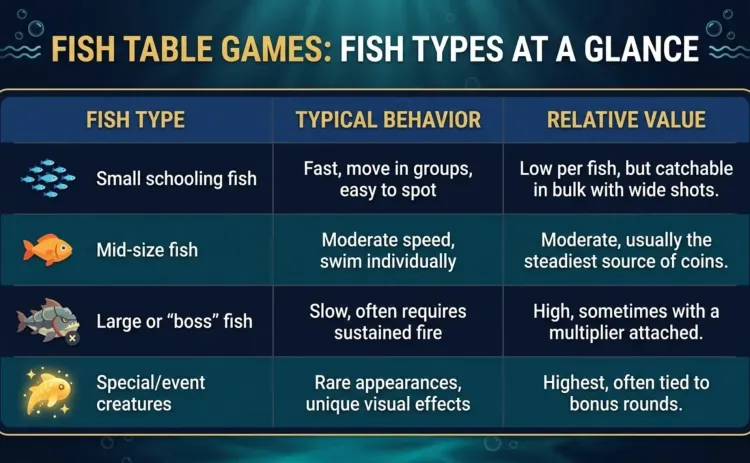
Weapon strength interacts with this tier system. A weak weapon against a boss fish might barely register a dent, while a top-tier weapon against small schooling fish is often an inefficient use of coins since the payout per fish doesn't scale with the extra cost per shot. Matching weapon tier to target type is the closest thing to a core strategy in this genre.
Single-Player Online Versions vs. the Original Multiplayer Tables
It's worth being specific about what changed when fish table games moved online, since the term gets used for both formats and that causes some confusion. The original cabinets were genuinely multiplayer: everyone at the table shot at the same shared screen of fish, and a boss fish catch sometimes paid out to whichever player landed the final hit, or split credit among everyone who'd damaged it.
Most online and sweepstakes casino versions of fish table games are single-player, even though they keep the same visual language and scoring system. You get your own screen, your own fish, and your own results, without competing against other players for the same targets. Some platforms have experimented with online multiplayer fish tables that recreate the shared-screen feel digitally, but the single-player format is far more common in sweepstakes casino libraries today.
How Fish Table Games Fit the Sweepstakes Currency Model
On a sweepstakes casino, a fish table game is just another title in the library, governed by the same two-currency structure as everything else:
- Gold Coins let you play fish table games purely for entertainment, with no prize attached to the outcome.
- Sweeps Coins carry the sweepstakes prize element. They're obtained through no-purchase-necessary methods described in the platform's official rules, through promotions, or as a bonus gift alongside an optional Gold Coin purchase, and they can be redeemed for a prize if you win.
This structure is what keeps fish table games, like every other game on the platform, operating under sweepstakes and promotional law instead of traditional gambling law in most states. The legal distinction hinges on the fact that no payment is required to obtain a chance at winning, not on what the game looks like or how it's played.
Terminology You'll See Across Different Fish Table Games
A short glossary helps when you're jumping between different fish table titles, since developers don't always use identical terms:
- Ammo or shots: The ammunition consumed per use of your weapon, usually tied directly to your coin cost per shot.
- Catch rate / hit rate: An informal way players describe how often their shots are successfully catching fish during a session, though it's not usually a number the game displays directly.
- Boss fish / king fish: The largest, highest-value creatures in a given title, often tied to a build-up event or timer.
- Freeze / bomb / chain weapons: Special weapon types that can affect multiple fish at once rather than a single target.
- Multiplier fish: Fish that, when caught, apply a temporary payout multiplier to subsequent catches.
How Odds and Payout Percentages Work in a Fish Table Game
Every fish in a fish table game has an assigned catch probability and a point value, and together these determine the game's overall return-to-player math, in the same conceptual sense that a slot's symbol weights and paytable determine its RTP. A small, low-value fish might have a relatively high catch probability but pay very little when caught. A boss fish might have a low catch probability per shot but pay enough to offset dozens of missed attempts when it finally lands.
This is why point-chasing without any sense of the underlying math can be misleading. Catching ten small fish might feel productive because the catch animations keep triggering, but the actual coin return from those ten catches could easily be smaller than a single successful hit on a mid-tier fish. Reputable platforms have this balance tested and certified by independent labs before launch, the same way slot RTPs are verified, so the numbers behind the visuals aren't arbitrary even if the game doesn't display a running RTP figure the way some slots do.
Common Mistakes New Players Make
- Firing constantly without tracking a specific target. Spraying shots at whatever crosses the screen burns coins quickly without the efficiency of tracking a specific fish through its movement path.
- Jumping straight to the strongest weapon. A higher weapon tier costs more per shot. Using it against fish whose point value doesn't justify the cost is one of the fastest ways to drain a coin balance without much to show for it.
- Ignoring the weapon-to-fish matchup. Every title has some version of a tier system where certain weapons are notably more efficient against certain fish sizes. Learning this for a specific game before committing serious coins pays off.
- Assuming a visual hit always means a catch. As covered above, the catch result is probability-based, so a shot that visually connects doesn't guarantee a payout.
- Playing a brand-new title at a high bet level immediately. Starting at a lower bet level while you learn a specific game's fish values and event timing is a more sustainable way to explore a new release.
Choosing a Fish Table Title That Fits How You Want to Play
Sweepstakes casino game libraries often carry several different fish table titles, and they're not interchangeable. A few things worth comparing before settling on one as a regular game:
- Fish variety and visual clarity. Some titles use a busier screen with many overlapping fish, which can be harder to track; others use a cleaner layout with clearer separation between fish types.
- Bonus event frequency. Titles differ in how often boss fish or special events appear. If you enjoy the anticipation of a building event, look for games that advertise or visibly display an event meter.
- Weapon variety. Some games offer a simple two or three weapon tier system; others have a more elaborate progression with special effect weapons like freeze or chain lightning built in from an early tier.
- Pacing. Faster-paced titles with constant fish movement suit players who want nonstop action; slower-paced ones give you more time to plan each shot.
Trying two or three different titles in Gold Coin mode during the same session is a quick way to figure out which style actually suits you, rather than committing to the first fish table game you happen to open.
How Fish Table Games Spread Across the U.S.
The format's growth in the United States followed a fairly specific path. It first took hold in arcades and game rooms with significant Asian immigrant communities, where the cabinets were already familiar, before spreading into general-audience game rooms and eventually sweepstakes parlors in states including North Carolina, Georgia, Florida, and California. By the time online sweepstakes casinos became widespread, fish table games were already a known, trusted category rather than something platforms had to introduce from scratch, which is a big part of why they're now a standard inclusion in most sweepstakes casino libraries rather than a niche add-on.
Why Some Players Prefer Fish Table Games Over Slots
This comes down to pacing and involvement more than anything mathematical. A slot asks you to make one decision (bet size) and then watch a result unfold automatically. A fish table game asks you to keep making small decisions throughout: which fish to target, when to switch weapons, whether to save coins for an approaching boss fish event. For players who find slots a little too passive, that constant stream of small choices is the appeal.
It's worth being honest, though, that this sense of control is partial. You're choosing targets and timing, but the actual catch outcome for any individual shot still runs through the same kind of certified random outcome system that governs a slot spin. The skill is real, but it's a skill of efficient decision-making and coin management, not a skill that overrides the underlying odds on any given shot.
Setting Expectations Before Your First Session
A reasonable first session with any new fish table title looks less like a strategy and more like calibration. Spend the first stretch of play in Gold Coin mode, if it's available, and resist the instinct to chase the biggest fish on screen right away. Watch how often small and mid-tier fish get caught at the base weapon level, note roughly how long a boss fish event takes to build, and pay attention to whether the game's pacing feels too fast, too slow, or about right for how you like to play.
Once you've got a feel for those basics, switching to Sweeps Coins for an actual shot at a prize redemption is a more informed decision than jumping in cold. This mirrors the same logic that applies to trying a new slot before committing serious coins to it: a few minutes of low-stakes observation tends to save a lot of wasted coins later, and it turns what could be a frustrating guessing game into something closer to an informed choice.
New to GoldenDragon.Casino? Use code DRAGON20 for 20% off. Limited to one use per user, valid through January 1, 2030.
It's also worth remembering that, like any sweepstakes game, fish table games are built for entertainment first. The aiming, the boss fish events, and the weapon upgrades are genuinely fun mechanics on their own, independent of whatever Sweeps Coins might be in play. Treating a session as a form of digital arcade entertainment, rather than a task to be optimized, tends to produce a healthier and more enjoyable relationship with the games overall.
Frequently Asked Questions
1. What are fish table games?
Fish table games are arcade-style games, originally built into shared physical cabinets called tables, where players use a virtual weapon to shoot and catch on-screen fish of varying point values for coins. Online and sweepstakes casino versions keep the same scoring and shooting mechanics in a typically single-player format.
2. How does sweepstake casino work?
A sweepstakes casino offers games, including fish table games and slots, using two currencies: Gold Coins for play-for-fun gaming with no prize attached, and Sweeps Coins, obtained through no-purchase-necessary methods or promotions, which can be redeemed for a prize under the platform's official rules.
3. Why is it called a sweepstake?
The term "sweepstakes" comes from traditional prize promotions where entrants compete for a prize pool without having to pay to enter, a format long used in contests and giveaways. Sweepstakes casinos apply that same no-purchase-necessary legal structure to casino-style games like slots and fish table games.
4. Are fish table games legal?
Fish table games offered through a properly structured sweepstakes casino, where Sweeps Coins are never sold directly and a free, no-purchase-necessary path to obtain them always exists, generally operate under sweepstakes and promotional law in most states, rather than gambling law, which is a separate legal category with its own licensing requirements.
5. What is an RNG game, and do fish table games count?
An RNG game relies on a random number generator, or a similar certified random outcome system, to determine results. Fish table games qualify, even though the shooting mechanic makes them feel different from a slot, because the catch probability behind each shot is still governed by tested, certified odds rather than pure player skill.
6. Sweepstakes casino slots vs fish table games: what's the difference?
Both run on the same Gold Coin and Sweeps Coin structure and the same certified random outcome principles, but slots are a passive, spin-and-wait format, while fish table games involve active aiming, target selection, and weapon choice throughout the session.
7. How can I get free sweeps coins to try a fish table game?
Platforms typically offer several no-purchase-necessary ways to obtain Sweeps Coins, including daily login bonuses, mail-in or email entry requests described in the official rules, and occasional social media promotions. Bonus Sweeps Coins are also commonly included as a promotional gift alongside optional Gold Coin package purchases, though the coins themselves are never sold outright.
8. Do fish table games pay out differently than slots?
The payout mechanics look different on the surface, since fish table games pay based on which specific fish you catch rather than which symbols land on a payline, but both formats are governed by certified, tested odds behind the scenes. Neither format inherently pays more or less than the other; it depends on the specific game's programmed math.
Summary
A fish table game is, at its core, an arcade shooting game dressed up with fish, point values, and the occasional boss-fish event, descended directly from multiplayer arcade cabinets that gave the genre its name. The online and sweepstakes casino versions keep that DNA intact while trading the shared physical table for a single-player screen. Whether you're drawn to the active aiming or you'd rather stick with a slot's simpler spin-and-wait format, the legal and currency structure underneath is the same: Gold Coins for fun, Sweeps Coins for a no-purchase-necessary shot at a prize.
If you're new to the genre, spending some time in Gold Coin mode first is the easiest way to get a feel for a specific title's fish values and weapon tiers before deciding how to use your Sweeps Coins.
The name might sound a little odd out of context, but once you've seen the arcade cabinets that started it all, or spent ten minutes aiming at a school of digital fish on your phone, "fish table" stops being a strange term and starts being a pretty accurate, almost literal, description of exactly what you're looking at: a table, built for a game about catching fish.
Not sure how to get Sweeps Coins without buying anything? Here’s how to get free Sweeps Coins, step by step.
Purchase Securely With