Blog
How to Play Online Slots: A Beginner’s Guide to Reels, Paylines, and RNG

Casino
- Key takeaways
- What an online slot actually is
- The core mechanics: what happens when you play
- Choosing your bet size and coin value
- Paylines versus ways-to-win
- Spinning and autoplay
- Playing on mobile versus desktop
- Bonus rounds and special symbols
- Understanding RNG: what makes each spin fair
- RTP and volatility: what the numbers actually mean
- How sweepstakes casino slots work
- Playing your first online slot: a practical walkthrough
- Common mistakes beginners make
- Responsible play
- Frequently asked questions
- 1. What are sweepstake slots?
- 2. What is sweepstakes casino slots, exactly, compared to a regular online slot?
- 3. What is an RNG game?
- 4. How does a sweepstakes casino work?
- 5. Do sweepstakes casinos pay real money?
- 6. What do paylines mean on a slot?
- 7. What is an RTP percentage?
- 8. What is slot volatility?
- 9. Do I need to download anything to play online slots?
- Learn more about how the sweepstakes model works
Every online slot looks the same at first glance: spinning reels, a row of symbols, a button to press. What’s actually happening behind that spin is less obvious, and it’s the part most beginners skip past on their way to clicking “spin.” Once you understand how to play online slots at the mechanical level (how outcomes are generated, what a payline actually does, why some games pay small and often while others sit quiet for a while), the whole experience stops feeling like guesswork.
This guide walks through slot mechanics from the ground up: how the games are built, what happens the instant you spin, how fairness gets verified by outside labs, and how the rules shift slightly when you’re playing at a sweepstakes casino instead of a traditional real-money site. If you’re brand new to online slots generally, you may also want our companion pieces on online slots for beginners and slot volatility explained; this one focuses specifically on how to actually play.
Key takeaways
- Every legitimate online slot runs on a certified random number generator (RNG), which determines the outcome the instant you press spin, not before and not based on your history.
- Paylines and “ways to win” determine which symbol combinations pay out; more lines or ways generally means more frequent (though usually smaller) wins.
- RTP (return to player) is a long-run statistical average, not a promise for any individual session. It’s tested and published, but it says nothing about what happens in the next ten spins.
- At a sweepstakes casino, Gold Coins are for entertainment only and can’t be redeemed, while Sweeps Coins are the promotional currency that can potentially be redeemed for prizes under the site’s rules.
- No purchase is required to participate in a legitimate sweepstakes promotion that’s a defining feature of the model, not a footnote.
What an online slot actually is
Strip away the theme and an online slot is a math model wrapped in animation. Underneath the dragons, fruit symbols, or treasure chests, every slot is built from three components: a reel set (the number of symbol positions per reel), a paytable (what each symbol combination is worth), and a random number generator that decides which symbols land where on each spin.
Physical slot machines used to rely on actual mechanical reels with a fixed number of stops. Online slots don’t have that constraint. The “reels” are a visual layer sitting on top of a mathematical outcome. The game software already knows the result before the animation finishes playing; the spinning reels are there so the experience feels like a slot machine, not a random number ticker.
This matters for how to play online slots well, because it explains why watching the reels for patterns, timing your spins, or trying to “read” a machine doesn’t do anything. There’s no mechanical state to read. Each spin is a fresh, independent calculation.
The core mechanics: what happens when you play
Learning how to play online slots step by step is mostly about understanding what each screen element controls, since the actual spinning takes one click.
Choosing your bet size and coin value
Most slots let you set two things before spinning: the value of a single coin or credit, and the number of coins wagered per line or per spin. Multiply them together and you get your total bet. Some games simplify this into one “total bet” slider instead of separate coin value and line count fields. Check which format a game uses before you start, since the same displayed number can mean different things on different titles.
Paylines versus ways-to-win
A payline is a fixed pattern across the reels traditionally a straight line, though modern games use zigzags and diagonals too where matching symbols need to land in sequence, usually starting from the leftmost reel, to pay out. Classic games might have as few as 1 payline; modern video slots commonly run 20 to 50.
“Ways to win” games (sometimes branded as Megaways or similar) drop fixed lines entirely. Instead, any matching symbols landing on adjacent reels count, regardless of position within the reel. A game with 243 ways or several thousand ways is just describing every possible combination of symbol positions across the reels. More ways generally means more frequent small hits, spread across a wider mathematical spread.
Neither format is inherently better. Fixed paylines are easier to track visually and often let you choose how many lines to activate, which controls both your bet and your risk. Ways-to-win games are simpler to understand (any adjacent match counts) but you can’t selectively reduce coverage.
Spinning and autoplay
Pressing spin locks in your bet and triggers the RNG. Most platforms also offer an autoplay option that repeats your current bet for a set number of spins, sometimes with stop conditions (stop if balance increases by X, stop if a bonus triggers, and so on). Autoplay doesn’t change the math of any individual spin. It just removes the manual click, so it’s worth setting loss and win limits before turning it on rather than after.
Playing on mobile versus desktop
The mechanics don’t change between a phone screen and a desktop browser, but a few practical details do. Mobile layouts often condense the paytable and bet controls into a swipe-up panel rather than a fixed sidebar, so it can take an extra tap to find the info screen. Desktop play tends to make it easier to keep a game’s rules and paytable visible while you play, since there’s more screen space to work with. Neither format changes the RNG or RTP behind the game it’s purely a matter of what’s comfortable for you to read and navigate.
Bonus rounds and special symbols
Most slots layer extra mechanics on top of the base game: wild symbols that substitute for other symbols to complete combinations, scatter symbols that pay or trigger bonuses regardless of position, multipliers that scale a win by a fixed factor, and free spin rounds that run a batch of spins without additional wagering. These features are built into the same math model as the base game a “free spins” trigger isn’t a separate random system, it’s a predefined outcome within the same RNG-driven design.
Understanding RNG: what makes each spin fair
RNG stands for random number generator, and it’s the single most important piece of infrastructure behind any legitimate slot. In practice, most online slots use a pseudorandom number generator (PRNG) an algorithm that continuously cycles through number sequences so fast that the value it lands on the instant you hit spin is, for practical purposes, unpredictable and independent of anything before it.
That last part is the one worth sitting with: independent of anything before it. A slot has no memory. It doesn’t know you just lost five spins in a row, doesn’t “owe” you a win, and doesn’t adjust odds based on how long you’ve been playing. Every spin draws fresh from the same probability distribution, which is exactly why chasing losses or expecting a machine to “turn around” after a cold streak doesn’t hold up mathematically.
Because RNG fairness isn’t something a player can verify just by looking at a screen, the industry relies on independent testing labs to check it. Organizations like eCOGRA, Gaming Laboratories International (GLI), and iTech Labs specialize in auditing casino software running enormous batches of simulated spins, checking statistical distribution against the game’s published math model, and verifying that the operator hasn’t altered anything after certification. This is the same kind of testing infrastructure used across the wider gaming industry, not something unique to any single operator, and it’s what allows a game’s published numbers to mean something rather than being a marketing claim.
RTP and volatility: what the numbers actually mean
Two figures matter more than any other stat on a slot’s information screen: RTP and volatility.
RTP (Return to Player) is the percentage of all wagered credits a game is mathematically designed to pay back over a very large number of spins usually stated as millions of rounds, not a single session. A game listed at 96% RTP doesn’t mean you’ll get 96 cents back for every dollar you play tonight. It means that across the entire theoretical lifetime of the game, played by everyone who ever spins it, the payout converges toward that percentage. Your next ten spins could land anywhere from zero payout to a large multiplier RTP describes the long-run shape, not the short-run outcome.
Volatility (sometimes called variance) describes how that RTP gets distributed across spins. A low-volatility game pays smaller amounts more frequently, which tends to feel steadier. A high-volatility game pays out less often but with larger amounts when it does hit, which produces longer dry spells punctuated by bigger swings. Two games can share the same RTP and feel completely different to play because their volatility differs. We go into this in more depth in our slot volatility guide worth a read if a game’s pattern of wins feels confusing.
Reputable platforms publish RTP figures on the game’s info screen (often under a paytable, rules, or “i” icon), and these figures are set by the game developer and confirmed through the same independent lab testing that verifies RNG fairness.
How sweepstakes casino slots work
If you’ve landed on this guide from a sweepstakes site like GoldenDragon.Casino rather than a traditional online casino, there’s one more layer worth understanding before you play: sweepstakes slots run on the same RNG, RTP, and paytable mechanics described above, but the currency and legal structure around them is different.
Sweepstakes casinos operate under sweepstakes promotion law rather than gambling law. The distinction hinges on a legal concept most people have encountered without realizing it the same one behind “no purchase necessary” contest disclaimers on cereal boxes and fast-food cups. Traditional gambling law generally requires three elements to apply: prize, chance, and consideration (meaning you have to pay to play). Sweepstakes promotions remove that third element by offering a way to participate and potentially win without any purchase, which is why you’ll see “no purchase necessary” language on legitimate sweepstakes casino sites.
That structure shows up in the dual-currency system these sites use:
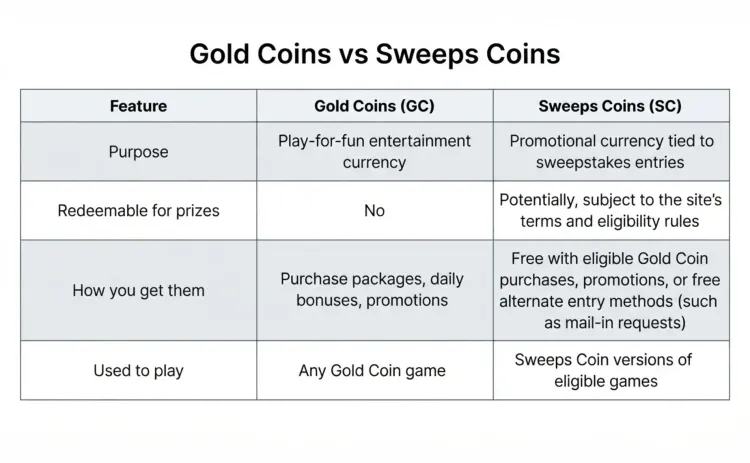
Gold Coins let you play slots and other games purely for entertainment there’s no redemption path, and no real-world value attached to them. Sweeps Coins are the promotional side: you can typically obtain them for free through daily login rewards, ongoing promotions, or a no-purchase alternate entry method (commonly a mail-in request), and depending on the platform’s rules and your state’s eligibility, accumulated Sweeps Coins may be redeemable for cash-equivalent prizes once minimum thresholds and any playthrough requirements are met.
The mechanics of the slot itself (reels, RNG, paylines, RTP) don’t change based on which currency you’re playing with. What changes is the legal and promotional framework wrapped around the coins.
Playing your first online slot: a practical walkthrough
- Pick a game and open its info screen first. Check the RTP, volatility rating if listed, and paytable before spinning a single time. Five minutes here saves confusion later.
- Set your coin value and bet level. Start small while you’re learning a new game’s pace you can always increase once you understand how often it pays and how its bonus features trigger.
- Check how paylines or ways-to-win are structured. Know whether you’re activating fixed lines or playing every way, since that affects what counts as a win.
- Spin manually for the first several rounds. This gives you a feel for the game’s rhythm before you consider autoplay.
- Watch for bonus symbols. Note which icons trigger free spins, wilds, or multipliers so you’re not caught off guard mid-session.
- Set a time or spin limit before you start, not after. Decide in advance how long you’re playing, and stick to it regardless of how the session is going.
- Read the redemption rules if you’re on a sweepstakes platform. Understand upfront which currency you’re using and what, if anything, applies to it.
Common mistakes beginners make
New players tend to make the same handful of errors, and most of them come from misunderstanding the mechanics above rather than bad luck.
Treating a cold streak as meaningful is probably the most common one. Because the RNG has no memory, a run of losses says nothing about what the next spin holds but it’s a very human instinct to feel like a win is “due.” It isn’t, statistically.
Jumping into a game’s bonus round expecting it to behave like the base game is another. Free spin rounds often carry different multiplier rules or modified symbol weighting, and skipping the paytable means missing that entirely.
Confusing a high-RTP game with a “safe” one also trips people up. RTP describes long-run averages across enormous sample sizes, not the volatility of a single session. A high-RTP, high-volatility game can still produce a long stretch without a payout.
On sweepstakes platforms specifically, the most common confusion is not knowing which coin type is in play. Gold Coin and Sweeps Coin versions of the same game look nearly identical on screen, so it’s worth glancing at the coin indicator before you start spinning.
Ignoring the paytable entirely is a smaller mistake but a frequent one. Every slot’s paytable lists what each symbol is worth at different bet levels, and skimming it before playing tells you which symbols to watch for and roughly how the game’s payouts are weighted between common small wins and rarer larger ones.
Responsible play
Online slots, including sweepstakes-style Gold Coin and Sweeps Coin games, are built for entertainment, and treating them that way makes for a better experience regardless of format. Set a time budget before you sit down, decide on a spin or session limit in advance, and treat any bonus features or big wins as a pleasant surprise rather than an expectation. If a session stops being enjoyable, that’s the natural signal to stop no game mechanic changes that math for you.
Frequently asked questions
1. What are sweepstake slots?
Sweepstakes slots are the same style of RNG-driven slot games found at traditional online casinos, but played using a sweepstakes platform’s dual-currency system Gold Coins for entertainment play and Sweeps Coins as the promotional currency tied to the sweepstakes model. The reel mechanics, paylines, and RTP work the same way; the difference is the legal and currency framework around them.
2. What is sweepstakes casino slots, exactly, compared to a regular online slot?
Functionally, very little differs at the game level both use certified RNGs and published RTP figures. The difference is structural: a sweepstakes casino operates under promotional sweepstakes law with a no-purchase-necessary entry option, while a traditional online casino operates under gambling licensing law and requires a real-money deposit to play.
3. What is an RNG game?
An RNG game is any casino-style game whose outcomes are determined by a random number generator rather than a fixed, predictable pattern. Slots are the most common example, but table games like virtual roulette or card-shuffling simulations also rely on RNGs. A properly certified RNG game produces outcomes that are statistically independent from one round to the next.
4. How does a sweepstakes casino work?
A sweepstakes casino distributes two currencies: Gold Coins for entertainment-only play with no redemption value, and Sweeps Coins, which are distributed through promotions, bonuses, or free alternate entry methods and can potentially be redeemed for prizes under the site’s published terms. Because a no-purchase path to obtaining Sweeps Coins exists, the model falls under sweepstakes promotion law instead of traditional gambling regulation.
5. Do sweepstakes casinos pay real money?
Some sweepstakes platforms allow Sweeps Coins to be redeemed for cash-equivalent prizes once minimum redemption thresholds and any applicable requirements are met, subject to the platform’s terms and your state’s eligibility rules. Gold Coins, by contrast, are never redeemable they exist purely for entertainment play. Always check the specific redemption terms and eligibility restrictions listed on the platform you’re using, since they vary.
6. What do paylines mean on a slot?
A payline is a defined pattern across the reels where matching symbols need to land in sequence to produce a payout. Games vary widely in how many paylines they offer, and some use “ways to win” instead of fixed lines, where any adjacent matching symbols count regardless of exact position.
7. What is an RTP percentage?
RTP, or return to player, is the theoretical percentage of all money wagered on a slot that the game is mathematically designed to return to players over a very large number of spins. It’s a long-run statistical figure, independently tested and published by the game developer, not a guarantee for any individual session.
8. What is slot volatility?
Volatility describes how a slot’s payouts are distributed over time. Low-volatility games pay smaller amounts more often; high-volatility games pay less frequently but with larger amounts when they hit. Two slots can have identical RTP figures and still feel very different to play because of volatility differences.
9. Do I need to download anything to play online slots?
Most modern online slots, including sweepstakes-platform versions, run directly in a web browser or mobile app without a separate software download. Check the specific platform’s requirements, since this can vary by device and game provider.
Learn more about how the sweepstakes model works
Understanding how to play online slots is really about understanding two separate things: the game mechanics (RNG, RTP, paylines, volatility) that apply to any slot, and the sweepstakes framework (Gold Coins, Sweeps Coins, no-purchase entry) that applies specifically to platforms like GoldenDragon.Casino. If you want a deeper look at how the sweepstakes model itself is structured eligibility, entry methods, and how redemption works that’s covered in detail in our sweepstakes policy and FAQ resources. Play is intended for entertainment, and no purchase is ever necessary to participate.
Purchase Securely With