Blog
Slot volatility explained: What it means and why it changes the way a game plays
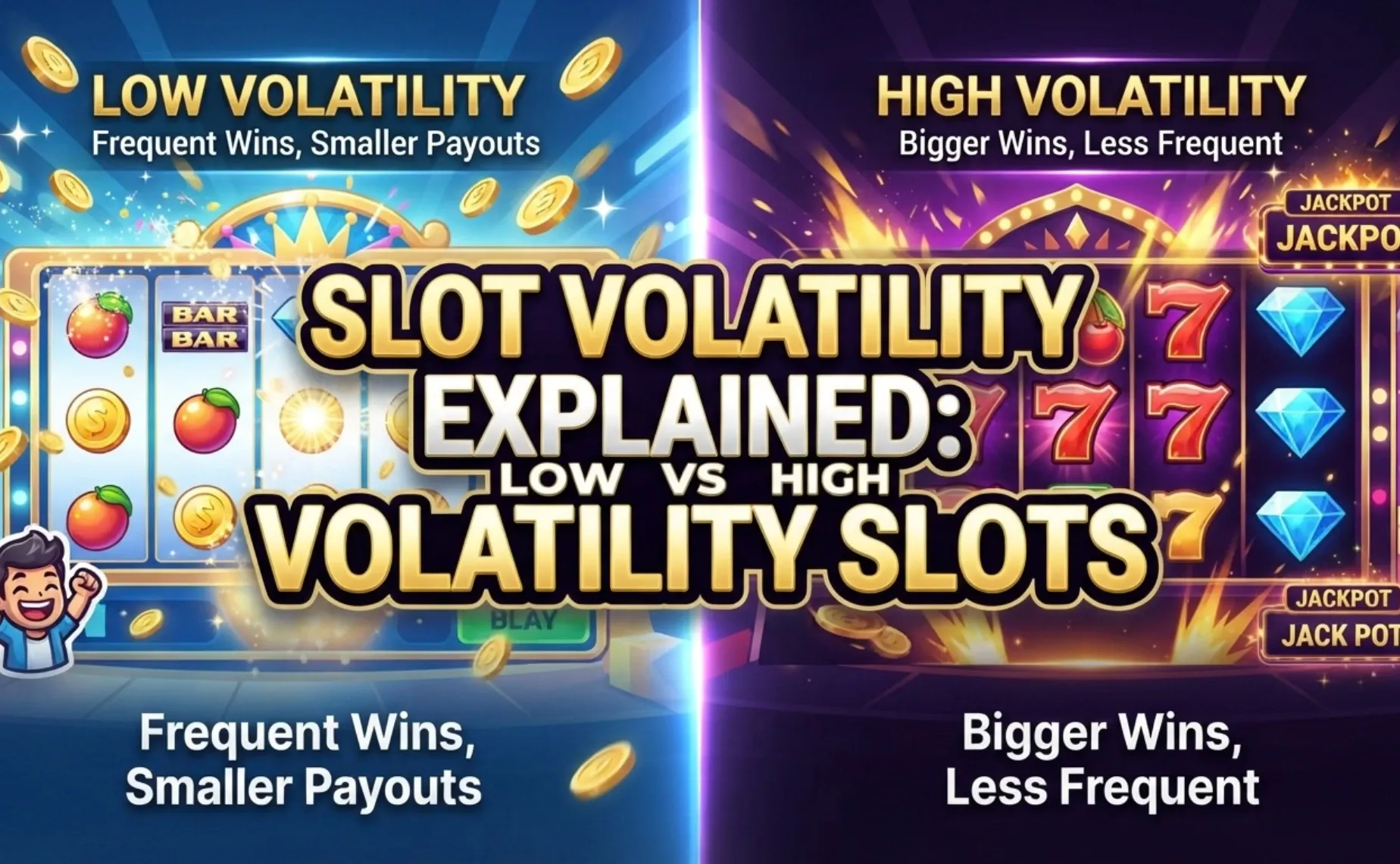
Casino
- Key takeaways
- What slot volatility actually means
- Low, medium, and high volatility: what each one actually looks like in play
- Low volatility slots
- Medium volatility slots
- High volatility slots
- Volatility, RTP, and hit frequency are three different numbers
- How randomness is generated, and why independent testing matters
- How volatility plays out in the sweepstakes casino model
- Choosing a volatility level that matches how you actually want to play
- Common mistakes players make with volatility
- Frequently asked questions
- What is low vs high volatility?
- Does volatility affect RTP?
- What are sweepstake slots?
- How does a sweepstakes casino slots platform work?
- What is an RNG game?
- Are sweepstakes the same as gambling?
- How does sweepstake casino work in terms of coins?
- Can a slot’s volatility change over time?
- Is a high volatility slot better for chasing bigger results?
- A soft closing note
If you’ve ever opened two different slot games, played each for ten minutes, and walked away with completely different impressions of how “generous” they felt, you already understand volatility. You just didn’t have the word for it yet.
Slot volatility (sometimes called variance) is one of the most useful things to understand before you spend real time with online slots, yet it’s rarely explained clearly. Most people learn what RTP means before they ever hear the word volatility, even though volatility often has a bigger effect on the actual experience of playing a round. This guide breaks down what slot volatility means, how it’s measured, how it relates to RTP and hit frequency, how the random number generator behind every spin gets tested, and how all of this fits into the sweepstakes casino model that sites like GoldenDragon.Casino operate under.
Key takeaways
- Slot volatility describes how a game distributes its payouts over time, not how often it pays or how much it pays back on average.
- Low volatility slots pay smaller amounts more frequently; high volatility slots pay rarely but can produce much larger results when they do.
- Volatility and RTP are separate statistics. A game can be high volatility with a low RTP, or low volatility with a high RTP. They don’t move together.
- Every spin outcome is generated by a random number generator (RNG), which independent testing labs such as GLI, iTech Labs, and eCOGRA verify for fairness and statistical randomness.
- On a sweepstakes platform, volatility affects how Gold Coins and Sweeps Coins move during play, but it doesn’t change the underlying legal structure: Sweeps Coins are earned through free entry methods, not purchased, which is what keeps the model inside sweepstakes law rather than gambling law.
What slot volatility actually means
Volatility is a statistical description of risk and payout distribution. It tells you how a slot’s total payouts are spread across the outcomes it produces, not how much money moves in an absolute sense.
Picture two vending machines that both, on average, give you back the same total value over a thousand uses. One gives you a small item almost every time. The other gives you nothing most of the time, but every so often hands you something far bigger than the small item ever could be. Both machines can average out to the same long-run value. They just feel completely different to use. That’s volatility.
Game studios calculate volatility during development, usually by running simulations of millions of spins and mapping how the payouts distribute. The math behind this is closer to actuarial science than gut feeling. Developers look at the standard deviation of outcomes, essentially how far results tend to swing from the average, and use that to classify the game.
You’ll typically see volatility described in a few ways:
- A numeric scale, often 1 to 5 or 1 to 10, where a higher number means bigger swings
- Simple labels: low, medium, medium-high, or high
- Star ratings shown directly in the game’s information panel
Not every studio publishes an exact volatility index, and the label itself is not standardized across the industry the way RTP percentages are. One provider’s “high volatility” might sit closer to another provider’s “medium-high.” Treat the label as a useful signal, not a precise scientific unit.
Low, medium, and high volatility: what each one actually looks like in play
This is where volatility stops being an abstract statistic and starts affecting how a session feels.
Low volatility slots
Low volatility games pay out more often, but the amounts tend to be modest relative to the stake. Balances move in small, frequent steps rather than big jumps. Sessions tend to last longer for the same starting balance, because you’re rarely going long stretches without any return at all.
These games are often built around simpler mechanics: fewer complex bonus features, smaller top-line jackpots, and paytables where mid-tier symbols do a lot of the work.
Medium volatility slots
Medium volatility sits in between, and honestly, most slot games released today land somewhere in this range. Payouts are less frequent than low volatility games but noticeably bigger when they land. Balances swing up and down more visibly over a session. Bonus rounds tend to matter more here, since a chunk of the bigger payout potential often sits inside free spins or multiplier features rather than the base game.
High volatility slots
High volatility games can go long stretches with little to no return, followed by a payout that’s disproportionately large compared to what led up to it. The swings are the point. These games are usually built with a small number of high-value outcomes that account for a large share of the total payout math, even though they occur rarely.
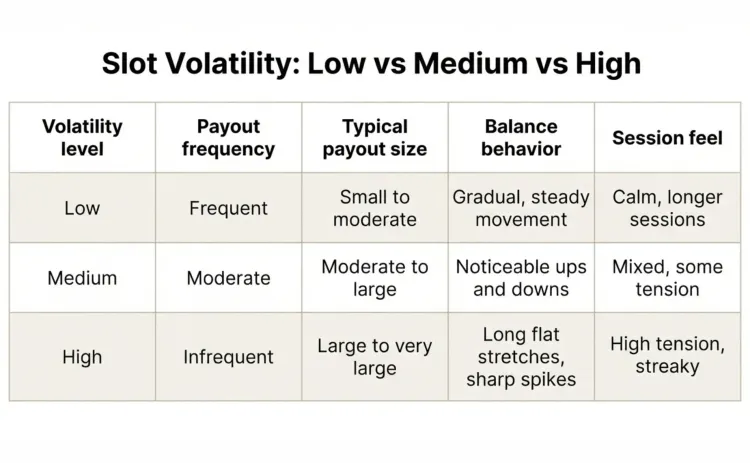
None of these are objectively “better.” They’re different risk profiles, and which one suits a given player depends on what that player actually wants out of a session, which we’ll get into later.
Volatility, RTP, and hit frequency are three different numbers
This is probably the single most common point of confusion, so it’s worth being precise about it.
RTP (return to player) is a theoretical long-run average, expressed as a percentage, describing how much of all wagered value a game is designed to return over a very large number of rounds. An RTP of 96% means that over millions of spins, the game is mathematically designed to return 96% of total wagers as payouts, with the remainder built into the house edge. RTP says nothing about how that return is distributed. It’s an average, not a promise about any individual session.
Hit frequency is how often a spin produces any payout at all, regardless of size. A game can have a high hit frequency (you win something on a large share of spins) while still paying out very small amounts most of that time.
Volatility describes the shape of the payout distribution, how far outcomes swing from the average and how payout size correlates with rarity.
Here’s why the distinction matters: two games can share the exact same RTP and still feel nothing alike. A 96% RTP low volatility game and a 96% RTP high volatility game are both mathematically designed to return the same average over the long run, but one gets there through frequent small returns and the other through rare large ones. Does volatility affect RTP directly? No. They’re independent variables. A studio can build a high volatility game with a relatively low RTP, or a low volatility game with a high RTP. Knowing one number tells you nothing about the other.
Hit frequency and volatility are related but not identical either. A game can have a moderate hit frequency and still be high volatility, if most of those hits are small and a rare few are enormous.
How randomness is generated, and why independent testing matters
Every spin on a legitimate online or sweepstakes slot is decided by a random number generator, or RNG. This is software that produces unpredictable, statistically random outcomes for each spin, independent of anything that happened on previous spins. There’s no “due” for a payout, no pattern to time your spins around, and no memory of past results built into the math. Each spin is its own independent event.
Because RNG fairness isn’t something a player can verify just by looking at a screen, the industry relies on independent testing laboratories to check it. Organizations such as Gaming Laboratories International (GLI), iTech Labs, and eCOGRA audit game software against the studio’s declared math model, confirming that outcomes are genuinely random and that the stated RTP matches what the game actually produces over large sample sizes. Different labs approach this slightly differently: GLI tends to function as a technical engineering lab focused on compliance testing, iTech Labs combines technical testing with a broad international footprint, and eCOGRA layers in player protection and dispute-resolution standards alongside its testing work. When a game carries certification from one of these labs, it means the RNG and payout math have been checked against an outside standard, not just taken on the studio’s word.
This matters just as much on a sweepstakes platform as it does on a real-money gambling site. The games themselves usually run on the same underlying software and RNG engines used across the wider igaming industry. The sweepstakes model changes the legal structure around how you access and redeem play, not the mechanics of how a spin is decided.
Certification isn’t usually a one-time event either. Game studios update titles, patch bugs, and occasionally adjust math models, so reputable labs re-test software after meaningful changes rather than certifying it once and walking away. If a platform lists which labs certify its game library, or a game shows a certification mark in its help screen, that’s a reasonable signal the RNG has been checked against outside standards rather than taken purely on trust.
How volatility plays out in the sweepstakes casino model
Sweepstakes casinos work differently from real-money gambling sites, and it’s worth being clear about the mechanics before talking about how volatility fits in.
Sweepstakes platforms operate under promotional sweepstakes law rather than gambling law. That distinction rests on a legal concept called consideration, one of the three elements (consideration, chance, and prize) that traditionally define gambling. Sweepstakes casinos remove consideration by making their promotional currency, usually called Sweeps Coins, available through free methods: no-purchase sign-up allotments, daily login rewards, promotions, and mail-in entry requests where offered. Sweeps Coins cannot be bought directly. That’s not a minor policy detail; it’s the specific mechanism that keeps the model inside sweepstakes law instead of gambling law.
Most sweepstakes platforms, including GoldenDragon.Casino, run on a dual-currency structure:
Gold Coins are a play-for-fun currency with no cash value. They exist purely for entertainment and can’t be redeemed for anything.
Sweeps Coins are the promotional currency. They’re obtained through free entry methods, used to play eligible games, and can potentially be redeemed for prizes once any applicable requirements are met.
Volatility works exactly the same way mathematically whether you’re playing with Gold Coins or Sweeps Coins, because it’s a property of the game’s underlying math model, not the currency sitting on top of it. A high volatility slot still pays rarely and big; a low volatility slot still pays often and small, regardless of which coin type is in play. What changes is what those coins represent. Since Gold Coins carry no cash value, volatility in Gold Coin play is purely about the entertainment pattern of the session. In Sweeps Coin play, the same volatility concept applies to a promotional balance rather than to money that was deposited or wagered in the gambling sense.
If you’re new to the format entirely, it helps to separate two questions that often get blurred together: what a game’s volatility rating means, and how the sweepstakes redemption process works. They’re unrelated systems that happen to sit on the same screen.
Choosing a volatility level that matches how you actually want to play
There’s no universally “correct” volatility choice. The right one depends on what you’re actually optimizing for during a session.
If you value longer sessions and steadier balance movement, low volatility games tend to suit that better. You’ll see more frequent small returns, and your starting balance will typically last longer before it’s exhausted, since you’re not waiting through long dry stretches.
If you don’t mind long flat periods in exchange for the chance at a disproportionately large result, high volatility games are built for that. Just go in expecting exactly what the math implies: extended stretches with little happening, punctuated by occasional larger outcomes.
If you want a mix of both, medium volatility covers a lot of ground, which is part of why so many newer releases sit in that middle band.
A few practical habits carry over regardless of volatility level, and they’re worth mentioning if you’re still getting comfortable with how to play online slots in general:
- Check the game’s information panel before playing. RTP, volatility rating, and hit frequency (when published) are usually listed there.
- Start with a smaller sample of spins before drawing conclusions about a game. Short sessions on high volatility games in particular can look nothing like the long-run math, simply because of how few outcomes you’ve seen.
- Treat volatility as a pacing tool, not a prediction. It describes the shape of a distribution over a huge number of spins. It says nothing about what the next ten spins will do.
- Read the paytable. It tells you which symbols and features are doing the heavy lifting in a game’s payout structure, which usually explains why it’s rated the way it is.
For anyone just getting oriented with online slots for beginners more broadly, volatility is one of the first concepts worth understanding, right alongside RTP and how the RNG behind every spin actually works. Once those three ideas click, reading any slot’s information panel becomes a lot more meaningful.
Common mistakes players make with volatility
A few misunderstandings come up often enough that they’re worth addressing directly.
Assuming volatility and RTP measure the same thing is probably the most frequent one. They don’t. A game can be high volatility with a mediocre RTP, or low volatility with a strong one. Always check both numbers separately.
Judging a game’s volatility from a short session is another common trap. Ten or twenty spins on a high volatility game can look flat, streaky, or wildly generous purely by chance. The volatility rating describes behavior across a huge sample size, not a snapshot.
Assuming a “big win” on a low volatility game or a “dry spell” on a high volatility one means something has gone wrong with the game. It hasn’t. Individual outcomes can and do deviate from what the volatility label implies. That’s what randomness means.
Confusing volatility with the legal or structural side of sweepstakes play is a newer mistake, but it happens. Volatility is a math property of the game itself. Whether you’re playing with Gold Coins or Sweeps Coins, entering for free, or navigating redemption rules is a completely separate topic governed by sweepstakes promotional law, not by the game’s payout distribution.
New to GoldenDragon.Casino? Use code DRAGON20 for 20% off when eligible. Limited to one use per user, valid through January 1, 2030.
Frequently asked questions
What is low vs high volatility?
Low volatility means a game pays out more frequently, usually in smaller amounts, resulting in steadier, more predictable balance movement. High volatility means payouts happen less often but can be significantly larger when they land, resulting in longer flat stretches punctuated by bigger swings. Medium volatility sits between the two.
Does volatility affect RTP?
No. Volatility and RTP are independent statistics. RTP is the theoretical long-run percentage of wagered value a game returns on average. Volatility describes how that return is distributed across outcomes. A game’s volatility rating doesn’t raise or lower its RTP, and knowing one number doesn’t tell you the other.
What are sweepstake slots?
Sweepstake slots are slot games offered on sweepstakes casino platforms, played using a dual-currency system rather than real-money wagers. Gold Coins are used for play-for-fun entertainment with no cash value, while Sweeps Coins are a promotional currency obtained through free entry methods that can potentially be redeemed for prizes. The games themselves typically use the same RNG-based mechanics found across the wider slot industry.
How does a sweepstakes casino slots platform work?
A sweepstakes casino slots platform offers games that function like standard online slots in terms of mechanics (RNG-driven outcomes, paylines, RTP, volatility), but access is structured around sweepstakes promotional law. Players receive Gold Coins and Sweeps Coins, often through a free sign-up allotment or ongoing promotions, rather than purchasing chips or credits to wager directly.
What is an RNG game?
An RNG game is any game, including virtually all online slots, where outcomes are determined by a random number generator: software designed to produce statistically random, unpredictable results for each play, independent of prior outcomes. RNG games are distinct from live-dealer formats, where outcomes come from a physical, human-operated process instead of software.
Are sweepstakes the same as gambling?
Sweepstakes platforms operate under a different legal framework than gambling. Traditional gambling law generally requires three elements: consideration (payment), chance, and prize. Sweepstakes casinos are structured to remove the consideration element by offering their redeemable currency, Sweeps Coins, through free entry methods rather than direct purchase. That structural difference is why sweepstakes platforms operate under promotional sweepstakes law rather than gambling law, though rules and availability can vary by location.
How does sweepstake casino work in terms of coins?
Most platforms use two currencies. Gold Coins are for entertainment only and carry no cash value. Sweeps Coins are earned through free methods like sign-up bonuses, daily rewards, or promotions, used to play eligible games, and can potentially be redeemed for prizes once any stated requirements are met.
Can a slot’s volatility change over time?
The volatility rating itself, as designed by the studio, doesn’t shift from one session to the next. It’s built into the math model. What can vary is your personal experience within any given session, since a small number of spins is never a reliable preview of the full distribution. A high volatility game can occasionally string together a few decent returns early on, and a low volatility game can occasionally sit flat for a stretch. Neither means the underlying rating was wrong.
Is a high volatility slot better for chasing bigger results?
“Better” depends entirely on what you’re weighing it against. High volatility games are built so that a larger share of the total payout potential sits in rarer, bigger outcomes, which is why they get associated with bigger individual results. That comes paired with longer stretches of little to no return in between. Low volatility games spread the same kind of value across many smaller, more frequent outcomes instead. Neither structure changes the game’s RTP; they just deliver it on a different schedule.
A soft closing note
Slot volatility explained simply: it’s a description of how a game’s payouts are shaped over time, not a signal, a strategy, or a guarantee. Pairing that understanding with how RTP, hit frequency, and RNG certification work gives you a much clearer picture of what any given slot is actually doing behind the screen.
If you’re curious about how the sweepstakes format itself works, including the difference between Gold Coins and Sweeps Coins, how free entry methods function, and what the redemption process typically involves, GoldenDragon.Casino’s help resources walk through the model in more detail. Understanding the structure first tends to make the games themselves a lot more interesting to explore.
Purchase Securely With