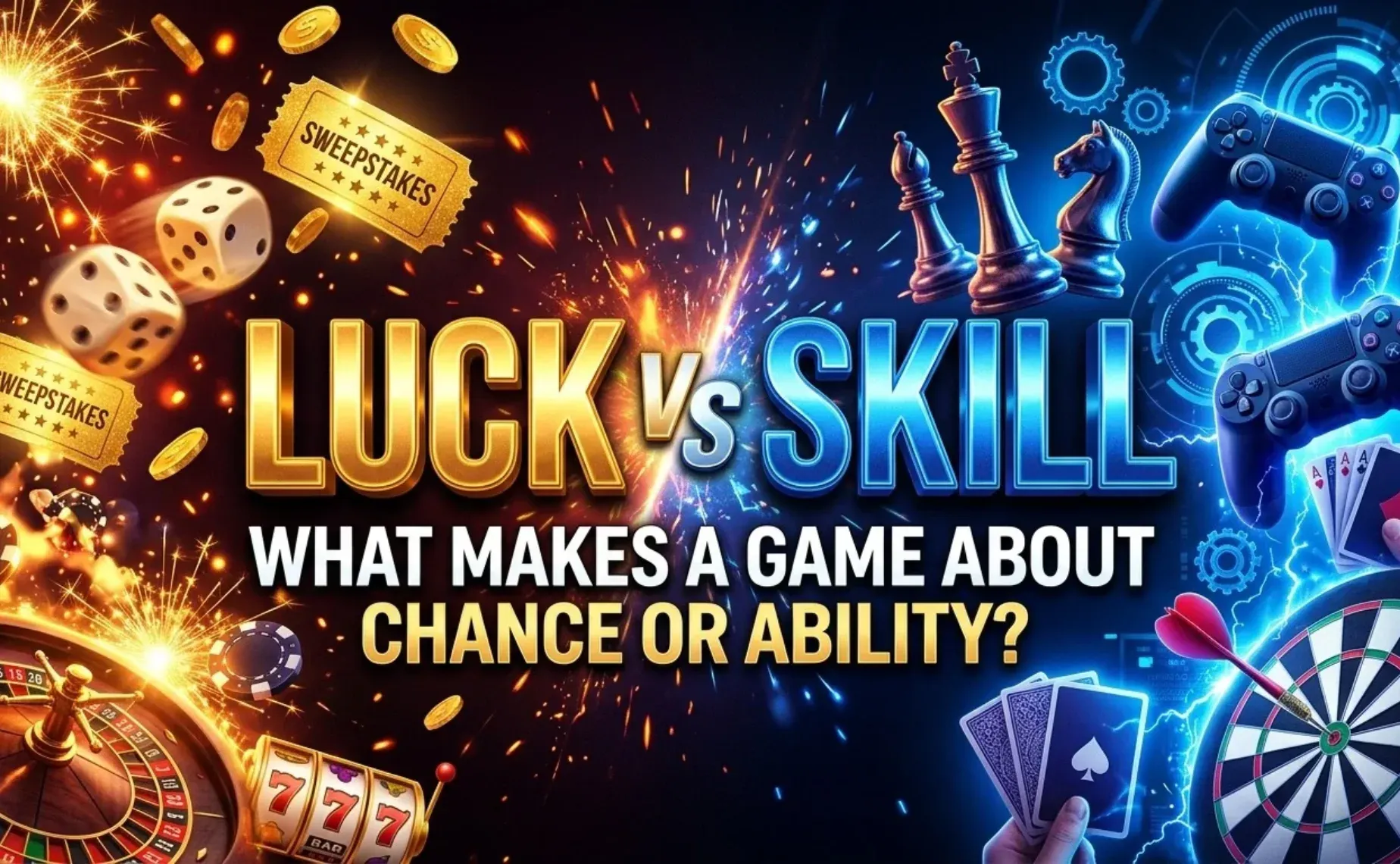
Luck vs Skill: What Makes a Game About Chance or Ability?
Published Nov 5, 2026
Casino
Ask ten people whether poker is a game of luck or skill and you will get ten confident answers, often split down the middle. Ask about slots and the answers get more uniform. Ask about chess and almost nobody says luck. The interesting part is everything in between, because most casino-style games are not purely one or the other. They sit somewhere along a line.
This guide is about that line. It explains how to think about luck vs skill in a practical way, where common games land, and why the distinction matters for expectations, for the law, and for anyone trying to understand sweepstakes-style gaming platforms. It is educational only. Nothing here is a recommendation to play anything, and nothing here suggests that any game or strategy produces reliable winnings.
A note on who is writing: this is an editorial explainer from the GoldenDragon.Casino team, not legal, financial or professional gaming advice. Where we describe how the law treats chance and skill, we keep it general on purpose. Rules vary by place and change over time, so we do not cite specific statutes or cases.
Key Takeaways
- Luck and skill are better understood as a spectrum than a switch. Most games contain both.
- The most useful test is simple: if you play the same decisions better, does your average result improve over many rounds? If yes, skill matters. If no, it is chance.
- Games with independent random outcomes (a roulette spin, a slot reel result) leave almost no room for skill to change the odds.
- Games with hidden information plus decisions (poker, blackjack) mix both. Skill shapes the average result, while luck dominates any single session.
- Games built on knowledge or reaction (trivia, puzzles) tilt strongly toward skill.
- Short-term results can mislead in every game. Variance is real, and a good decision can lose while a poor one wins.
- Legal systems often treat games of chance and games of skill differently, which is one reason the distinction comes up so often. Details vary and are not covered here.
- On a sweepstakes casino, Gold Coins are for entertainment only and cannot be redeemed, while Sweeps Coins are promotional and may be redeemable for prizes under the platform's official rules. No purchase is necessary to participate.
Why people argue about luck vs skill
The argument is rarely just academic. People care because the answer changes how they feel about a result. If a game is mostly skill, a loss feels like a lesson. If it is mostly luck, a loss feels like weather. And if you believe a chance game rewards skill, you may over-trust your own judgment, which is where much of the frustration around casino-style games comes from.
There is a second reason. Regulators, courts and platform operators have all had to decide where a game belongs. Some legal systems draw a line between games of chance and games of skill and treat them differently. We will touch on that later in general terms, but the short version is that the classification is not a matter of opinion, and it is not something a blog post can settle for any particular place.
For everyday readers, the question is simpler. Can I get better at this? And if I can, how much does getting better actually move the needle?
A working definition of luck and skill
Before sorting games, we need definitions that hold up under pressure.
Luck (or chance) is any factor you cannot control or predict that affects the outcome. A shuffled deck, a spun wheel, a random number generator, a die roll. You can understand the odds, but you cannot influence the result.
Skill is any factor within your control that reliably changes your results through knowledge, practice, judgment or physical ability. Memorizing a map, calculating probabilities, reading an opponent, managing your time.
The word that matters in that second definition is reliably. A lucky guess is not skill. Skill shows up as a pattern: a better player beats a weaker one more often than not, across enough repetitions.
The repeatability test
Here is the cleanest test we know. Imagine two players of very different ability playing the same game a few thousand times.
- If the stronger player comes out ahead consistently, skill is a major factor.
- If the results look like a coin flip no matter who sits down, chance dominates.
- If the stronger player wins more but loses plenty of individual rounds, you are looking at a blend.
Notice what the test does not say. It does not say skilled players win every time. In nearly every game with any chance in it, even the best players lose regularly. That is why single results tell you so little.
Variance, the quiet third factor
Variance is the natural swing in results around the average. It explains why a strong poker player can have a losing month and a beginner can have a hot night. Variance is not skill and it is not exactly luck in the everyday sense. It is the mathematical consequence of chance showing up in small samples.
The practical lesson: the smaller the sample, the more luck dominates the story. A skill edge, if there is one, announces itself slowly.
The spectrum at a glance
Here is a rough map. Placement is a general guide, not a precise measurement, and reasonable people would nudge some of these left or right.
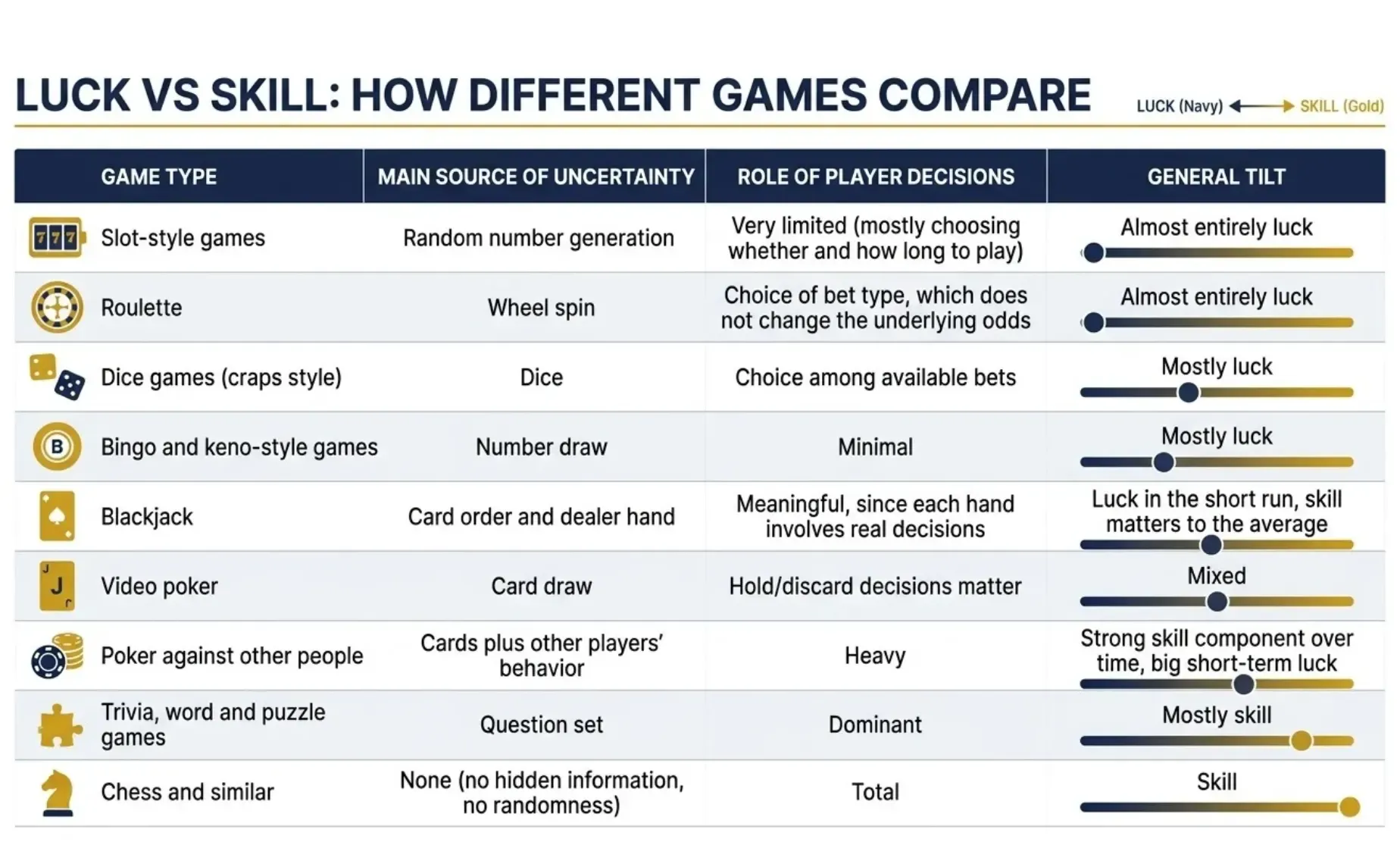
The rest of this guide walks through the logic behind the table.
Games where luck does nearly all the work
Slot-style games
In a slot-style game, the outcome of each spin is determined by a random number generator, commonly called an RNG. Your only real choices are whether to play, how much to stake (in whatever currency the platform uses), and when to stop. None of those choices changes the odds of the next result.
This surprises people who feel they can sense a pattern. They cannot, and the reason is structural. Each spin is designed to be independent of the last one. A reel that has not produced a certain symbol in a while is not "due." A machine that just paid out is not "cooling off."
What can vary between slot-style games is volatility, meaning how often and how large the swings tend to be. Some games are designed to produce frequent small outcomes, others rare large ones. Understanding that is useful for expectations, but it is knowledge about the game's design, not a skill that tilts the result in your favor.
Roulette
Roulette makes the point visually. A ball lands in one pocket on a wheel. You can bet on a single number, a color, odd or even, or groups of numbers. Different bets have different payouts, and that is the whole decision space.
Choosing red instead of a single number changes how often you expect to be right and how much a correct bet pays, but it does not change the relationship between the two. The house edge is built into the payout structure. Careful bet selection can make a session feel different, with more small swings or fewer big ones, but it cannot beat the structure.
You will find plenty of "systems" online for roulette. Betting progressions that increase a stake after a loss are the most common. They change the shape of your results, but they do not change the expected outcome per spin, and they typically increase how much is at stake when a bad run arrives. We mention them here because they are the clearest example of confusing a strategy with skill. A strategy that cannot change the odds is not an edge.
Dice, bingo and keno-style games
These follow the same pattern. The draw or throw is random, and your choices are limited to which available option to select. Where there are multiple bet types, some carry a higher built-in advantage for the house than others, so a well-informed player may choose wisely. But that is the skill of reading the odds table, not the skill of influencing the dice.
The gambler's fallacy
No section on chance games is complete without it. The gambler's fallacy is the belief that past independent results change the likelihood of future ones. "Black has come up six times, so red is due" is the textbook version.
A fair wheel has no memory. The next spin has the same odds as the first. The related idea, the law of large numbers, says that over a very large number of trials, results tend toward their expected proportions. That is a statement about the long run, not an instruction that short-run streaks must correct themselves. People often blur the two.
The middle of the spectrum: luck and skill together
Blackjack
Blackjack is the classic hybrid. The cards are random, but each hand presents decisions: hit, stand, double, split. Those decisions have mathematically better and worse answers depending on your hand and the dealer's visible card.
Many players study what is commonly called basic strategy, a chart of the statistically preferred action for each situation. Following it tends to reduce the house advantage compared with guessing. That is a genuine skill element: knowledge applied consistently.
Two honest caveats belong next to that. First, better decisions improve your average result, not your next hand. A correct play can still lose, and a questionable play can win. Second, reducing the house edge is not the same as erasing it. A chart tells you how to lose more slowly, on average, in most standard versions of the game. We say "most" and "on average" deliberately because rules vary between versions and we are not going to overstate precision.
You may also hear about card counting. It is a well-known idea in blackjack discussion, and it depends on specific physical-game conditions. We will not describe how it works. It is mentioned only because it illustrates the broader principle that more information can, in certain settings, shift odds, while most digital and sweepstakes-style versions are designed with their own rules and shuffling procedures.
Video poker
Video poker sits close to blackjack on the spectrum. You are dealt cards, then choose which to keep and which to replace. Some hold-or-discard choices are clearly better than others over time, and the best choice depends on the specific pay table of the game in front of you.
That last point is easy to miss. Two machines that look identical can pay differently for the same hands, which changes what correct play looks like. So the skill involved is partly strategic and partly just reading the rules carefully. Even with perfect play, the initial deal and the replacement draw are random, and results over a short session can run far from the average.
Poker against other players
Poker deserves its own treatment because it is where the luck vs skill debate gets loudest.
Poker has hidden information (you cannot see opponents' cards), randomness (the deal), and, critically, other people making decisions. That combination creates several layers of skill: understanding probabilities, managing your resources across many hands, reading patterns in how opponents behave, and controlling your own emotional reactions after a bad outcome.
The honest summary is that both sides of the argument are partly right. Over a large number of hands, better decision-making tends to separate stronger players from weaker ones. In a single hand, or a single evening, the cards can overwhelm everything. That is why experienced players often talk about judging decisions rather than results. A good decision that loses to an unlucky card was still a good decision.
It also explains why poker is often the example people reach for when a legal system has to decide how to classify a game. Reasonable authorities have reached different conclusions in different places, which is exactly why we are not going to claim a single answer here.
Games where skill dominates
Trivia, word and puzzle games
When the outcome depends mainly on what you know or how quickly you can solve something, skill leads. Trivia rewards knowledge. Word games reward vocabulary and pattern recognition. Puzzle games reward logic and speed.
Luck can still sneak in. A trivia round might happen to include your best subject, or a puzzle might have a favorable starting layout. But repeat the same game enough and the results line up with ability. This is the same repeatability test from earlier, just pointed the other way.
Games with no hidden information and no randomness
Chess, checkers and similar games sit at the far end. Both players see everything, and no dice or shuffled cards intervene. Outcomes come from decision quality alone. These are rarely described as casino games, but they are useful as the reference point at the skill end of the line.
A decision framework you can reuse
If you want to place any game on the spectrum yourself, ask these five questions.
- Is there a random element, and how often does it fire? A single draw at the start is different from fresh randomness every turn.
- Can I make decisions after seeing partial results? Decisions made with new information are where skill lives.
- Do my decisions change the odds, or only the payout structure? Changing a bet size is not the same as improving a play.
- Is there hidden information, and can I reason about it? Inferring what an opponent holds is a skill. Guessing a random draw is not.
- Would a better player beat me over thousands of rounds? If the honest answer is "not reliably," chance is doing the heavy lifting.
Run a few games through those questions and the table above starts to feel intuitive instead of memorized.
Why the distinction matters in practice
It sets realistic expectations
Believing a chance game is a skill game is the root of many bad experiences. People start crediting themselves for wins and blaming "the game" for losses, which makes patterns out of noise. Knowing a game's actual mix of luck and skill is a form of consumer protection. For a grounded look at prizes and expectations on sweepstakes sites, see our guide on how to win at sweepstakes casinos. It lets you treat an outcome as an outcome.
It changes what "getting better" means
In a skill-heavy game, improvement means practice and study, and the payoff is a higher average result. In a chance-heavy game, there is nothing to improve. What you can improve is your understanding: knowing the format, knowing that volatility exists, and deciding in advance how much time you want to spend. That is a different kind of competence, and it is perfectly legitimate, but it is not an edge.
It matters to the law, in general terms
Many legal systems distinguish between games of chance and games of skill, and the treatment can differ. We are not going to say which jurisdiction does what, because we cannot verify it for every reader's location and because it changes. If the classification matters to you for a practical reason, it is a question for a qualified legal professional in your area, not for a blog.
What we can say is why the question exists at all. When the outcome is determined mainly by chance, regulators often view it differently than when the outcome is determined mainly by ability. That is one reason the "mix" in games like poker attracts so much attention.
How the sweepstakes model fits in
Because GoldenDragon.Casino is a sweepstakes casino, it helps to explain how that model works, since it is often confused with traditional online gambling. This section describes the general model. For the exact rules that apply to any particular platform, the official sweepstakes rules and terms are the authority.
The two-currency structure
Sweepstakes casinos typically use two kinds of virtual currency.
- Gold Coins are for play-for-fun entertainment. They have no cash value and cannot be redeemed for prizes.
- Sweeps Coins are promotional. Under the platform's official rules, they may be redeemable for prizes, subject to eligibility requirements and verification.
No purchase necessary
The defining feature of the model is that a purchase is not required to take part. Sweepstakes platforms generally provide a free method of entry, which is why they describe themselves as operating under sweepstakes law rather than gambling law. The specifics of free entry, such as how coins can be obtained without a purchase, are set out in each platform's official rules and should be read there.
Luck and skill in a sweepstakes setting
The same luck-vs-skill logic applies to any game you see on such a platform. A slot-style title is chance-driven whether the coins involved are Gold or Sweeps. A card or strategy-based title still contains whatever mix of chance and decision-making it contains. The currency type does not change the nature of the game itself. Nothing about a sweepstakes structure turns a chance game into a skill game or guarantees any result.
What it does not mean
It does not mean results are guaranteed, that prizes are certain, or that a strategy can create an edge in a chance game. It also does not mean the rules are the same everywhere. Eligibility differs by location, and anyone considering participation should read the official rules and confirm what applies to them.
Common mistakes when judging luck vs skill
- Judging by short-term results. A hot streak feels like proof of skill. A cold streak feels like proof of a rigged game. Neither is reliable evidence when the sample is small.
- Mistaking a betting system for an edge. Progressions and patterns change the shape of your swings. They do not change the underlying odds of independent events.
- Overrating "feel." Many people report a sense that a machine or table is running a certain way. Human brains are good at finding patterns and bad at admitting when there is none.
- Ignoring the rules of the specific version. Pay tables, rule variations and house rules matter. A strategy built for one version can be wrong for another.
- Treating luck as an insult. Some players resist the idea that a game is mostly chance because it feels like a judgment on their intelligence. It is not. It is just a description of the game's design.
- Assuming skill guarantees profit. Even in skill-influenced games, a skill edge may be small, may be offset by the house's built-in advantage, and may take a long time to show up.
Reading a game's information before you judge it
Most reputable platforms publish rules, and many publish information about how outcomes are generated. Here is a short checklist for evaluating what you are looking at.
- Read the game's rules or help screen. Look for how outcomes are determined.
- Check whether decisions are available mid-round and whether they change odds.
- Look for published payout or pay table information.
- Treat any claim that a particular approach "beats" a chance-based game with strong skepticism.
- Remember that independent testing and certification, where a platform cites them, are claims you can ask about and verify rather than assume.
A practical way to think about entertainment value
Strip away the luck-vs-skill framing and what remains is a simple question: what are you getting out of this? For many people, a chance-based game is a few minutes of light entertainment, closer to a puzzle app or a card game with friends than to anything strategic. A skill-based game offers a different kind of satisfaction, the sense of improving.
Neither is better. But they are different, and knowing which one you are engaging with helps you set expectations that match reality. If you find that a game is affecting your mood, your time or your finances in ways you do not like, taking a break is a reasonable response. Many platforms offer tools for setting limits or pausing, and national and local support organizations exist for people who want to talk to someone. If you think you may need support, a quick search for a responsible-play helpline in your area is a sensible first step.
FAQs
1. Is poker a game of luck or skill?
It is both. Poker includes random card deals, so luck strongly influences any single hand or session. It also involves decisions, probability judgments and reading opponents, so skill tends to influence results over a large number of hands. How a particular legal system classifies it varies and is a question for a qualified professional.
2. Can skill beat a slot-style game?
No. Slot-style outcomes are determined by random number generation, and your choices do not change the odds of a given result. What you can control is whether you play, how long, and with what expectations. Be wary of any claim that a technique or pattern improves your chances.
3. How can I tell if a game relies more on luck or skill?
Use the repeatability test. If a better player would win consistently over many rounds, skill matters. If results would look similar regardless of ability, chance dominates. Then check whether your decisions come after new information and whether they change the odds or only the payout.
4. Are sweepstakes the same as gambling?
Not in structure. A sweepstakes casino operates on a promotional model with no purchase necessary and uses two virtual currencies, Gold Coins for entertainment and Sweeps Coins that may be redeemable for prizes under official rules. These platforms position themselves under sweepstakes law rather than gambling law. Legal treatment can differ by place and changes over time, so the official rules and a qualified legal professional are the right sources for specifics.
5. What is the difference between a sweepstakes casino and a casino?
A traditional casino generally requires a stake of real money to play for cash outcomes. A sweepstakes casino offers casino-style games using virtual coins, provides a free method of entry, and offers prize redemption only through Sweeps Coins, subject to its official rules and eligibility requirements. Gold Coins cannot be redeemed. The games may look similar, but the legal and promotional structure is different.
6. Does a strategy guarantee better results in blackjack?
No. Following a well-known basic strategy tends to improve your average results compared with guessing, but it does not guarantee a win in any hand or session. Variance can still produce long losing runs, and a strategy does not remove the house advantage in most standard versions.
7. What is the gambler's fallacy?
It is the mistaken belief that past results of independent events influence future ones, such as thinking a color is "due" after a streak on a roulette wheel. In a fair game each spin or draw is independent, so previous outcomes do not change the odds of the next one.
Final thoughts
Luck and skill are two ends of a line, and most games sit somewhere in the middle. Slot-style games and roulette lean heavily on chance. Blackjack and video poker blend decisions with randomness. Poker adds other people into the mix. Trivia and puzzles reward what you know. Once you can place a game on that line, claims about "systems" and "secrets" become much easier to evaluate.
If you take one idea away, make it this: judge decisions by their quality over many repetitions, not by the result of any single round. That habit helps in games, and it helps in plenty of other places too.
New to GoldenDragon.Casino? Use code DRAGON20 for 20% off when eligible. Limited to one use per user, valid through January 1, 2030.
This article is for general education only and is not legal, financial or gambling advice. Participation in any sweepstakes is subject to its official rules and eligibility requirements, and availability varies by location. Please play responsibly and only if you are of legal age where you live.