

Can Random Really Be Random? How a Random Number Generator Decides Digital Game Outcomes
Published Oct 31, 2026
Casino
Flip a coin and you know what is happening. Gravity, a thumb, a bit of spin. Press a button in a digital game and something just as unpredictable seems to happen, except there is no coin, no cards, no dice. There is a piece of software producing a number.
That software is a random number generator, usually shortened to RNG. It sits underneath online slots, virtual card shuffles, digital dice, loot drops in video games, lottery draws and a good share of the security that protects your bank login. People trust it, argue about it, and mostly misunderstand it.
This guide explains what an RNG is, why a computer that follows instructions can still produce results nobody can predict, and how outside laboratories check that a generator behaves as claimed. It also covers the myths that grow around "random" games, and how all of this applies to sweepstakes casinos such as GoldenDragon.Casino. It is educational. It does not tell you to play anything, and it does not promise outcomes of any kind.
A note on where this comes from: we are a sweepstakes platform, so we have an obvious interest in the topic. We have tried to stick to well-established computer science and testing practice, and where a detail varies by game provider, jurisdiction or lab, we say so instead of guessing.
Key takeaways
- A random number generator is a method for producing numbers with no usable pattern. Games turn those numbers into reel positions, card orders or dice results.
- Most digital games use a pseudo-random number generator (PRNG): a mathematical process that starts from a seed and produces sequences that pass statistical tests for randomness, even though the process is deterministic.
- True random number generators draw on physical noise, such as electrical or atmospheric fluctuations. Many systems blend both approaches.
- Each result from a properly built RNG is independent. Past outcomes do not make future ones "due". That belief is the gambler's fallacy.
- Independent test labs examine RNG code and output statistically. Their reports are one of the better trust signals available, but they do not change the odds of any single result.
- RTP (return to player) describes a long-run average across enormous numbers of rounds. It says very little about what happens in a short session.
- Sweepstakes casinos use Gold Coins for entertainment-only play and Sweeps Coins as a promotional currency that can be redeemed for prizes, with a free route to obtain them. That structure is what separates them from regulated gambling, and it is explained in its own section below.
What a random number generator actually is
A random number generator produces a stream of numbers that should be impossible to predict from the numbers that came before. "Impossible" is the standard, and it is a high one. If you could look at the last thousand outputs and work out the next one with better than chance accuracy, the generator would be considered broken.
In a game, the raw numbers are rarely used directly. Suppose a virtual die needs a result from one to six. The software asks the generator for a number, maps it onto that range, and shows the face. A card game asks for a long series of numbers to put 52 cards in order. A slot game asks for one number per reel, and each number points to a position on that reel's internal strip of symbols.
Three properties matter.
Uniformity: Every possible outcome should come up with its intended probability. If six faces are supposed to be equally likely, then over a very large number of rolls each should land close to one in six.
Independence: One output must not influence the next. The generator has no memory of "fairness". It does not balance things out.
Unpredictability: Without knowing the secret internal state, an observer cannot work out what comes next.
Notice what is missing from that list: variety that feels random to a person. Humans are poor judges of randomness. We expect streaks to be short and results to alternate neatly, and real random sequences contain far more clumps than most people anticipate. A generator that never repeated a result twice in a row would actually be less random, not more.
True random versus pseudo-random
There are two broad families, and the difference is easy to get wrong.
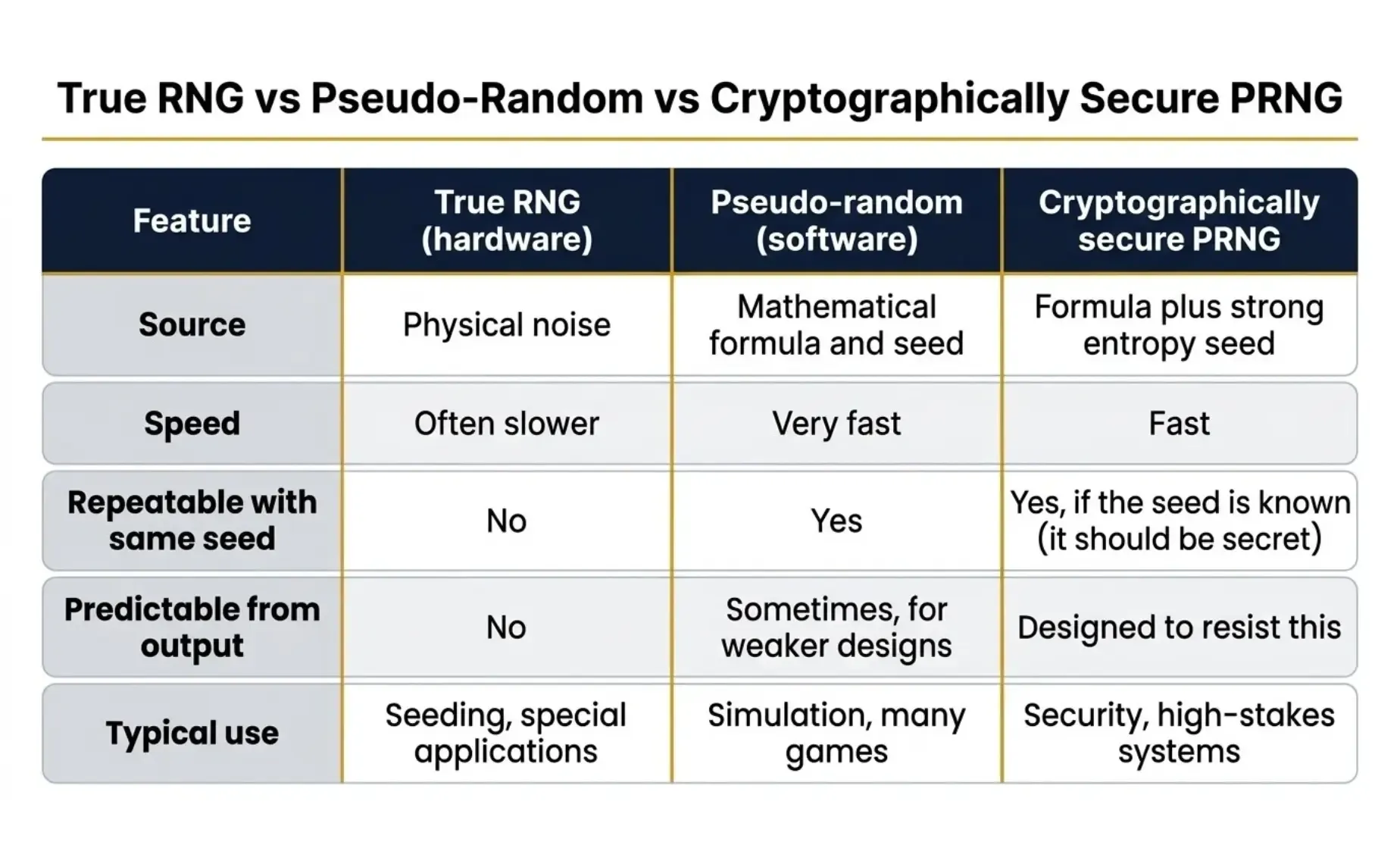
Hardware or true random number generators
A true random number generator (TRNG) measures a physical process that is hard to predict in practice. Common sources include electrical noise in a circuit, timing jitter, atmospheric noise picked up by a radio receiver, or the decay of a radioactive material. The service random.org, for example, has long described using atmospheric noise. Cloudflare has publicly discussed using a wall of lava lamps, photographed by a camera, as one input into its randomness pool. It makes a memorable picture, though it is one source among several.
Physical sources have drawbacks. They can be slow, they can drift or fail, and raw measurements are often biased and need processing before use. For a game that needs thousands of numbers per second, that is a lot to ask of a physical device.
Pseudo-random number generators
A PRNG is an algorithm. You give it a starting value called a seed, and it applies a formula repeatedly to produce a long sequence. Given the same seed, you get exactly the same sequence every time. That sounds like the opposite of random, and in a strict sense it is. The goal is a sequence that looks random to every statistical test anyone can reasonably run, and that cannot be predicted without knowing the seed and the internal state.
PRNGs are fast, repeatable and easy to test, which is why almost every digital game uses one. Repeatability is also useful: developers and auditors can replay a sequence to investigate a problem.
Not all PRNGs are equal. A simple linear congruential generator, an old and compact design, is fine for a casual simulation but has known structural weaknesses. The Mersenne Twister, published by Makoto Matsumoto and Takuji Nishimura in 1997, has an extremely long period (the point after which the sequence repeats) of 2 to the power 19937 minus 1, and became a default in many programming languages. It is excellent for simulation and not designed to resist an attacker who can observe enough output, so it is generally not recommended where security matters.
For that, there are cryptographically secure PRNGs (CSPRNGs). These are designed so that even seeing a large amount of output gives an attacker no practical way to predict the next value. Operating systems expose them for exactly this purpose, and they are what protects encryption keys and session tokens.
The hybrid approach
In practice, serious systems combine the two. A hardware source or the operating system's entropy pool supplies a high-quality seed, and a PRNG or CSPRNG stretches that into a fast stream. This is why "is it truly random?" usually has the answer "random enough that the difference is not exploitable", rather than a clean yes or no.
A short history of making random numbers
People wanted random numbers long before computers existed. Statisticians and scientists needed them for sampling, and early methods were physical: dice, drawing numbered tickets, spinning devices.
In 1955 the RAND Corporation published a book called A Million Random Digits with 100,000 Normal Deviates, generated with an electronic roulette-style device and then tested and corrected. It was used as a reference table by researchers for years, and it is still a pleasing piece of history that it exists as a printed book of numbers.
Computers changed the question. John von Neumann, in the 1940s, proposed the middle-square method, in which you square a number and take the middle digits as the next. It has short cycles and bad failure modes, and he was well aware that a deterministic procedure could not be truly random. His oft-quoted remark about the sin of using arithmetic to produce random digits is worth looking up in context rather than quoting from memory. The point stands: the field has always known that algorithmic randomness is an approximation, and has worked to make the approximation good enough.
From there came linear congruential generators in the 1950s, the long-period generators of the 1990s, and today's cryptographic designs. For casino-style games, the practical shift was from mechanical devices (physical reels, physical cards) to software-driven outcomes. Once an outcome is chosen by software, the visual presentation, spinning reels or flipping cards, becomes animation of a decision that has already been made.
How a game turns random numbers into outcomes
Understanding the pipeline removes much of the mystery.
Slots and reel-based games
A modern digital slot does not move physical reels. When you press the button, the game requests numbers from its generator, one for each reel. Each number is mapped to a stop position on a virtual reel strip. The strip is a list of positions, and the game designer decides how many times each symbol appears on it.
This is where designers shape the game. If a high-value symbol appears once on a strip of 64 positions and a low-value symbol appears many times, the high-value symbol is rarer by design. The visible reel on screen may show only a few symbols, but the underlying strip has all of them, and the animation is built to match the result. The generator does not decide "this is a near miss". The mapping from numbers to symbols produces near misses at a rate that falls out of the arithmetic.
Card games
Shuffling a deck means choosing one of 52 factorial possible orders, a number close to 8 times 10 to the power 67. A well known and correct way to shuffle on a computer is the Fisher-Yates shuffle (the modern in-place version is credited to Richard Durstenfeld, and popularised by Donald Knuth). It works through the deck once, swapping each card with a randomly chosen card from the remaining positions.
The details matter. A poorly written shuffle can be biased even with a good generator, and a good shuffle with a generator whose seed has too few possible values cannot reach every possible deck. A seed of 32 bits allows only about four billion distinct starting points, which is a tiny fraction of the possible decks, since covering 52 factorial takes roughly 226 bits of state. This is a real, documented class of software flaw, not a hypothetical one, and it is the kind of issue independent code review is meant to catch.
Dice and simple draws
Digital dice are the easy case. Pick a number in a range with equal probability for each value. Even here a subtle bug called modulo bias can creep in when a generator's range does not divide evenly into the target range, slightly favouring lower numbers. Careful implementations discard out-of-range values and draw again.
Bonus rounds and features
Many games decide features, free spin triggers or multipliers using the same machinery, often with separate draws or separate tables. The outcome of one draw is not usually "linked" to the next in a way a player could exploit, and a properly built game does not change its odds depending on how long you have been playing or what you did previously.
How RNGs are tested and certified
This is the section that matters most for trust, and also the one most often handled loosely online.
What independent testing labs do
Independent test laboratories evaluate gaming software and publish or provide certificates. Names you will see mentioned in the industry include Gaming Laboratories International (GLI), eCOGRA, iTech Labs and BMM Testlabs. Regulators in various jurisdictions require or recognise testing by approved labs, and the exact requirements differ by place and by type of operator. Sweepstakes operators are not necessarily subject to the same testing mandates as licensed gambling operators, so whether a given platform uses third-party certification is something to check on that platform rather than assume.
Broadly, a lab review has two parts.
Source code and implementation review. Engineers read the code: how the generator is seeded, how its output is scaled to game ranges, whether the shuffle or reel mapping is implemented correctly, whether there are any hidden branches that alter odds, and how the software is protected from tampering.
Statistical testing of output. The lab collects very large samples of generator output and runs statistical tests designed to catch bias or patterns. Published test suites exist for this. NIST Special Publication 800-22 describes a widely cited battery of statistical tests for random and pseudo-random generators, and the Dieharder suite is another well known open collection. Labs may use these, proprietary tests, or both. Typical checks include whether each value appears at the expected rate, whether runs of identical results are neither too long nor too short, and whether there is correlation between one output and the next.
A third step often follows: game-level verification. The lab simulates the full game, millions of rounds or more, and confirms that observed behaviour matches the paytable and the stated return percentage.
What passing a test does and does not mean
A certificate means that, at the time of testing, the generator and game logic met the lab's criteria. It is a meaningful signal, much like an independent financial audit. It is also limited.
It does not mean you will see any particular result. It does not mean results are "balanced" over a session. And a certificate applies to a specific version of the software, which is why version control and recertification after changes matter. The honest way to read a certification claim is to look for the lab's name, the scope, and the date, and to be a little wary of badges with no detail behind them.
Provably fair systems
Some platforms, particularly in the cryptocurrency space, use a different model called provably fair. The idea is that the operator commits to a secret value in advance by publishing a hash of it, and the player contributes their own input, so that after the round the player can verify the outcome was determined by those inputs and not changed afterwards. It addresses a different concern, whether results were manipulated, and it is a verification method rather than a replacement for understanding the odds. It is not the standard approach for most traditional slot content.
RTP, volatility and why RNG output looks streaky
Two ideas explain most of the gap between how people expect random games to feel and how they actually behave.
RTP: a long-run average
Return to player, or RTP, is a percentage expressing the theoretical long-run average of what a game returns across a vast number of rounds. A game described as having 96 percent RTP is designed so that over an enormous number of plays, the average return approaches 96 percent of the amount staked, and the rest is the house edge in regulated gambling.
Two cautions apply. First, "enormous" means far more rounds than a person plays in a lifetime of casual sessions, so RTP is a design and compliance figure, not a forecast for your session. Second, RTP is a feature of regulated real-money gambling, where staked money is compared with returned money. In a sweepstakes setting, the same game mathematics may be used by a provider, but you should read each platform's own terms and game information rather than assume how an RTP figure applies to promotional coins.
Volatility: how bumpy the ride is
Two games can share the same RTP and feel completely different. A low volatility game spreads its returns across many small results. A high volatility game concentrates them in rarer, larger ones. Volatility is a property of the paytable and the reel strips, and it explains why one game seems to give constant small hits while another goes quiet for long stretches.
Why randomness looks like patterns
Here is a quick exercise. Flip a fair coin ten times and the chance of getting ten heads in a row starting from a given flip is 1 in 1,024. That sounds rare. But in a long run of flips, such streaks appear. A common rule of thumb is that in n flips, the longest run of identical results is typically around log base 2 of n, so in a thousand flips you should expect a streak of roughly ten. If your instinct says streaks that long prove something is rigged, your instinct is the thing that is miscalibrated.
This is the gambler's fallacy in action. After a long run of one result, people feel the other result is overdue. For an independent generator, it is not. The coin, or the number stream, has no memory.
The mirror image is the "hot hand" feeling, the sense that a streak will continue. Neither belief is supported when each draw is independent.
Common myths about RNGs
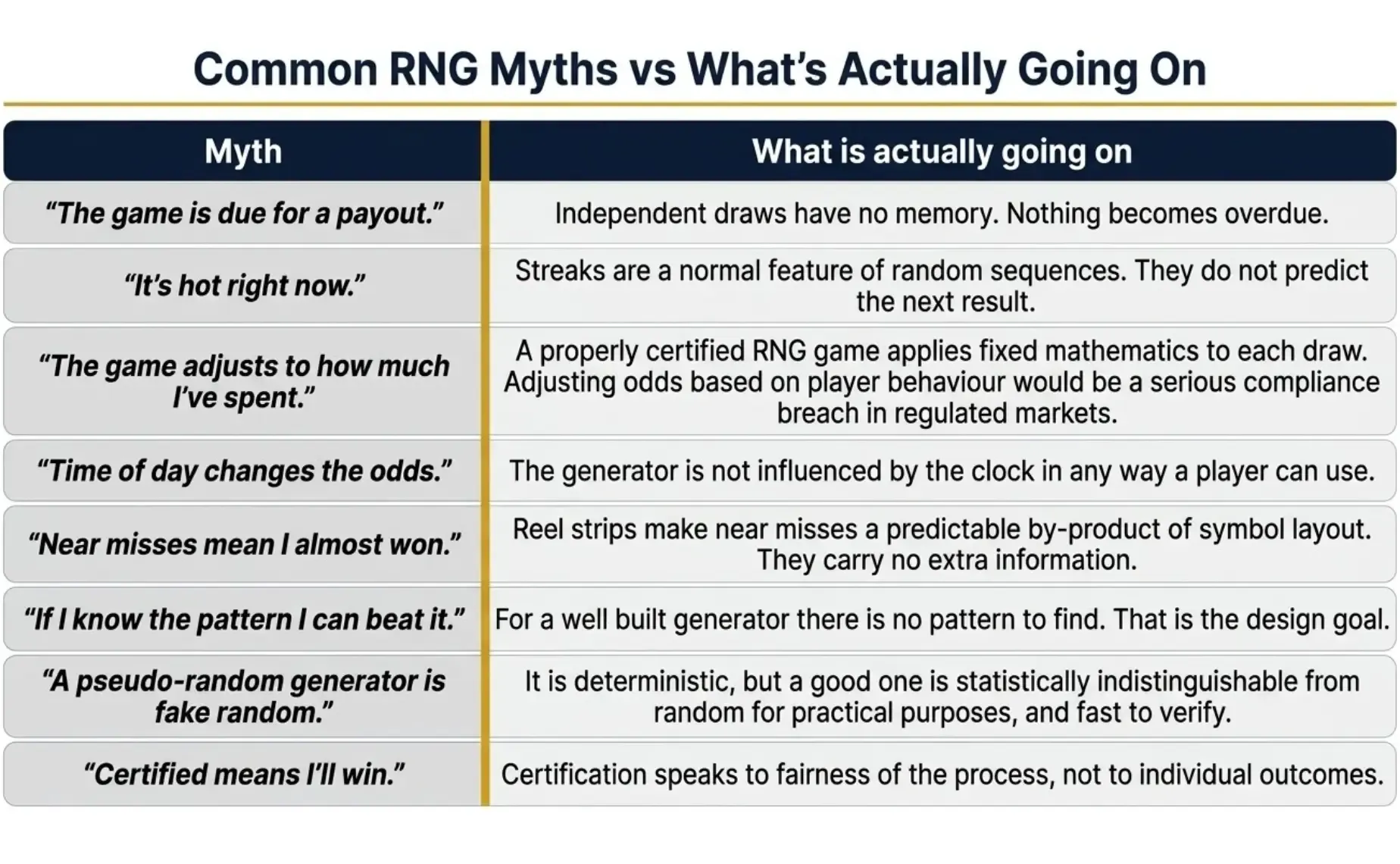
One caution on the "game adjusts to you" myth. I am describing how a correctly built and certified RNG system works. Poorly built or unlicensed software can in principle behave badly, which is exactly why independent testing, transparent terms and a platform's reputation matter, and why you should be sceptical of any site that gives no information about how its games are verified.
How to evaluate a platform's claims about fairness
You do not need to be a programmer to ask sensible questions. Here is a practical checklist.
- Look for named testing: Does the platform say which laboratory tested its games, and does it give a certificate or a verifiable reference? Vague phrases like "fully audited" with no detail are weak.
- Check game provider information: Many games come from established software studios, and their own documentation may describe the game's mathematics.
- Read the game information screen: Games often list the paytable, feature rules, and sometimes a stated return percentage.
- Find the terms and official rules: For a sweepstakes platform, these explain how coins work, how prizes are handled and how to enter without making a purchase.
- Check support and complaints handling: A platform that answers clear questions clearly is a better sign than one with only marketing copy.
- Be realistic about what testing proves: It supports fairness of the process. It does not make any specific result more likely.
The sweepstakes model, explained accurately
Because this site is a sweepstakes casino, it is worth being exact about what that means, since the term is often confused with gambling.
Gold Coins and Sweeps Coins
Sweepstakes casinos typically run on two virtual currencies.
Gold Coins are for entertainment only. They have no cash value and cannot be redeemed for prizes. Players use them to try games for fun.
Sweeps Coins are a promotional currency. Under the sweepstakes rules, Sweeps Coins can be redeemed for prizes, subject to the platform's terms, verification steps and eligibility rules. They are not sold directly; they are provided as a promotion.
No purchase necessary
The legal basis of the model is the "no purchase necessary" principle. A user can obtain Sweeps Coins through free methods, such as a daily login allocation, promotional offers, or by sending a request by mail, often called an alternative method of entry (AMOE). Some platforms also offer optional coin packages, which usually include a promotional allocation of Sweeps Coins as a bonus. The core point is that a free route to participate exists and carries equal standing.
Why sweepstakes law and not gambling law
In many legal systems, gambling is generally understood as involving three elements: a prize, chance, and consideration (something of value paid to take part). Remove any one and the activity typically falls outside the standard definition of gambling. Sweepstakes are structured around removing consideration by offering a genuine free way to enter. That is why they are generally governed by sweepstakes and promotional laws instead of gambling licensing regimes.
That is a general description, not legal advice. The details differ from place to place, regulators and courts have taken varying positions, and some US states restrict or prohibit sweepstakes-style casino play. Eligibility, age requirements and available regions are set out in each platform's official rules, and you should read them and make sure you are eligible before taking part. If you are unsure about your local position, check with your state or local authority or a qualified legal professional.
Where RNG fits in
The games on a sweepstakes platform commonly look and behave like casino games, and their outcomes are typically produced by the same kind of RNG described in this article. The random number generator governs the result of each game round. The sweepstakes structure governs how coins are obtained and how prizes are redeemed. They answer different questions.
Two points of caution. Sweepstakes play is not a way to earn money, and nothing in any game result, RNG or otherwise, guarantees a prize. And if play ever stops being fun, take a break. Set your own time limits, and if you feel it is becoming a problem, free confidential support is available from organisations such as the National Problem Gambling Helpline (1-800-GAMBLER in the United States).
Common mistakes people make about randomness
Treating a short session as a sample: A few hundred rounds tell you almost nothing about a game's long-run behaviour. Short samples are noisy by nature.
Reading intent into animation: Spinning reels, building tension, a slow reveal: these are presentation. The result was determined before the animation began.
Confusing RTP with a promise: A percentage average over millions of rounds is not a statement about your next ten minutes.
Trusting badges over detail: A logo that says "fair" is not evidence. A named lab, a certificate reference and a date are.
Assuming "random" means "evenly spread: Real randomness clumps. If a game's results looked too tidy, that would be a reason for suspicion.
Believing a system can beat a good RNG: Betting patterns, tracking previous results and "cycle" theories do not work on independent draws. They mostly feed the fallacies described above.
Frequently asked questions
1. What is an RNG game?
An RNG game is any digital game whose outcomes are decided by a random number generator rather than by player skill or a physical device. Online slots, virtual dice, digital card shuffles and many video game loot systems are examples. The generator produces numbers, and the game maps those numbers to results such as reel positions or card orders. In a well-built game, each result is independent of the last.
2. Is a random number generator really random?
It depends on the type. A true RNG measures physical noise and is unpredictable in principle. A pseudo-random generator is an algorithm that is technically deterministic, but a good one produces output that passes demanding statistical tests and cannot be predicted without its secret seed and internal state. For games, that second kind is standard, and many systems seed it from a hardware source.
3. How do I know a game's RNG is fair?
Look for independent testing by a named laboratory, a verifiable certificate, clear game rules and transparent platform terms. Certification does not predict any individual result, but it is meaningful evidence that the generator and game mathematics were reviewed and found to behave as described. Be cautious where there is no verifiable information at all.
4. Are sweepstakes the same as gambling?
No, not in the legal sense they are designed around. Gambling is generally understood to combine a prize, chance and consideration. Sweepstakes remove consideration by providing a free method of entry, so they are generally governed by sweepstakes and promotional law. Rules vary by location, and some states restrict sweepstakes casinos, so check the official rules and local regulations. This is general information, not legal advice.
4. Do sweepstakes casinos pay real money?
Sweepstakes casinos do not offer real-money wagering. Gold Coins have no cash value and cannot be redeemed. Sweeps Coins are a promotional currency that can be redeemed for prizes, subject to the platform's terms, eligibility requirements and verification. No prize is guaranteed, and results of any game are determined by chance.
5. How does a sweepstakes casino work?
A user creates an account and receives Gold Coins for entertainment play. Sweeps Coins are distributed as a promotion, with free ways to obtain them, such as daily offers or a mail-in request. Games run on a random number generator. Sweeps Coins won in games may be eligible for redemption as prizes under the platform's rules. A free path to participate always has to exist, which is what keeps the model within sweepstakes law.
6. Does the game get hot or cold, or is a win due after a loss streak?
No. With an independent generator, each result is unaffected by earlier ones. Streaks happen naturally in random sequences, and the sense that a result is overdue is the gambler's fallacy. Nothing in the generator balances out past outcomes.
Where to go from here
If this guide changed one thing about how you see digital games, I hope it is this: randomness is not a mood, a rhythm or a debt that comes due. It is a number drawn from a process designed to have no pattern, and the animation on screen is a story told about that number afterward.
If you want to learn more about how the sweepstakes model works, including how Gold Coins and Sweeps Coins differ and what the no purchase necessary rules mean in practice, the official rules and educational pages on GoldenDragon.Casino are the right place to start. Read them before you decide anything. Participation is for adults who are eligible in their location, it is entertainment, and it is never a source of income.
New to GoldenDragon.Casino? Use code DRAGON20 for 20% off when eligible. Limited to one use per user, valid through January 1, 2030.
Editorial note: this article is general education written by the GoldenDragon.Casino editorial team. It is not legal, financial or gambling advice. Technical details such as testing standards and regulatory requirements vary by lab, provider and jurisdiction; confirm specifics against primary sources such as NIST publications, the testing laboratories' own documentation and a platform's official rules. Last updated October 2026.