
Sweepstakes vs Gambling vs Betting: Where The Legal Lines Are Drawn
Published Nov 19, 2026
Casino
Key takeaways
- Most US states define gambling (and illegal lotteries) by three elements: a prize, chance, and consideration. Take one away and the activity usually falls outside gambling law.
- A sweepstakes keeps the prize and the chance but removes consideration by letting anyone enter free. That free route is the No Purchase Necessary or Alternative Method of Entry (AMOE).
- Betting is a form of gambling. Sports betting is legal only where a state licenses it, which states have been free to do since the Supreme Court’s 2018 Murphy v. NCAA decision.
- Courts and regulators have pushed back where they saw the free entry as a formality, from sweepstakes cafes in North Carolina and Florida to social casino coins in Washington.
- At least eleven states had enacted laws aimed at dual-currency sweepstakes casinos by November 2026, regardless of whether they offer free entry.
The question of sweepstakes vs gambling sounds like it should have a one-line answer. It doesn’t, and that is not lawyers being difficult. A sweepstakes and a slot machine can both involve paying money, both involve luck, and both end with someone winning something. Whether one is a lawful promotion and the other is a crime depends on a small set of legal definitions, how strictly a state reads them, and lately on whether a legislature has decided to write a new rule altogether.
This guide walks through those definitions, explains why “no purchase necessary” carries so much weight, compares sweepstakes with betting, and then looks at the places where courts and regulators have said the structure was not enough. It reflects US law as reported through November 2026. It is general education, not legal advice.
Sweepstakes vs gambling starts with three elements
Any sweepstakes vs gambling analysis begins with the same three-part test found in most state gambling and lottery laws. A promotion is generally treated as illegal gambling or an illegal lottery when it has all three of these at once, as Thompson Coburn’s sweepstakes law team explains.
Prize
A prize is something of value that a participant can receive. Cash, merchandise, gift cards and trips clearly count. Very low-value rewards, like bragging rights or being named “winner of the week,” usually don’t. The harder cases sit in between, and as you’ll see below, at least one federal appeals court has treated virtual game currency as a thing of value under one state’s law.
Chance
Chance means the outcome depends on luck rather than the participant’s skill. Almost every game has some luck in it, so courts need a way to decide how much is too much. Many use what is often called the dominant factor test, which asks whether skill or luck is the more important factor in picking the winner. A Legal 500 analysis of the test notes how unpredictable the results can be: pinball and poker have been classified as chance by some courts and skill by others. Our article on luck versus skill goes deeper into how games are designed around that line.
Consideration
Consideration is what a participant gives up to take part. In most states that means paying money or buying a product. Some states read it more broadly. In certain jurisdictions, being required to visit a store or take an action you wouldn’t otherwise take can also count as consideration, according to the same Thompson Coburn guidance. That broader reading is one reason national promotions are drafted so carefully.
Sweepstakes vs gambling: remove one element and you get something else
Each familiar promotion type is really just the three-element test with one piece removed.
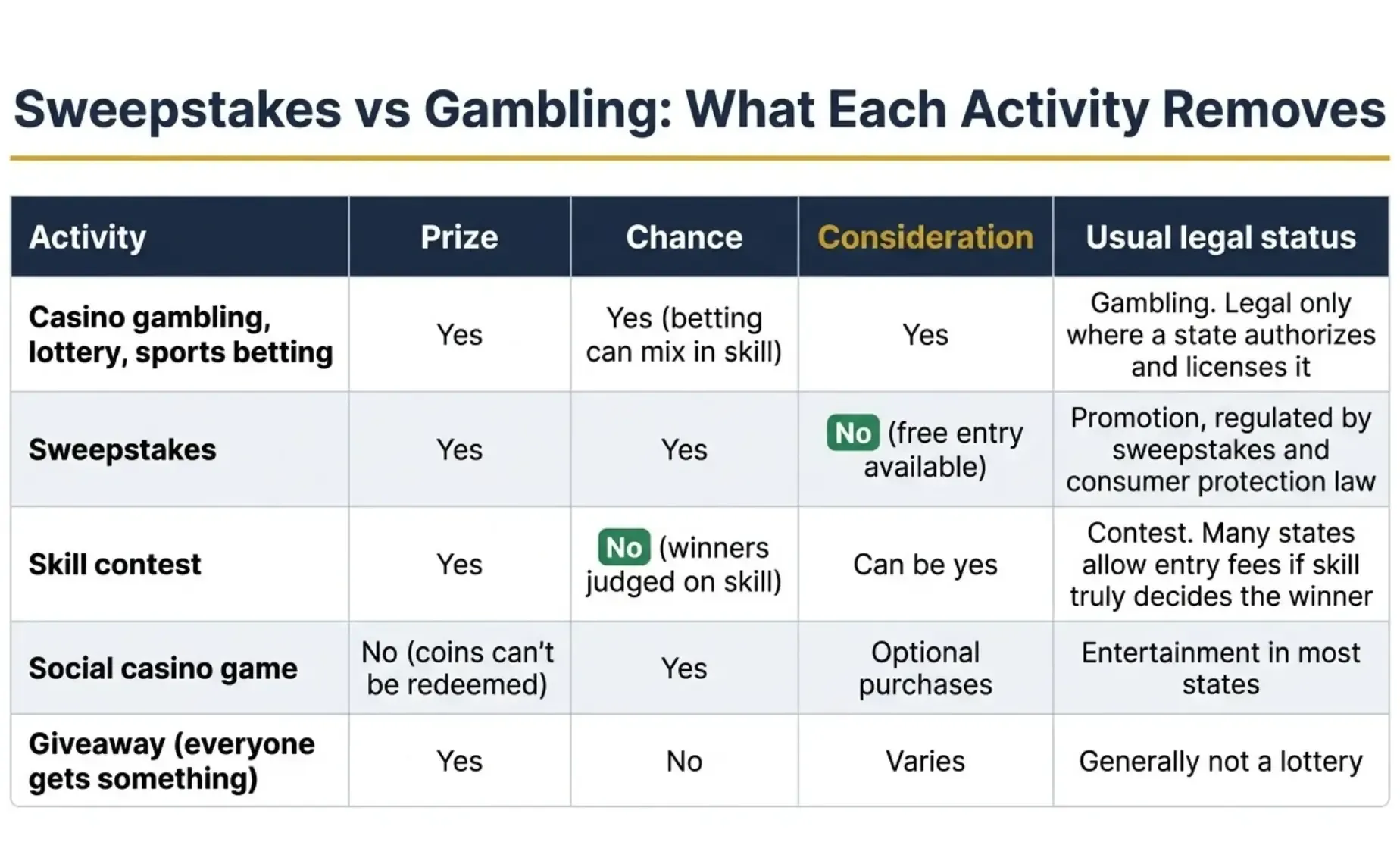
This is the core of the sweepstakes vs gambling distinction. A sweepstakes doesn’t remove luck and it doesn’t remove prizes. It removes the requirement to pay. That single design choice is the reason a cereal box game or a fast food promotion is lawful in places where a private lottery is not.
The U.S. Postal Inspection Service makes the same distinction in Publication 546, a consumer booklet it co-published: a lottery differs from a sweepstakes because it “requires some form of payment to participate,” and lotteries are illegal except when run by states and certain exempt charities.
Is sweepstakes considered gambling?
Generally, no, when it is properly structured. A sweepstakes with a genuine free method of entry lacks consideration, so it fails the three-element test in most states. That is why the Federal Trade Commission tells consumers that “real sweepstakes are free and by chance,” and warns that it is illegal for anyone to ask you to pay to increase your odds of winning.
“Properly structured” carries a lot of weight in that sentence, though. A sweepstakes can drift into gambling territory when:
- the free entry route is hard to find, hard to use or capped so tightly it barely exists;
- paid participants get better odds or more valuable entries than free ones;
- the “product” being sold has no real value apart from the sweepstakes entries attached to it;
- a state has passed a law that specifically defines the activity as gambling, whatever its structure.
The first three are judgment calls that courts and attorneys general make case by case. The fourth is a policy choice, and it is the one that changed the most in 2025 and 2026. Our guide to sweepstakes laws covers the general rules sponsors follow.
Why No Purchase Necessary carries so much weight
Because consideration is the element a sweepstakes removes, the free entry method is the whole legal foundation of the sweepstakes vs gambling distinction. If it fails, the promotion has all three elements again.
What a valid free entry looks like
The classic version is a mail-in entry: write your name and address on a card, mail it, receive an entry. Online forms are now common too. A June 2026 analysis by Thompson Coburn on online free methods of entry sets out the standard sponsors aim for: a valid AMOE “must be free, offer equal odds of winning, and be easily accessible and trackable.” The same analysis cites McDonald’s 2025 Monopoly promotion, which offered an online AMOE request form so customers could enter without buying food.
Equal dignity
Lawyers use the phrase “equal dignity” to describe the idea that the free route should be about as easy and as rewarding as the paid one. In Thompson Coburn’s words, “Equal dignity hinges on the AMOE being as simple as other paid or ‘consideration’ methods of entry.” An AMOE buried behind many pages, or one designed to discourage entry, can lead authorities to conclude the promotion is really an illegal gambling scheme.
Disclosure rules
For promotions sent through the mail, federal law adds disclosure requirements. According to Publication 546, the Deceptive Mail Prevention and Enforcement Act requires mailed sweepstakes to state clearly that no purchase is necessary and that a purchase will not improve the chances of winning, and it bars mailings that falsely tell people they have already won. Many states layer their own sweepstakes disclosure rules on top.
How this applies to sweepstakes casinos
Sweepstakes casinos apply the same structure to casino-style games. Players can purchase Gold Coin packages, which are a play-for-fun currency with no cash value. Sweeps Coins are promotional sweepstakes entries, given free with Gold Coin packages and also available with no purchase through the operator’s No Purchase Necessary method, such as a mail-in request. Sweeps Coins can be redeemed for sweepstakes prizes under the official rules, subject to eligibility, verification and minimums set out there. The legal theory is that the purchase is for Gold Coins, and the sweepstakes entries are free and equally available to everyone.
Whether that theory holds is exactly what regulators have been testing.
Sweepstakes vs betting
Betting is the most common word people use for gambling, and in legal terms it is gambling. When you place a bet, you stake money (consideration) on an uncertain outcome (chance) for a payout (prize). All three elements are present.
Sports betting is gambling, even with skill involved
Sports bettors often point out that research and knowledge matter. That’s true, but the outcome of a game is still outside the bettor’s control, which is why states regulate sports betting as gambling. Until 2018, a federal law called the Professional and Amateur Sports Protection Act (PASPA) stopped most states from authorizing it. On May 14, 2018, the Supreme Court decided Murphy v. NCAA and held that PASPA’s ban on states authorizing sports gambling violated the anticommandeering principle, which bars Congress from dictating what state legislatures may do. Since then, states decide for themselves, and those that allow sports betting do it through licensing.
How sweepstakes and betting differ
The difference comes down to payment and odds. A sweepstakes never requires payment to take part, because a free entry method must be available, while betting means staking money on every wager. In a sweepstakes, free and paid entries must have equal odds, but in betting larger stakes mean larger potential payouts and losses. Sweepstakes are governed by sweepstakes, promotion and consumer protection law and overseen by attorneys general and consumer protection agencies. Betting falls under state gaming law with licensing and is overseen by state gaming regulators.
The phrase sweepstakes vs betting can also describe a newer hybrid: sweepstakes-style sites that offer sports picks or pick’em contests. States have treated those with suspicion. New York’s 2025 law, for example, sits alongside the state’s licensed sports betting market, which Covers reported was left unaffected by the ban.
Where courts and regulators have pushed back on the sweepstakes vs gambling line
The three-element test has been around for a long time. So has the effort to find its edges. Here are the main points of friction.
Sweepstakes cafes and video sweepstakes machines
Before online sweepstakes casinos, the fight was over storefront “internet cafes” where customers bought internet time or phone cards and received sweepstakes entries revealed on screens that looked like slot machines.
North Carolina banned electronic machines that reveal sweepstakes results through an “entertaining display,” such as video poker. Operators argued the ban restricted free speech. In December 2012 the North Carolina Supreme Court disagreed in Hest Technologies v. State ex rel. Perdue, holding that the statute regulates conduct, not protected speech, and upholding it.
Florida followed in 2013. According to the Florida Senate’s bill summary of HB 155, the law limited the game promotion exception to sweepstakes “that truly are incidental to the sale of products or services,” and created a presumption that a device is an illegal slot machine if it simulates a game of chance, requires pay to play and awards something of value. The phrase “truly incidental” captures the core concern: the product being sold has to be the real reason for the purchase.
Virtual coins as a thing of value
The next challenge targeted the prize element. In 2018, the federal Ninth Circuit decided Kater v. Churchill Downs, a class action over a social casino app. The court held that virtual chips were a “thing of value” under Washington law because they extended the privilege of playing, even though they could not be cashed out, and let the player’s claim under Washington’s gambling loss recovery law proceed.
Washington’s gambling regulator later issued guidance on online social casinos stating that games where players use purchased virtual currency for a chance to win more of it “are likely to constitute illegal gambling” in the state. Washington is an unusual case because its law treats all gambling as illegal unless specifically authorized, but it shows that “no cash prize” is not a guaranteed defense.
Enforcement letters and lawsuits
State regulators have also used the laws already on their books. In 2025, New York’s attorney general sent cease-and-desist letters to 26 sweepstakes operators, and regulators in Louisiana, Arizona, Michigan and other states sent their own, according to iGaming Business’s 2025 review. In August 2026, Florida’s attorney general filed lawsuits against two large sweepstakes operators under existing gambling law and the state’s deceptive and unfair trade practices act, seeking injunctions and civil penalties, as Legal Sports Report summarized.
Private class actions have been filed too, often under state laws that let people recover money lost at illegal gambling. Results have been mixed and frequently turned on procedure rather than the gambling question itself. In July 2025, for instance, a federal judge in Georgia dismissed one such case on jurisdiction and arbitration grounds, CasinoBeats reported, without ruling on whether the model was gambling.
New laws aimed at the dual-currency model
The biggest change is legislative. Rather than argue about whether a free entry method removes consideration, a growing number of states have passed laws that target dual-currency online sweepstakes directly. As of November 2026, the enacted laws we could verify are:
- Montana: SB 555, effective Oct. 1, 2025
- Connecticut: SB 1235, signed June 2025
- New Jersey: A5447, effective Aug. 15, 2025
- California: AB 831, effective Jan. 1, 2026
- New York: S5935, signed December 2025
- Indiana: HB 1052, effective July 1, 2026
- Maine: LD 2007, enacted 2026
- Iowa: SF 2289, effective July 1, 2026
- Louisiana: HB 883, effective Aug. 1, 2026
- Tennessee: HB 1885 / SB 2136, signed May 22, 2026
- Oklahoma: SB 1589, effective Nov. 1, 2026
These laws differ in the details. Some create felonies (Montana, Connecticut, Oklahoma), some rely on civil penalties enforced by an attorney general or gaming commission (Indiana, Tennessee), and several extend liability to payment processors, geolocation providers, suppliers and affiliates. What they share is a decision to stop treating the free entry method as the end of the analysis. Louisiana’s 2026 law, for example, classifies dual-currency online sweepstakes games as illegal “gambling by computer,” according to InfoLawGroup’s 2026 summary.
California’s law also draws a useful line for this discussion. As Sweepsy reported, AB 831 targets games using the dual-currency model but does not cover social casino games that offer only a play-for-fun currency with no redemption. In other words, the state left the “no prize” model alone and went after the “no required purchase” model.
More bills are pending. A Pennsylvania ban was introduced in September 2026, and a Wyoming draft was under consideration for 2027, according to Legal Sports Report. The list will keep changing, so treat any state list, including this one, as a snapshot. Our page on whether sweepstakes casinos are legal explains the general picture, and an operator’s official rules list its current eligible states.
Gray areas: how the test plays out in practice
Some everyday examples make the sweepstakes vs gambling line easier to see. These are general illustrations, not rulings on any specific promotion.
A coffee chain prints game pieces on cups and also lets anyone request a free game piece by mail. Prize and chance are present, but the free route removes consideration. This is a standard sweepstakes.
A photo contest charges a $10 entry fee, and a panel of judges picks the winner using published criteria. Prize and consideration are present, but skill rather than chance decides the outcome. In many states that is a lawful skill contest, though some states restrict paid entry contests.
A storefront sells internet minutes nobody uses, and each purchase comes with sweepstakes entries revealed on slot-style screens. On paper there may be a free entry form. In practice, North Carolina and Florida both decided this kind of arrangement was gambling, because the “product” was not the real reason for the purchase.
An app sells virtual chips for slot-style games, and the chips can never be cashed out. In most states, no prize means no gambling. In Washington, the Ninth Circuit and the state regulator have said otherwise.
A sportsbook takes a $20 stake on a football game. All three elements are present. It is legal only if a state has licensed the operator.
What this means for you
You don’t need to master the finer points of sweepstakes vs gambling law to make sensible choices. A few habits cover most of it:
- Read the official rules before you take part. Look for the No Purchase Necessary section, the free entry method, eligibility by state, and how prizes are verified and awarded.
- Check that the free entry route is real and reasonably easy to use. If you can’t find it, that tells you something.
- Be skeptical of anything suggesting that paying improves your odds in a sweepstakes. The FTC calls that illegal.
- Know your state’s current rules. Laws in this area changed in more than ten states in under two years.
- Remember that prizes can have tax consequences. The IRS lists prizes and awards as taxable income in Publication 525. This is not tax advice, so speak with a tax professional about your situation.
Responsible play
The legal label on an activity doesn’t change how it can feel. Sweepstakes games, social casino games and real-money gambling all use random outcomes and fast feedback, and spending on optional purchases can add up. Set a budget and time limit before you start, and use any limit tools an operator provides.
If gaming of any kind is causing stress, the National Council on Problem Gambling offers a free, confidential National Problem Gambling Helpline. You can call or text 1-800-MY-RESET (1-800-697-3738) or use online chat, 24 hours a day.
FAQS
1. Is sweepstakes considered gambling?
A properly structured sweepstakes is generally not considered gambling because it removes consideration: anyone can enter free through a No Purchase Necessary method, with equal odds. Gambling requires a prize, chance and consideration together. That said, several states have passed laws since 2025 that treat dual-currency online sweepstakes casinos as illegal gambling regardless of their free entry route.
2. What is the difference between sweepstakes and gambling?
Gambling combines a prize, chance and a required payment to take part. A sweepstakes keeps the prize and the chance but makes entry free, usually through a mail-in request or online form, and paying must not improve your odds. That missing payment requirement is what moves a sweepstakes from gambling law into promotion and consumer protection law.
3. What is the difference between sweepstakes and betting?
Betting means staking money on an uncertain outcome for a potential payout, which makes it a form of gambling. Sports betting is legal only where a state licenses it. A sweepstakes never requires a payment to participate, offers equal odds to free entrants and is governed by sweepstakes law rather than gaming law.
4. What are the three elements of gambling?
The three elements are prize (something of value you can win), chance (an outcome decided mostly by luck rather than skill) and consideration (paying money or giving something of value to take part). Most US states treat an activity as gambling or an illegal lottery only when all three are present at the same time.
5. Why does no purchase necessary matter so much?
It removes consideration, the one gambling element a sweepstakes can drop while still offering prizes awarded by chance. For that to work, the free method must be genuinely free, give equal odds and be reasonably easy to use. If the free route is a formality, regulators and courts may treat the promotion as gambling.
6. Have courts ever ruled against sweepstakes-style games?
Yes. The North Carolina Supreme Court upheld the state’s ban on video sweepstakes machines in 2012, and Florida tightened its sweepstakes rules for internet cafes in 2013. In 2018 a federal appeals court held that virtual casino chips could be a thing of value under Washington law. Outcomes depend heavily on each state’s statutes.
7. Are sweepstakes casinos gambling?
It depends on where you are. In many states, sweepstakes casinos operate as promotional sweepstakes because Sweeps Coins are free entries and Gold Coins have no cash value. As of November 2026, at least eleven states have enacted laws that prohibit dual-currency sweepstakes casinos, so availability depends on your state and the operator’s official rules.
Understanding the rules before you play
In the end, sweepstakes vs gambling comes down to whether you have to pay to take part, and whether your state has decided that the free entry method settles that question. For anyone curious about a sweepstakes platform, the most informative document is its official sweepstakes rules: they show the free entry method, the eligible states, and how prizes are verified and awarded. Read them first, and check your own state’s current law.
New to GoldenDragon.Casino? Use code DRAGON20 for 20% off when eligible. Limited to one use per user, valid through January 1, 2030.
This article is for general educational purposes and is not legal advice. Laws change frequently and vary by state. If you need advice about a specific situation, talk to a licensed attorney in your state.