

How Does Digital Card Shuffling Work Without a Physical Deck?
Published Nov 17, 2026

Casino
Digital card shuffling is a short piece of code that puts 52 items in an order nobody can predict. There are no hands, no cards and no riffle. The program takes a list, runs a procedure, and produces a sequence that is supposed to be a fair draw from every possible arrangement of the deck.
That "supposed to" carries a lot of weight. A shuffle can look random on screen and still be flawed underneath. This guide explains how card shuffling works in software, what separates a sound shuffle from a biased one, and how independent testing tries to catch the difference. It is written for curious players and for anyone who has wondered whether a virtual deck can be trusted.
Everything here is educational. Nothing in this article is advice on how to beat a game, and no shuffle method changes the fact that outcomes in card games are uncertain. A short section near the end also explains how sweepstakes platforms such as GoldenDragon.Casino are structured, since that context affects how you should think about the games.
Key takeaways
- A digital shuffle has two parts: an algorithm that rearranges the deck (the standard choice is the Fisher-Yates shuffle) and a random number generator that feeds it choices.
- A 52-card deck has 52! arrangements, a 68-digit number. A good system has to be able to reach all of them, not just a small slice.
- The most common failures are not exotic. They are a naive swap loop, a modulo shortcut, or a seed with too few possible values.
- Pseudo-random generators are deterministic. Their quality depends on the algorithm, the seed, and how the output is used.
- Independent labs run statistical tests and review code, but a test report is evidence of quality, not a guarantee of any result.
- On a sweepstakes platform, Gold Coins are for entertainment only and Sweeps Coins are promotional. A fair shuffle does not make any outcome certain.
What card shuffling means in software
A physical shuffle is a messy mechanical process. You cut the deck, riffle the halves together, and repeat. The result is a rough mixing of the order, and how rough depends on how well you do it.
Software skips the mechanics entirely. A deck is stored as an ordered list, for example the numbers 0 to 51, each mapped to a card. Card shuffling is then a matter of producing a permutation of that list. A permutation is just a particular ordering. Once the program has one, dealing is trivial: take the first card, then the second, and so on.
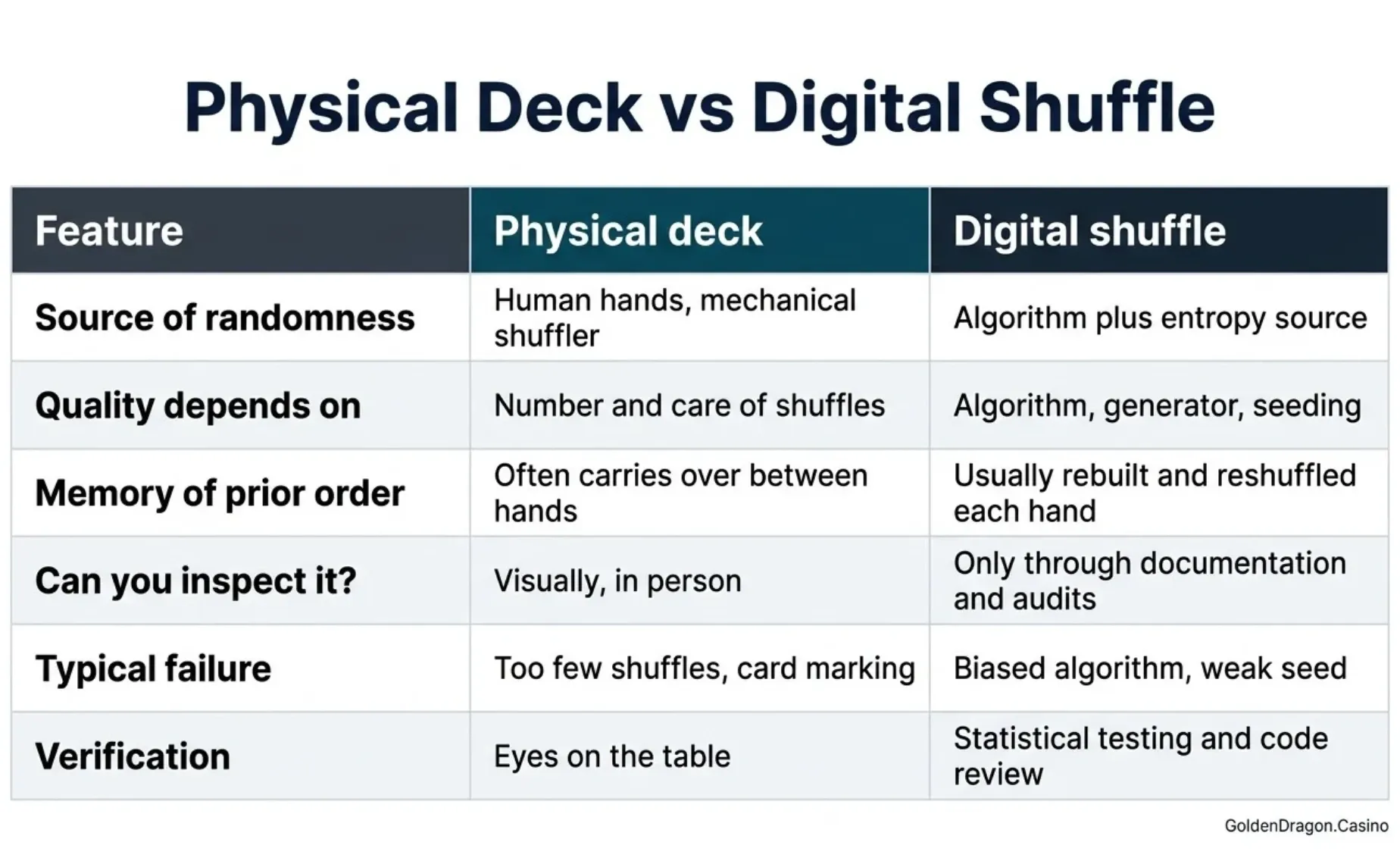
There is no memory of how the deck "was" a moment ago, which is one real difference from the table. In a casino, a dealer may use a deck that has been played through several times, and the previous order feeds into the next. In most digital implementations the deck is rebuilt in a fixed order and shuffled from scratch for every hand. Each hand starts clean. That detail matters later, when we get to the myth of "due" cards.
Two components do all the work:
- The shuffle algorithm. The step-by-step procedure that rearranges the list.
- The randomness source. The thing that supplies unpredictable numbers to that procedure, usually a random number generator.
Get the first one wrong and the shuffle is biased no matter how good the randomness is. Get the second one wrong and the shuffle can be predictable even with a perfect algorithm. Both have to be right.
How many ways can a deck be arranged?
The size of the problem is worth seeing once. The number of orderings of 52 distinct cards is 52 factorial, written 52!, which means 52 x 51 x 50 and so on down to 1. We computed it directly in a script rather than quote it from memory:
52! = 80,658,175,170,943,878,571,660,636,856,403,766,975,289,505,440,883,277,824,000,000,000,000
That is a 68-digit number, roughly 8.07 x 10^67. A few comparisons make it concrete. A 32-bit number can hold only 4,294,967,296 values (about 4.29 x 10^9), and a 64-bit number holds 18,446,744,073,709,551,616 values (about 1.84 x 10^19). A 128-bit number reaches about 3.40 x 10^38 values, which is still far short of the number of possible shuffles. Only a 256-bit number, at about 1.16 x 10^77 values, is large enough to cover every arrangement.
Taking the base-2 logarithm of 52! gives about 225.58. In plain terms, you need at least 226 bits of information to be able to name every possible shuffle of a deck. A 32-bit seed can pick out only about 4.3 billion different shuffles, a vanishingly small fraction of 52!, and a 64-bit seed is still tiny by comparison.
Why does that matter? If a system derives each shuffle from a seed, the number of distinct shuffles it can ever produce is capped by the number of distinct seeds. A system seeded with 32 bits can never deal more than 4,294,967,296 distinct decks, no matter how long it runs. That is not necessarily a fairness problem in everyday terms, since 4.3 billion is a lot of hands. It is a predictability problem, and we will come back to it.
A common framing says “every shuffle you see has probably never happened before in history.” That is true of physical shuffling, where the sheer size of 52! makes repeats astronomically unlikely. For a digital system with a small seed space, it is not automatically true. It depends on the design.
The Fisher-Yates shuffle
If you read only one section, read this one. The standard way to shuffle a list fairly is the Fisher-Yates shuffle, also called the Knuth shuffle.
Ronald Fisher and Frank Yates described the original pencil-and-paper version in 1938. Richard Durstenfeld published the faster in-place computer version in 1964, and Donald Knuth later popularized it in The Art of Computer Programming. The modern version is only a few lines long.
Here is the idea in words. Start at the last position in the deck. Pick a random position from the start of the deck up to and including that last position. Swap the card there with the card in the last position. Now the last card is settled and never touched again. Move one step toward the front, and repeat with a smaller range, until you reach the first position.
In pseudocode:
for i from 51 down to 1:
j = random integer from 0 to i (inclusive)
swap deck[i] and deck[j]
That is the whole algorithm. Three properties make it the right tool:
- It is unbiased, assuming the random picks are unbiased. Every one of the 52! orderings comes out with exactly the same probability. The proof is short. There are 52 choices for the first pick, 51 for the next, then 50, and so on, which multiplies out to exactly 52! equally likely paths. Each path ends in a different final ordering, and no ordering is reached by two paths.
- It is fast. It does one pass and one swap per card, so the work grows in step with the deck size.
- It is in place. It needs no second list.
The key phrase is the first one: assuming the random picks are unbiased. Fisher-Yates does not create randomness. It converts a stream of fair random integers into a fair permutation. If the integers are skewed or predictable, the shuffle inherits that.
One detail trips people up: the range of the random pick shrinks as you move through the deck. At step i, the pick is between 0 and i, not between 0 and 51. That small shrinking range is what makes the count of outcomes come out to exactly 52! rather than 52 to the 52nd power. Which brings us to the shuffle that gets it wrong.
Why naive shuffles are biased
The most common mistake looks harmless. A programmer loops through every position and swaps each card with a randomly chosen position anywhere in the deck:
for i from 0 to 51:
j = random integer from 0 to 51 // full range every time
swap deck[i] and deck[j]
It feels random. Every card gets moved. But it is provably biased, and the reason is a counting argument.
This loop makes 52 independent choices, each from 52 options, so it has 52^52 equally likely paths. The number of distinct orderings is 52!. For the shuffle to be fair, 52^52 would have to divide evenly by 52!, so every ordering is reached by the same number of paths. It does not divide evenly. Some orderings are reached by more paths than others, so they are more probable.
You can see this on a tiny deck. We ran the naive loop for every possible sequence of random choices on a three-card deck. That is 3^3 = 27 paths for 3! = 6 orderings. A fair shuffle would give each ordering 4.5 paths, which is impossible, so the split cannot be even. The actual counts are uneven. Out of 27 equally likely paths, the orderings (2, 3, 1), (2, 1, 3) and (1, 3, 2) each turn up 5 times (18.5 percent each), while (3, 1, 2), (3, 2, 1) and (1, 2, 3) each turn up only 4 times (14.8 percent each). A fair shuffle would give each ordering about 16.7 percent.
On a four-card deck the same exercise gives 4^4 = 256 paths for 24 orderings, and the counts range from 8 to 15. The most common ordering appears nearly twice as often as the least common.
On a full deck the skew is subtler to the eye but it exists, and it is exactly the kind of structural flaw a statistical test can find. The takeaway is a rule worth remembering: when the number of equally likely paths does not divide evenly by the number of outcomes, the shuffle is biased. Fisher-Yates passes this test by construction. Naive swap-with-anyone does not.
Other ways a shuffle goes wrong
The naive loop is the famous one. A few others show up in real code reviews.
Sorting by a random key. Some developers shuffle by assigning each card a random number and sorting the deck by it. That can be fine if the keys are drawn from a large enough range with no ties. It goes wrong when the sort comparison itself is random (for example, a comparator that returns a random sign), because many sorting algorithms assume consistent comparisons and produce uneven results when they do not. It is also needlessly slow compared with Fisher-Yates.
Modulo bias. Suppose your generator produces a 32-bit number and you need a random position from 0 to 51. The tempting shortcut is number % 52. The trouble is that 2^32 is 4,294,967,296, and 4,294,967,296 does not divide evenly by 52. It leaves a remainder of 48. So 52 x 82,595,524 = 4,294,967,248 values map evenly, and the last 48 values wrap around and make positions 0 through 47 very slightly more likely than 48 through 51. With a 32-bit source the effect is tiny, about one extra chance in 82 million for the favored positions. With a small source, such as a single byte (256 values, remainder 48 again when divided by 52), the skew is large: positions 0 to 47 come up 5 times in 256 while 48 to 51 come up only 4. The standard fix is rejection sampling. You throw away any raw value that falls into the uneven leftover zone and draw again.
Off-by-one range errors. Picking j from 0 to i-1 instead of 0 to i produces a variant sometimes called Sattolo's algorithm, which only generates cyclic permutations. A card can never stay in place. That is useful for some tasks and wrong for a deck.
Too little randomness for the list. Python's documentation on random.shuffle carries a note that, for long enough lists, the number of permutations can exceed the period of the underlying generator, so most orderings can never occur. For a 52-card deck, the Mersenne Twister generator it uses has a period of 2^19937 - 1, which is far larger than 52!, so that specific concern does not apply to cards. The principle still does: the generator and the size of the thing being shuffled have to be matched.
Where the randomness comes from
Fisher-Yates needs a steady supply of random integers. There are two broad sources.
Pseudo-random number generators
A pseudo-random number generator, or PRNG, is an algorithm that produces a long sequence of numbers that pass statistical tests for randomness. The word "pseudo" is honest: the sequence is fully determined by a starting value called the seed. Start from the same seed and you get the same sequence, every time.
That sounds like a weakness, and for gambling-style games it can be one. For simulations, it is a feature, because it makes results reproducible. The issue is purely about who knows the seed and whether the internal state can be worked out from the outputs.
Generators fall into two practical groups:
- General-purpose PRNGs, such as the Mersenne Twister, are designed for statistical quality and speed. The Mersenne Twister has an internal state of 624 32-bit words and a period of 2^19937 - 1. That is enormous, and it passes most standard statistical batteries. But it is not designed to resist an attacker. If someone observes enough consecutive outputs (624 32-bit values is the commonly cited figure), the entire internal state can be reconstructed and every future output predicted. It is a fine tool for a physics simulation and a poor one for anything where prediction matters.
- Cryptographically secure PRNGs, or CSPRNGs, are built so that observing any amount of output does not let you predict the next value, as long as the internal state stays secret. Operating systems expose these, and well-known constructions include ones built on stream ciphers and hash functions. A game that cares about unpredictability should use one of these.
Hardware and operating system entropy
A seed has to come from somewhere unpredictable. Operating systems gather entropy from timing jitter, hardware events, and dedicated hardware random number generators on many processors, and mix it into a pool that applications can draw from. A well-designed system takes its seed from that pool and feeds a CSPRNG, rather than inventing its own seed.
Dedicated hardware generators, which measure physical noise such as thermal or electronic effects, exist too. Some systems use them directly; others use them only to seed a software generator. We do not have visibility into how any particular operator configures its stack, so treat claims on this point as something to look for in published documentation rather than assume.
PRNG seeding: where good shuffles go to die
Seeding is the step that sounds minor and has caused the most embarrassing failures in the history of digital card games.
Here is the logic. If the seed is predictable, the whole shuffle is predictable, even with perfect Fisher-Yates and a high-quality generator. A seed taken from the system clock in seconds, or milliseconds, has very few plausible values. An attacker who knows roughly when a hand was dealt can try every plausible seed, regenerate the shuffle for each, and see which one matches the cards already visible. After that, the rest of the deck is known.
This is not hypothetical. A widely cited 1999 analysis of an online poker site's shuffle, written by security researchers who reviewed the published algorithm, described several flaws at once. As commonly recounted, the shuffle used a naive swap loop, drew from a generator limited to a 32-bit seed, and seeded it from the server's clock. Combining those, the number of possible decks was far below 52!, and a player who could synchronize with the server's clock could narrow the possibilities to a small set. We are describing the general shape of that account from memory of the public write-ups and cannot verify every detail, so read it as a cautionary illustration rather than a precise record. The lesson holds regardless: three individually small mistakes compounded into a shuffle that did not deserve the name.
The arithmetic from earlier explains why. With a 32-bit seed there are at most 4,294,967,296 possible decks, against 8.07 x 10^67 possible orderings. The reachable decks are a speck. Narrowing the seed by guessing the clock reduces that speck further.
A sound design does these things:
- Seeds from the operating system's entropy source, not from the clock.
- Uses a seed and internal state large enough to cover the problem, ideally 256 bits for a full deck.
- Uses a CSPRNG so that observing dealt cards reveals nothing about future ones.
- Reseeds periodically, or uses a construction that does so automatically.
- Keeps the generator on the server, so players cannot observe or influence its inputs.
That last point is a real structural difference between digital and physical games. In a browser game, the shuffle should happen on a server the player does not control, not in client-side code that could be inspected or manipulated.
Digital shuffling versus the real thing
How does all this compare with a hand shuffle? It is worth being fair to the physical deck, because it has its own limits.
Mathematicians Dave Bayer and Persi Diaconis analyzed the riffle shuffle in a well-known 1992 paper. Their result, widely quoted, is that about seven ordinary riffle shuffles are needed to mix a 52-card deck reasonably well by their chosen measure. Fewer than that leaves detectable structure. A casual two or three riffles, which is what many people do at a kitchen table, leaves a deck that is far from random. This is a result about a specific mathematical model of an idealized riffle, so treat "seven" as a guide rather than a law of nature.
A correctly implemented Fisher-Yates shuffle with a good random source is, in the mathematical sense, a better shuffler than any human hand. It has no habits, no fatigue, and no tendency to leave runs of cards together.
The trade-off is trust. At a physical table you can watch the deck. On a screen you cannot see anything. You are relying on the code, the randomness source, and whatever oversight exists. That trust question runs through the whole history of casino games, from mechanical slot machines to social play.That is why independent testing matters.
How independent testing works
If you cannot see the shuffle, someone else has to look at it on your behalf. That is the job of independent testing laboratories, and it is worth understanding in general terms, because the reports are easy to over-read.
Testing usually has two layers:
Statistical testing of the output. The lab collects a very large quantity of generator output and runs it through standard batteries of statistical tests. Publicly documented suites include the NIST SP 800-22 test suite, the Dieharder battery, and TestU01. These check things like whether zeros and ones appear in equal measure, whether patterns repeat more than chance allows, and whether the numbers cluster. For card games, labs also test the shuffle itself: they run many thousands or millions of shuffles and check that each card is equally likely to land in each position, that pairs and runs appear at expected frequencies, and so on.
Review of the implementation. Statistics can miss a flaw that only exists in rare conditions. So reviewers also read or test the code and the surrounding system: how seeds are produced, whether the generator is a suitable type, whether range mapping avoids modulo bias, whether the shuffle algorithm is a correct Fisher-Yates, and whether game logic handles the numbers correctly after they leave the generator. They also look at operational controls, such as who can change the software and how changes are tracked.
A few honest limits apply:
- Passing tests proves absence of detected flaws, not absence of flaws. No statistical battery can certify randomness. It can only fail to find non-randomness.
- Testing is a snapshot. A report covers a specific version of the software at a point in time. Updates need re-review.
- Certification says nothing about outcomes. A certified fair shuffle means the deck is unbiased. It does not mean any particular player, any particular hand, or any particular session will go a certain way.
- Not all labs and standards are equal. Different jurisdictions recognize different bodies and technical standards. A certificate is more useful when it names the issuer, the date, the software version, and the scope.
When you read an operator's fairness page, useful questions include: Who performed the testing? Is the report or certificate available to read, or only a logo? Does it name a version and a date? Does it cover the shuffle and the random number generator, or only one of them? Vague statements like "our games are tested" tell you little. We are not able to speak to any specific laboratory result here and do not attempt to.
What you can check yourself
You cannot audit a shuffle from the outside, but you can do a few sensible things.
- Look for a named, dated testing statement. Check whether it identifies an independent body and a software version.
- Read the game rules. Reputable games publish how many decks are used, whether the deck is reshuffled every hand, and any rule variations.
- Be skeptical of streak logic. If a pattern seems to appear, remember that people are very good at seeing patterns in random data.
- Treat any "system" claim cautiously. If a shuffle is sound, no betting pattern or timing trick can predict the next card.
That fourth point deserves a sentence of its own. A strong shuffle is not a puzzle to be solved. If someone tells you they have found a way to read it, they are selling something.
Common myths about digital shuffling
"The game is due to deal a good hand." If each hand is shuffled independently, the previous hand has no influence on the next. Streaks happen in random sequences all the time, and they say nothing about what is coming. This is the gambler's fallacy, and it is the single most common misunderstanding about shuffling.
"A shuffle that repeats a card pattern is broken." Not necessarily. With 52! orderings, any specific pattern is rare, but patterns that look meaningful to humans, such as three aces in a row, are not rarer than any other specific arrangement of the same size. We notice some outcomes more than others.
"Random means evenly spread." Real randomness is clumpy. If a shuffle produced a perfectly even spread of suits every time, it would be evidence of a flaw, not quality. The same clumpiness is why slot volatility produces long dry spells and sudden clusters of wins.
"Online shuffles can be rigged mid-hand by the house." This is a trust question rather than a mathematical one, and the honest answer is that it depends on the operator and its oversight. Independent testing, published rules, and regulatory structures exist to address that concern. They reduce the need for blind trust. They do not eliminate the value of reading what is actually published.
"Software shuffles are less random than real ones." The mathematics says the opposite for a well-built system. A sound digital shuffle is closer to uniform than almost any hand shuffle. The risk is not that software is inherently weaker, but that mistakes in software are invisible to the player.
A quick test you can run to see bias for yourself
If you write code, you can reproduce the demonstration above in a few minutes. Take a three-card or four-card deck. Enumerate every possible sequence of random choices for the naive swap loop, apply each, and count how often each final ordering occurs. Then do the same with Fisher-Yates, where the pick at step i ranges only from 0 to i. The naive loop gives an uneven table. Fisher-Yates gives a flat one, with every ordering hit by exactly the same number of paths.
We did this ourselves while preparing this article, and it is the quickest way to make the bias argument feel real rather than abstract. Seeing 5-5-5-4-4-4 in a table does more than any proof.
How sweepstakes platforms fit in
Because this guide is published by GoldenDragon.Casino, it should say how a sweepstakes platform works, so the card examples above are read in the right context.
A sweepstakes casino is not a real-money gambling site. It operates under sweepstakes law rather than gambling law, with a promotional structure built around a "no purchase necessary" principle. In general terms:
- Gold Coins are a play-for-fun currency. They are used for entertainment, they have no cash value, and they cannot be redeemed for prizes.
- Sweeps Coins are promotional. They are typically distributed free, for example through sign-up offers, daily login rewards, or a mail-in request, and depending on the platform's rules they can sometimes be redeemed for prizes after meeting eligibility and verification requirements.
- No purchase necessary. Under the sweepstakes model, there must be a free method of entry. Platforms may sell Gold Coin packages, but buying them is not required to participate, and purchases do not improve any odds of a prize.
Specifics differ by operator and by location. Eligibility depends on age and on where you live, and some regions restrict or prohibit sweepstakes games. The official rules published by each platform are the authoritative source, and you should read them before taking part. Nothing here is legal advice, and this article does not describe how any particular title on GoldenDragon.Casino is configured beyond the general principles above.
How does this connect to card shuffling? A shuffle is a mathematical process that is meant to be independent of who is playing and what currency is used. The same fairness questions apply whether a game uses Gold Coins or Sweeps Coins: is the algorithm sound, is the seed secure, has an independent party tested it, and are the rules published? A fair shuffle also makes no promise about results. Any outcome in a card game remains uncertain, and nothing about shuffling quality should be read as a path to prizes.
If you take part in any online game, set limits on your time, treat it as entertainment, and step away if it stops being enjoyable. Support organizations in your region can help if play feels hard to control.
Frequently asked questions
1. What is card shuffling in a digital game?
Digital card shuffling is the process of arranging a virtual deck into a random order using an algorithm and a random number generator. Instead of physically mixing cards, the software takes an ordered list of 52 items and rearranges it, most commonly with the Fisher-Yates shuffle. The goal is that every possible ordering is equally likely.
2. What is the Fisher-Yates shuffle?
The Fisher-Yates shuffle, also called the Knuth shuffle, is an algorithm that rearranges a list fairly. It works backward through the list, swapping each position with a randomly chosen position at or before it. If the random numbers are unbiased, every permutation comes out with exactly equal probability. It was first described by Ronald Fisher and Frank Yates in 1938 and adapted for computers by Richard Durstenfeld in 1964.
3. How many possible shuffles of a 52-card deck are there?
There are 52 factorial arrangements, which is about 8.07 x 10^67. Written out, it is an 80,658,175,170,943,878,571,660,636,856,403,766,975,289,505,440,883,277,824,000,000,000,000. Naming every possible ordering requires at least 226 bits of information, which is why a 32-bit seed can only ever reach a tiny fraction of them.
4. Why is a naive shuffle biased?
A naive shuffle that swaps every card with a random position anywhere in the deck has 52^52 equally likely paths but only 52! possible results. Since 52^52 is not evenly divisible by 52!, some orderings are reached more often than others. On a three-card deck, the naive method produces three orderings with 5 of 27 paths each and three with only 4, instead of an even split.
5. Is a pseudo-random number generator good enough for card shuffling?
It can be, if it is the right kind. A cryptographically secure PRNG with a large seed taken from operating system entropy is generally considered suitable. A general-purpose generator such as the Mersenne Twister has excellent statistical properties but can be predicted once enough output is observed, so it is a weaker choice where unpredictability matters. The seed and how the output is converted into card positions matter as much as the generator.
6. How do independent labs test random number generators?
Labs typically combine statistical testing with code and system review. They run large samples of generator output and shuffled decks through test batteries such as NIST SP 800-22, Dieharder, or TestU01, and check that card positions are evenly distributed. Reviewers also examine seeding, range mapping, and change controls. A passing result shows no flaws were detected in the tested version. It does not guarantee any particular outcome.
7. Does a fair shuffle mean I am more likely to win on a sweepstakes platform?
No. A fair shuffle means the deck order is unbiased and unpredictable, which protects the integrity of the game. It does not change the uncertainty of results, and it does not guarantee prizes. On sweepstakes platforms, Gold Coins are for entertainment only and have no cash value, while Sweeps Coins are promotional and may be redeemable for prizes subject to the official rules, eligibility, and verification.
Closing thoughts
Card shuffling looks like the simplest part of a card game and turns out to be one of the more instructive pieces of applied mathematics. The recipe is short: a Fisher-Yates loop, a large seed from a trustworthy entropy source, a generator built to resist prediction, and range mapping that avoids modulo bias. The failures are equally short: a swap loop that is almost right, a seed that is too small, a clock used as a secret.
For anyone evaluating a digital card game, the practical habit is to look for specifics. A named independent tester, a dated report, a software version, and published rules say more than a badge ever will. And whatever the shuffle quality, treat games as entertainment with uncertain outcomes, read the official rules of any platform you use, and keep your play within limits that feel comfortable.
New to GoldenDragon.Casino? Use code DRAGON20 for 20% off when eligible. Limited to one use per user, valid through January 1, 2030.