
Casino games explained: Types, RNG, RTP and Sweepstakes Play
Published Oct 17, 2026
Casino
You open a casino game for the first time. Maybe it's a spinning reel, a cannon aimed at a fish, or a dealer waiting to see if you'll hit. Different screens, different pace.
Underneath, they all do the same job. A random number generator picks the result, and a math model sets how often each result can show up.
This guide covers the main types of casino games, what RNG, RTP and volatility mean, and how sweepstakes versions differ from real-money ones. On that last point, the games look alike while the currency and the law behind them differ.
GoldenDragon.Casino is a sweepstakes casino, not a real-money gambling site. This guide is educational only, so check the official rules and your state's eligibility before taking part in any promotion.
Key takeaways
- Casino games fall into five families: slots, table games, fish games, live-style games and quick speciality games.
- RNG software decides most digital outcomes, and every round is independent of the last one.
- RTP is a long-run design figure, so it says little about your session. Volatility tells you how bumpy the ride will feel.
- Hit chances in fish games are built into the game, even though aiming feels like skill.
- Sweepstakes versions use Gold Coins and Sweeps Coins under promotion law, and no result is guaranteed.
Types of casino games at a glance
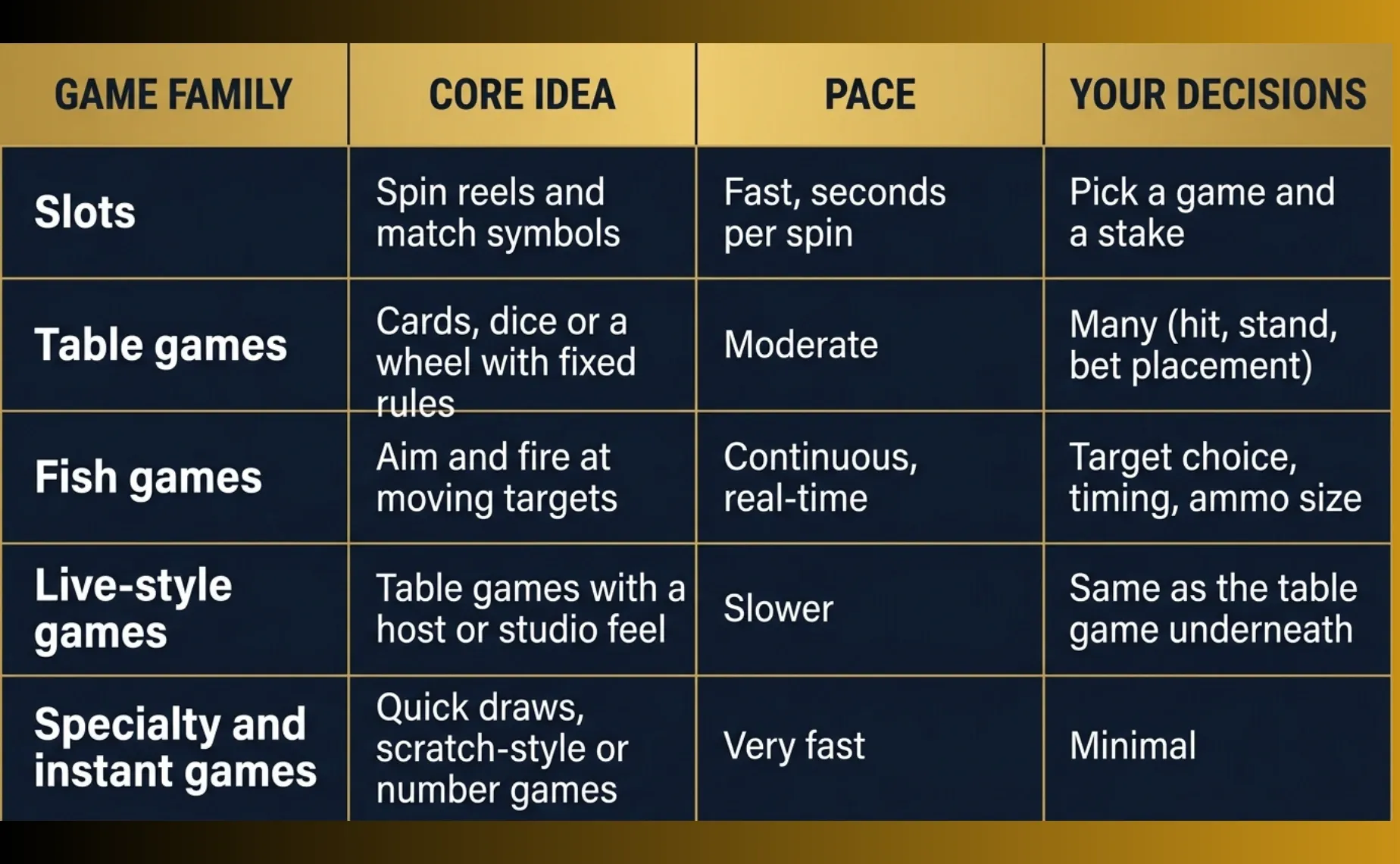
Most game libraries sort into the families below. Exact mixes vary by site, so use this as a rough map.
Slots: the biggest category
A classic slot has three reels and one payline. A modern video slot usually has five reels, several rows and anywhere from a handful to hundreds of ways to win. Some skip lines altogether and pay on clusters of touching symbols.
Here's what trips people up: the reels are theatre. The moment you press spin, the software has already drawn the result. The spinning, the near misses and the slow reveal are presentation. Think of it as a lottery draw with a light show attached.
So a slot has no memory. A game that's been quiet for an hour isn't "due," and a game that just paid big isn't cooling off.
Paylines, ways and features
A payline is a fixed path across the grid. Match symbols along it and that line counts. A ways-to-win game drops the fixed paths and counts matching symbols on adjacent reels from left to right, which is how a five-reel game ends up with thousands of ways.
Then come the extras: wilds that substitute for other symbols, scatters that trigger bonus rounds, multipliers that scale a result, free spins. They add variety, and they all sit inside the same math model that sets how the game behaves over time.
Table games: rules, odds and real decisions
Table games are the oldest part of the casino, and the part where your choices matter most. Digital versions follow the same rules as physical ones. Software handles the shuffle, the wheel or the dice.
Blackjack
The goal is a hand closer to 21 than the dealer's without going over. You choose whether to hit, stand, double down or split, and those choices change your odds.
Rules matter more than you'd expect. The number of decks, whether the dealer stands on soft 17 and what a blackjack pays all shift the built-in edge. A table paying 3 to 2 is a different game from one paying 6 to 5, and the info screen tells you which one you're looking at.
Roulette
A ball lands in a numbered pocket. European wheels have one zero. American wheels have a zero and a double zero, and that extra pocket raises the house edge in a conventional casino.
Inside bets on single numbers are rare and pay a lot. Outside bets like red or black cover more of the wheel and pay less. The bet type sets the payout, and the wheel stays the same.
Baccarat
Baccarat compares a Player hand and a Banker hand, with a tie as a third option. Drawing rules are fixed, so you're really just picking a side. It's easy to learn and easy to misread: the pattern boards in some games don't predict the next round.
Poker-style games
Casino poker usually pits you against a paytable instead of other players. Video poker is the clearest case of skill mattering, since good hold decisions raise the long-run return compared with bad ones. The shuffle is still random, so no decision guarantees a given hand.
Fish games: arcade action with a casino layer
Fish games look nothing like the rest of a library. You see an underwater scene, aim a cannon and fire at fish, sea creatures and the occasional boss target. Small targets are easy to hit and pay little. Big or rare ones are harder to hit and pay more.
Plenty of players assume it's all skill. Aiming and timing shape how you spend your ammo. Hit results come from probabilities built into the game, usually RNG-driven. Picture an arcade interface sitting on top of a probability model.
The real catch is speed. There are no natural pauses between rounds, so a coin balance can drain faster than you'd guess, especially at higher ammo tiers. Check the cost per shot before you fire, look for any stated RTP or notes on boss targets, and set a time or balance limit first. For a deeper look, see our fish table games explainer.
Live-style games: the table, presented differently
Live-style games borrow the feel of a table with a host. In real-money settings that usually means a studio, a human dealer and physical equipment on camera. In sweepstakes settings the label can mean different things: some are host-led presentations, others are software versions styled to feel similar. The game's info screen and the platform's help pages are the only reliable way to tell.
The mechanics underneath stay the same. Live-style blackjack is still blackjack. What changes is the rhythm, with slower rounds and a betting countdown. If slots feel too fast, you might like this pace. If you like speed, you'll probably find it a drag.
One practical difference: with real equipment, the physical wheel, deck or dice decides the outcome. With a software version, RNG does. Both can be fair, through different mechanisms.
Specialty and instant games
Most libraries also carry a few quick games that fit nowhere else: keno-style number draws, scratch-style reveals, simple dice or multiplier formats. They're fast, light on decisions and almost entirely RNG.
The appeal is simplicity. The catch is the same as with fish games, because short rounds add up quickly.
How RNG works in casino games
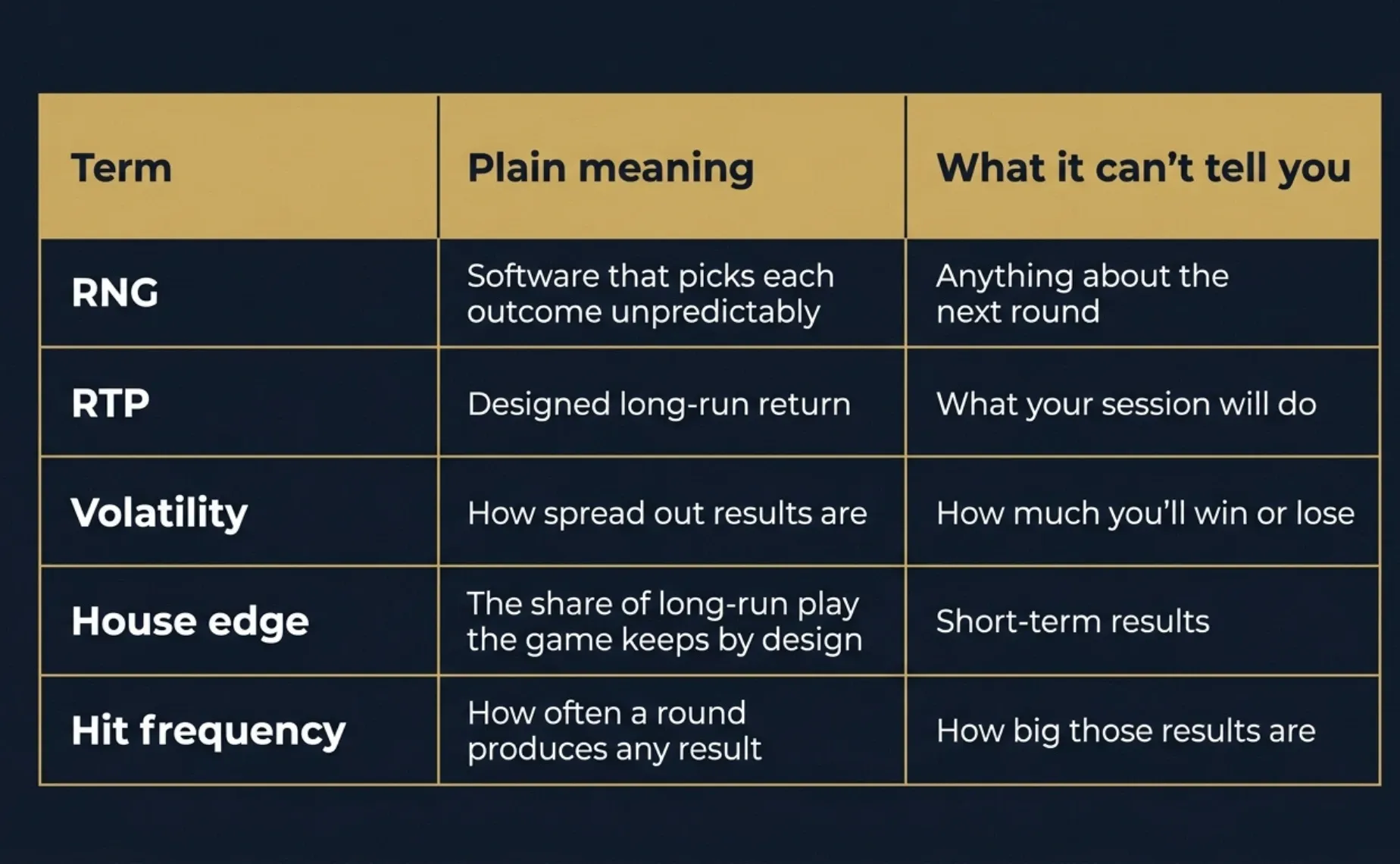
RNG stands for random number generator. Strictly speaking it's a pseudo-random generator, since it follows an algorithm, but a well-designed one produces output that's statistically indistinguishable from true randomness. When you press spin or deal, the game takes a number from that stream and maps it to an outcome: a symbol arrangement, a card order, a hit result.
Three properties matter. The numbers should be unpredictable. They should be evenly distributed, so every outcome shows up at the rate the math says it should. And they should be independent, so one round doesn't influence the next.
Independent testing labs check those properties. A passing result certifies that version of the game as fair by design, and your session can still go either way.
Some common RNG myths:
- Results arrive in tidy patterns. Randomness produces streaks and clusters.
- A game becomes due for a result after a dry spell. Each round is drawn fresh.
- Time of day, stake size or spin speed changes your outcomes. None of them do.
RTP and volatility: the two numbers to understand
RTP, return to player, is the percentage of all staked value a game is designed to return over a very large number of rounds, usually modeled across millions of simulated ones. A 96 percent RTP doesn't mean you'll get 96 back from every 100. A single session can land far above or far below it.
So why care? Because it's a handy way to compare games. All else equal, a higher-RTP game has a smaller built-in edge. Some games ship in several RTP versions, so the figure on the info screen of the version you're actually playing is the one that counts.
Volatility, sometimes called variance, is how bumpy the ride is. A low-volatility slot pays small results often, so sessions feel steady. A high-volatility slot pays small results rarely and bigger ones occasionally, so sessions feel streaky, with long quiet stretches. Neither is better, and the same RTP can sit behind both.
Some info screens label volatility directly. If yours doesn't, a huge top prize paired with tiny line results usually points high.
Sweepstakes casino games vs real-money casino games
On screen, they can look identical. The differences sit underneath, in the currency, the legal basis and the nature of the outcome.
A sweepstakes casino typically runs two virtual currencies. Gold Coins are for entertainment, have no cash value and can't be redeemed. Sweeps Coins are promotional and may be redeemable for prizes under the official rules, after eligibility and identity checks.
A free way to enter must exist (that’s what ‘no purchase necessary’ means), so the model is structured as a promotion rather than gambling. Some states still restrict or prohibit it, which is why eligibility matters. Our guide to Gold Coins vs Sweeps Coins covers the details, and Sweepstakes Gaming Explained walks through the legal logic.
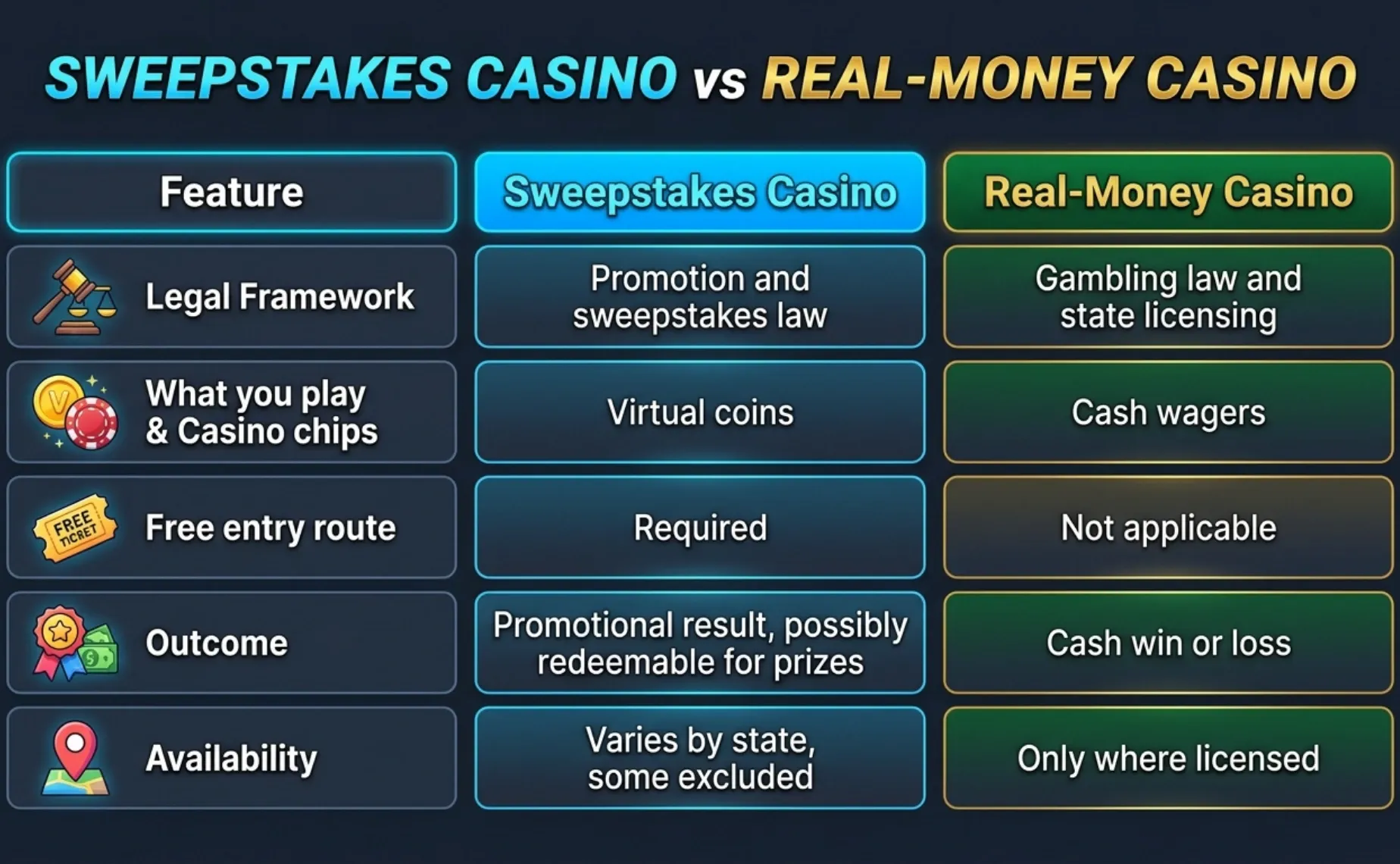
That's a structural comparison and carries no ranking. Details depend on each platform's own terms, so the official rules are always the source of truth.
How to read a game info screen
Almost every game has an info or help screen, usually behind an "i" or three lines. Most people skip it, which is a shame, because it holds nearly everything in this guide. Read it before your first round, before anything confusing happens. Look for:
- The RTP, and whether it applies to your version
- A volatility rating, or clues like top prize size
- The paytable and the rules for bonus features
- The stake range, so you know what a round costs in coins
- Which coin type the game uses
A minute of reading answers most of the questions people end up sending to support.
Responsible play
These games are built to be engaging. That's fine for entertainment, and it's a reason to set boundaries early. Decide your time and coin limits before you start, treat any purchase as an entertainment expense, and never use money you need for bills or essentials.
Don't chase losses. Take breaks, especially with fast formats like slots and fish games, and use any limits or time-out tools the platform offers.
If play stops being fun, step away and reach out for support. In the United States, the National Problem Gambling Helpline is available at 1-800-GAMBLER, and many states run their own services. Participation is for adults only, and the minimum age varies by jurisdiction. For more, see our responsible play page.
Frequently asked questions
What are the main types of casino games?
The main families are slots, table games, fish games, live-style games and specialty or instant games. Slots are fast and built around reels and symbols. Table games use cards, dice or a wheel with fixed rules and give you the most decisions. Fish games are real-time target games, live-style games add a host or studio feel to table games, and specialty games are quick draws or scratch-style formats.
What does RNG mean in casino games?
RNG stands for random number generator, software that selects the outcome of each round unpredictably. Slots, many table game versions, fish games and instant games commonly use it. Each round is drawn independently, so past results don't predict future ones, and no pattern or schedule changes the odds.
What is RTP, and is a higher RTP better?
RTP, or return to player, is the percentage of all staked value a game is designed to return over a very large number of rounds. All else equal, a higher RTP means a smaller built-in house edge. It's a long-run figure, so it says nothing certain about a single session and promises no result.
What is volatility in slots?
Volatility describes how spread out a game's results are. Low-volatility slots pay small amounts often and feel steady. High-volatility slots pay small amounts less often and larger ones occasionally, so sessions feel streakier. Two games can share the same RTP and feel completely different to play.
Are fish games skill or chance?
Both play a part, but chance sets the odds. Your target choice, timing and ammo management shape how you experience the game. Hit probabilities are generally built into the game design, often through RNG, so skill can't override them.
Is a live-style game the same as live dealer?
Not always. In real-money settings, live dealer games are usually streamed from a studio with a human dealer and physical equipment. In sweepstakes settings, a live-style label can mean a host-led presentation or a software version styled to feel similar. The game's information screen and the platform's help pages explain which one you're playing.
How do sweepstakes casino games differ from real-money casino games?
The games can look nearly identical. Sweepstakes versions use virtual coins inside a promotion, with a required free way to enter, and operate under promotion law. Real-money casinos accept cash wagers under gambling licenses. Eligibility for sweepstakes games varies by state and age, so check the official rules before taking part.
Where to go next
If you want the full picture of how the sweepstakes model works, start with Sweepstakes Gaming Explained and our guide on how to win at sweepstakes casinos. Then read the official rules for any platform you're curious about.
If you’d like to see how it all works in practice, GoldenDragon.Casino is a good place to start. New players can use code DRAGON20 for 20% off when eligible, limited to one use per user and valid through January 1, 2030.