

Fish Table Game Tips That Actually Make a Difference
Published Oct 11, 2026
Casino
Key Takeaways
- The highest-value tip in fish table games is matching weapon tier to target size; using a strong, expensive weapon on small fish wastes coins.
- Target selection and timing are real skills here, but the catch outcome of any individual shot is still governed by a certified random outcome system, not marksmanship alone.
- Holding coins in reserve for a building bonus event tends to produce better results than spending everything before the event even arrives.
- Session pacing matters more in fish games than in slots, since the constantly active screen makes it easy to fire continuously without noticing how fast your balance is moving.
- Trying a title in Gold Coin mode before committing Sweeps Coins remains the single most effective way to avoid an expensive learning curve.
Most "tips" articles about fish table games, the generic kind you can find scattered across forums and quick listicles, repeat the same three lines: aim carefully, manage your coins, and know when to stop. All true, but none of it explains why those things matter or how to actually apply them during a session. The tips below go a layer deeper, based on how these games are actually built, and on the patterns that show up again and again once you've watched enough sessions play out from start to finish, across enough different titles to see what's common to the genre versus what's specific to one game.
Tip 1: Match Your Weapon to the Target, Not the Other Way Around
The single most common inefficiency in fish table play is weapon mismatch: using a high-cost weapon on low-value fish, or a weak weapon on a boss fish that needs sustained firepower to crack. Every weapon tier has a cost-per-shot and a rough effectiveness range. Spend a few minutes with a new title's weapon list before a serious session, and treat weapon selection as a decision tied to what's currently on screen, not a fixed setting you pick once and forget.
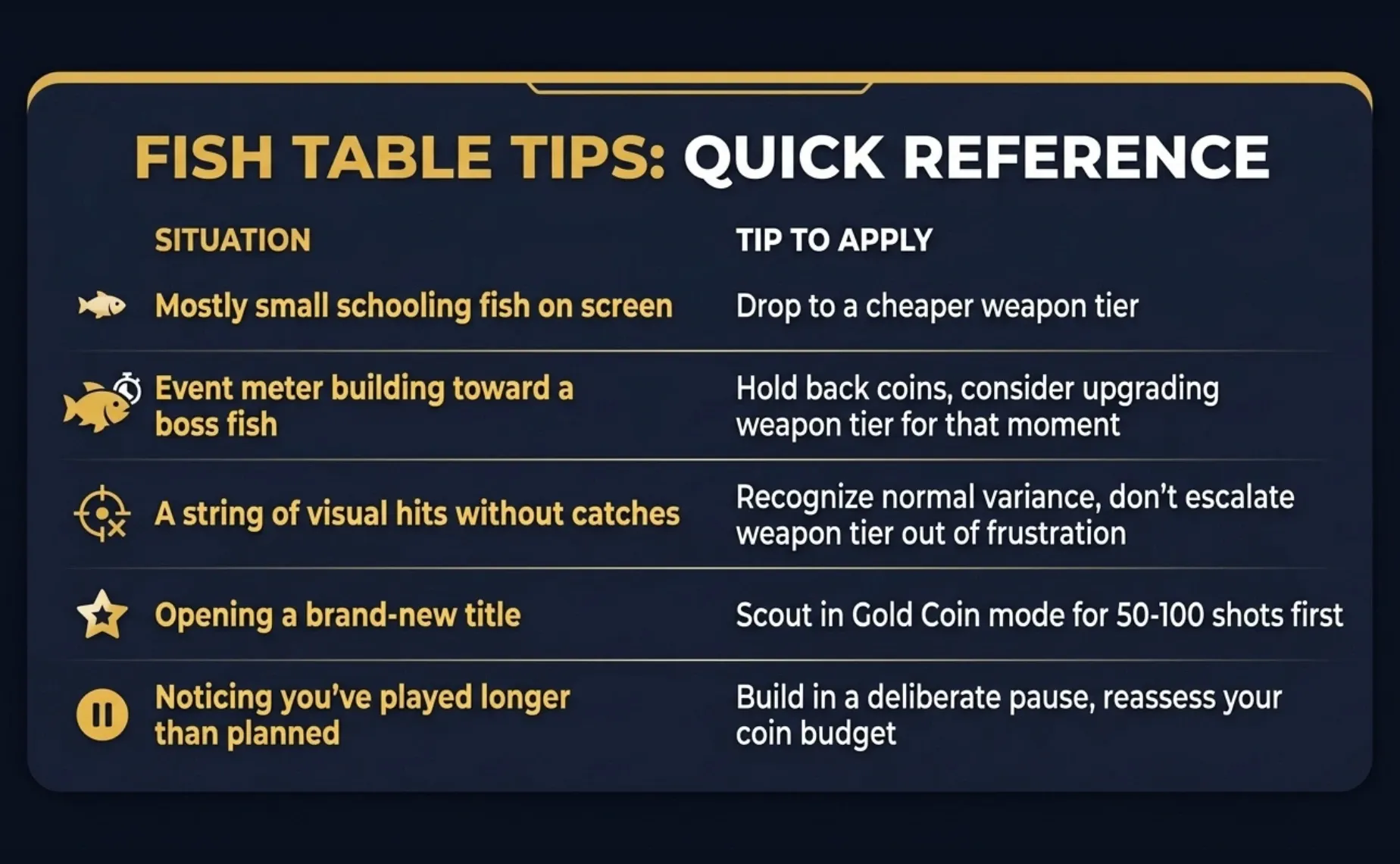
A practical rule that holds up across most titles: if you're mostly seeing small, fast schooling fish, drop down to a cheaper weapon. If a boss fish event is building, that's the moment to switch up, not before. Think of weapon tier the same way you'd think of choosing the right size tool for a job: using a sledgehammer on a thumbtack technically works, but it's not a good use of effort or resources.
Tip 2: Track Before You Fire
Firing reactively at whatever crosses your cursor wastes far more ammunition than tracking a specific fish for even half a second before committing a shot. This matters more for faster-moving or higher-value fish, where a mistimed shot is both more costly and less likely to land.
This is less about reflexes and more about patience. Watching a fish's path for a moment, anticipating where it'll be when your shot arrives, and firing into that spot rather than its current position is the core skill that separates efficient players from players who are just spraying shots.
Tip 3: Reserve Coins for Bonus Events
Nearly every fish table title builds toward some kind of special event: a boss fish, a multiplier creature, or a screen-wide effect. These events are disproportionately valuable compared to routine small-fish catches, which means running out of coins right before one triggers is one of the more costly timing mistakes a player can make.
Watch for the visual or audio cues that signal a building event, and consciously hold back a portion of your balance once you notice one approaching. This single habit tends to improve how a session "feels" more than almost anything else, since the big moments are what most players remember and enjoy most.
Tip 4: Don't Confuse a Visual Hit With a Catch
It's tempting to assume that if your shot visually lands on a fish, you should have caught it. The actual catch result runs through the game's certified random outcome system, which uses the fish's assigned catch probability and your weapon's strength to determine whether that specific shot converts into a payout. A visual hit and an actual catch aren't guaranteed to be the same thing.
Understanding this changes how you interpret a "cold" stretch. A string of visual hits without catches isn't a sign the game is broken or unfair; it's the probability working out the way it's designed to, especially against higher-value fish with inherently lower catch rates.
Curious how that works? Here’s what RNG means in casino games.
Tip 5: Use Gold Coins to Scout New Titles
Every fish table game has its own fish values, weapon costs, and event frequency. Jumping straight into Sweeps Coin play on a brand-new title means learning all of that on coins that carry a prize value, which isn't an efficient way to learn. A short scouting session in Gold Coin mode, even just 50 to 100 shots, tells you most of what you need to know about a title's pacing before you decide how to spend your Sweeps Coins on it.
Need coins to scout with? Here’s how to get free Sweeps Coins.
Tip 6: Treat the Screen's Constant Motion as a Pacing Trap
Unlike a slot, where each spin takes a couple of seconds and naturally builds in a pause, a fish table screen is continuously active. Fish keep swimming whether you're shooting or not, which creates a subtle pull to keep firing just because there's always something to aim at. This is worth being aware of specifically because it's easy to burn through a coin balance faster than intended without any single decision feeling like the cause.
A simple fix: build in your own pauses. Fire in short bursts, check your balance, and decide deliberately whether to continue, rather than letting the constant on-screen motion dictate your pace.
See how fish games compare to slots in our fish games guide.
Tip 7: Compare Bet Level Against Session Length Goals
Your bet level is a lever, not a fixed setting. If your goal for a session is to play for a while and enjoy the mechanics, a lower bet level stretches your coin balance across more shots. If you're specifically trying to have a meaningful stake in an approaching bonus event, a moderate bump in bet level right before that event can make the payout, if you catch something, more worthwhile. Adjusting this consciously, rather than setting it once at the start and forgetting about it, is a small habit that compounds over a session.
New to GoldenDragon.Casino? Use code DRAGON20 for 20% off when eligible. Limited to one use per user, valid through January 1, 2030.
Tip 8: Learn a Title's Fish Roster Before Chasing Big Targets
Every fish table game sorts its fish into a rough hierarchy of small, mid, large, and special/bonus creatures, and the exact values differ from title to title. Spend some of your early scouting time specifically noting which fish types appear most often and roughly how they're valued relative to each other. This lets you make faster decisions mid-session about which targets are actually worth prioritizing, rather than guessing based on size alone, since a visually large fish isn't always the highest-value target in every title.
Tip 9: Don't Chase Losses by Jumping Weapon Tiers
If a stretch of shots isn't connecting, the instinct is often to switch to a stronger, more expensive weapon, assuming it'll "break through." This doesn't work the way it feels like it should. Each shot is still an independent probability event; a stronger weapon improves your odds against a given fish type, but it doesn't guarantee a catch, and it costs more per shot while you figure that out. If a cold stretch is frustrating you, a short break is a more effective response than escalating your weapon tier out of frustration. Slots have cold stretches too. Here’s slot volatility explained.
Tip 10: Keep a Rough Mental Note Across Sessions
You don't need a spreadsheet, but a loose memory of which titles felt efficient, which weapon tiers worked well against which fish types, and roughly how often bonus events appeared gives you something to build on the next time you play. Over several sessions, this kind of informal tracking tends to sharpen your instincts faster than playing each session as if it were your first.
Tip 11: Pay Attention to Weapon Cooldowns and Fire Rate
Some weapon tiers fire faster than others, and a few titles include a brief cooldown between shots at higher tiers to balance their increased power. If you're not accounting for this, you can end up "wasting" taps or clicks that don't actually register as shots, which feels like the game is unresponsive when it's really just a timing mismatch between your input and the weapon's actual fire rate.
Spend a moment in Gold Coin mode specifically testing how quickly a given weapon tier can fire in succession. Knowing this rhythm ahead of time means you're not accidentally spacing your shots too closely or too far apart during a real session.
Tip 12: Use Sound and Animation Cues, Not Just the Visual Meter
Many fish table titles layer in audio cues, a shift in background music, a rising tone, or a distinct sound effect, as a bonus event approaches, sometimes slightly ahead of when the visual meter fully registers it. Players who primarily watch the screen without sound on, especially on mobile, can miss these early signals.
If you're playing with sound available, it's worth leaving it on, at least during your first several sessions on a new title, specifically to learn what the audio cues sound like. Once you've learned them, you can react to a building event even in the half-second before it's visually obvious, which is enough time to make a quick weapon switch if needed.
Tip 13: Recognize That Bigger Isn't Always Better
It's a natural assumption that the largest fish on screen is always the best target, but that's not universally true. Some titles include mid-size fish with unusually high point values relative to their catch difficulty, essentially a better payout-to-effort ratio than the obviously large "boss" style fish. This varies by title, which is part of why the scouting period in Gold Coin mode matters: it's your chance to notice these exceptions before you're playing with Sweeps Coins.
Why These Tips Work: A Closer Look at the Math
It helps to understand, at a basic level, why weapon-matching and target selection actually affect your results instead of just feeling like good practice. Every fish in a fish table game has two core numbers behind it: a catch probability and a point value. Multiply those together, averaged across a large number of shots, and you get that fish's expected return per shot at a given weapon tier.
A small fish might have a catch probability of, say, 70% at a base weapon tier, with a modest point value. A boss fish might have a catch probability closer to 5% per shot at that same base tier, but with a point value high enough that its expected return per shot is still meaningfully different, sometimes higher, sometimes lower, depending on the specific numbers the developer set. Upgrading your weapon tier against the boss fish increases that catch probability, which changes the math in your favor for that specific matchup, but it also raises your cost per shot.
None of this is information the game typically displays as a raw number the way a slot might show its RTP. But understanding that this math exists, and that it's different for every fish-and-weapon combination, is what separates a tip like "match your weapon to your target" from being vague advice versus being a genuinely useful habit grounded in how the game is actually built underneath the visuals.
Slots use the same idea. Here’s what RTP means in slots.
Tip 14: Don't Let a Big Win Change Your Baseline Behavior
Landing a large catch, especially from a boss fish or multiplier event, can shift how a session feels and tempt you into raising your bet level or weapon tier well beyond what you'd normally use, on the assumption that a hot stretch will continue. Treat a big catch as a result on its own, not as new information about the odds of your next shot. The probability behind the next shot is exactly the same as it was before the big catch happened.
Putting the Tips Together: A Quick Reference
Mistakes That Undo All of the Above
Even with good habits, a few patterns can quietly cancel out the benefit:
- Switching titles too frequently. Jumping between several fish table games in one session means you never build enough familiarity with any single title's fish values and event timing to apply these tips effectively.
- Ignoring the event meter entirely. Some players fire continuously without ever glancing at whether a bonus event is approaching, missing the exact moments where coin reserves matter most.
- Assuming a tip from one title transfers perfectly to another. Weapon costs and fish values aren't standardized across the genre, so a weapon-tier habit that works well in one game may be inefficient in another.
How These Tips Change Between Casual and Focused Sessions
Not every session needs to apply all fourteen tips with equal intensity. A casual session, where the goal is simply to relax and enjoy the visuals and shooting mechanic, can get away with looser weapon management and less attention to the event meter. A focused session, where you're more deliberately trying to use your Sweeps Coins efficiently, benefits from applying nearly all of them: scouting in Gold Coin mode first, tracking the event meter closely, matching weapon tiers carefully, and pacing your shots with deliberate pauses.
Being honest with yourself about which type of session you're in helps set reasonable expectations. A casual session that happens to burn through coins faster than a focused one would isn't a failure of strategy; it's just a different way of using the same game.
A Note on Reading Other Players' "Guaranteed" Tips
It's worth being skeptical of any tip, from any source, that claims a specific button sequence, timing trick, or betting pattern guarantees a catch or a bonus event. Because catch outcomes run through a certified random outcome system, there's no sequence of inputs that overrides the underlying probability. The tips in this guide are about efficiency and informed decision-making within that system, not about finding an exploit, because no such exploit exists on a properly built and certified game.
Here’s an honest look at how to win fish table games.
Frequently Asked Questions
What are fish table games?
Fish table games are arcade-style shooting games where players use a weapon to catch on-screen fish of varying point values for coins. They originated in physical multiplayer arcade cabinets and are now a common category in sweepstakes casino game libraries.
How does sweepstake casino work?
A sweepstakes casino offers games using two currencies: Gold Coins for play-for-fun gaming, and Sweeps Coins, available through no-purchase-necessary methods or promotions, which can be redeemed for a prize under the platform's official rules.
Do fish table game tips guarantee better results?
No single tip changes the underlying probability of any individual shot, since catch outcomes are governed by a certified random outcome system. These tips are about using your coins more efficiently and understanding the game's mechanics, not about overriding the built-in odds.
What is the biggest mistake new players make in fish table games?
Using an expensive, high-tier weapon against small, low-value fish is one of the most common inefficiencies, since the extra cost per shot usually isn't justified by a small fish's modest payout.
How can I get free sweeps coins to practice these tips?
Common no-purchase-necessary methods include daily login bonuses, mail-in or email entry requests described in a platform's official rules, and occasional promotions. Gold Coin mode is also available for practicing mechanics without touching Sweeps Coins at all.
Is sweepstakes gaming the same as gambling?
No. Sweepstakes gaming offers a free, no-purchase-necessary path to obtain Sweeps Coins and a genuine chance at a prize, which removes the payment-to-play element that defines gambling under most state laws.
Do stronger weapons always catch fish faster?
A stronger weapon generally increases catch probability and damage against larger fish, but it also costs more per shot and fires at a different rate depending on the title. Against small, low-value fish, a stronger weapon often isn't more efficient, even though it may still catch them with a higher per-shot probability.
Why does a cold streak happen in fish table games?
A cold streak, a stretch of shots without a catch, is a normal outcome of probability-based gameplay, the same way a slot can go several spins without a win. It reflects the fish's catch probability playing out over a small sample, not a malfunction or unfairness in the game.
Summary
The tips that actually move the needle in fish table games come down to matching your weapon to your target, tracking before firing, reserving coins for bonus events, and treating a cold stretch as normal variance rather than a reason to escalate. None of it changes the underlying odds on any given shot, but it does change how efficiently you use the coins you have, and how much of a specific title's pacing you understand before committing more of your Sweeps Coins to it.
If you're newer to the genre, revisiting the basic step-by-step mechanics alongside these tips tends to make the whole learning process click faster, and the combination of knowing both the how and the why is usually what turns a confusing first session into a genuinely enjoyable one by the third or fourth try, which is roughly how long it takes most players to stop thinking about the controls and start actually enjoying the game.
New to the genre? Start with what fish table games are, then come back to these tips.