
Slot Machine Sounds: Why Casino Games Sound the Way They Do
Published Oct 31, 2026
Casino
Turn the volume off on any online slot and something odd happens. The game feels thinner. The spin that seemed exciting a minute ago now looks like a grid of pictures changing places. That gap between the silent version and the loud one is the whole subject of this guide.
Slot machine sounds are not decoration. Designers build them on purpose, test them, and layer them to tell you what is happening, to set a mood, and to make small events feel larger than they are. That is worth understanding, especially if you play on a sweepstakes site like GoldenDragon.Casino, where the point of the experience is entertainment and awareness matters more than excitement.
We wrote this guide as the GoldenDragon.Casino editorial team. We are not audio engineers, psychologists, or regulators, and we say so where our knowledge runs out. What follows is a general, education-first explanation of how slot audio works, why it affects how you feel, and why it has no effect on results. Where research or industry practice is unsettled, we hedge instead of guessing.
Key Takeaways
- Slot machine sounds do three jobs: they give feedback (something happened), they set a mood (music and ambience), and they mark rewards (jingles and effects).
- Sound is often louder and more celebratory than the event it describes. A small return can get a big fanfare.
- Audio can make near-misses and small returns feel more exciting. Researchers have discussed this under terms like "near-miss" effects and "losses disguised as wins."
- Sounds never change outcomes. Results come from a random number generator (RNG) that decides the result before the reels finish animating.
- On a sweepstakes casino, Gold Coins are for play only and have no redeemable value, while Sweeps Coins are promotional and can be redeemed for prizes under the official rules. Audio feels the same either way, so it helps to know which coin you are using.
- Practical habits help: set a time limit, mute when you want a clearer head, and treat celebration sounds as animation, not information.
Why Slot Machine Sounds Exist in the First Place
Early slot machines were mechanical, and they made noise because machinery makes noise. Reels clicked into place, levers clanked, and coins dropped into a metal tray. Nobody had to design that soundscape. It simply came with the hardware.
Over time the noise became a feature. The bell is a good example. The Liberty Bell machine, commonly credited to Charles Fey in the 1890s, is one of the best known early designs, and bells became so tied to slot play that the sound still shows up in modern games with no physical bell anywhere near them. We are cautious about exact dates and details of that history because accounts differ, but the broader pattern is well documented: a sound that began as a mechanical byproduct became a signal people recognized.
Then the hardware changed. Electromechanical and later fully digital machines no longer needed to clatter. Yet game makers kept the clatter, and in many cases added more of it. That tells you something. If sound were merely a leftover, it would have faded as the mechanics disappeared. It stayed because designers learned it does real work.
In online slots, there is no hardware at all. Every sound is a file triggered by software at a chosen moment. That gives audio designers total control. They decide when the reel stop sounds, how long the win music lasts, and how a bonus feature announces itself.
The three jobs of slot audio
Almost every sound in a modern slot falls into one of three categories.
- Feedback: Sounds that confirm an action. You press spin and hear a start tone. Each reel stops with a soft thud. A button click tells you the game registered your input.
- Atmosphere: Background music and ambient layers that give the game a theme. A pirate slot has waves and creaking wood. An ancient-temple slot has drums and chimes. This layer sets mood, not information.
- Reward and event marking: Jingles, rising tones, and flourishes that signal a feature, a return, or a special symbol landing.
Keeping these three straight makes the rest of the guide easier. When a sound confuses you, ask which job it is doing.
The Building Blocks of Slot Machine Sounds
Take a typical online slot and pull the audio apart. Most games share the same layers, even when the themes look nothing alike.
Interface and spin sounds
These are the small, functional noises: the click when you change your stake size, the whoosh when reels start, the tick as each reel stops. They are short and quiet on purpose. Their job is to make an on-screen action feel physical. A button that makes no sound can feel broken, even if it works fine.
Reel stops deserve a closer look. In a game with five reels, the stops usually arrive one after another, left to right. The delay between stops creates rhythm and a little suspense. Some games slow the last reel down when earlier reels have lined up something interesting. That is a presentation choice, and we come back to it below when we discuss near-misses.
Background music
Slot music is usually a loop, a short piece designed to repeat without becoming irritating. Loops have to work for people who play for ten minutes and for people who play for an hour. So designers tend toward steady, mid-energy music that does not demand attention. It sits underneath everything else, filling gaps so the game never feels empty.
Many games also change the music when something special happens. A free-spin round might swap the calm theme for a faster, brighter track. The change itself is a signal: you have entered a different mode. This is feedback by contrast. You do not need to read a label to know the game state has shifted.
Symbol and win sounds
Individual symbols often get their own sounds. A high-value symbol might trigger a chime when it lands. A wild might have a distinctive whoosh. Some games build a short melody out of consecutive symbol sounds, so a run of matching symbols produces a rising phrase.
Then comes the win presentation. Most slots scale their audio to the size of the return. A small return gets a brief tone. A larger one gets a longer jingle, maybe with counting sounds as the number on screen climbs. A very large one can get a full fanfare. In principle that is sensible: bigger event, bigger sound.
In practice, the scale is more generous than you might expect, which leads to the next section.
Bonus and feature audio
Features such as free spins, pick-and-reveal rounds, and multipliers usually have their own sound design. The anticipation phase often has a distinct sound: a building drone, a drumroll, or a series of rising notes. The payoff phase gets a release. Builders of film scores use the same trick. Tension and release are among the oldest tools in music, and slots borrow them freely.
How Sound Shapes the Way Play Feels
This is the part people usually come for, so let us be careful and clear. We are describing well-established, general ideas about how sound influences attention and emotion. We are not claiming that any single sound produces a particular behavior in any individual, and we are not quoting studies we have not read.
Sound as feedback
Feedback is a basic concept in how people and machines interact. You do something, the system responds, and the response tells you the action counted. Fast, clear feedback makes interfaces feel responsive. Slow or missing feedback makes them feel uncertain.
Slots lean hard on this. Spin, sound, stop, sound, result, sound. The loop is short, which keeps each round feeling lively. The audio is a major reason a game with simple mechanics can feel busy and rewarding.
Reinforcement and the pull of "something just happened"
Psychology has long described reinforcement: when an action is followed by a pleasant event, people tend to feel drawn to repeat it. Slot sound design fits that pattern. A spin leads to a sound, and some sounds are pleasant, celebratory, or exciting.
What makes it interesting is that the pleasant sound does not always track a meaningful event. A game can celebrate a result that returns less than the stake, or the same as the stake, with the same bright tones it uses for a genuine gain. We will look at that in a moment. For now, the takeaway is simple: the sound tells you how the game wants the moment to feel, not necessarily what the moment is worth.
Anticipation
Anticipation is a feeling many people enjoy in its own right. Think about the quiet before a drumroll ends or the second before a gift is opened. Slots build anticipation with sound: reels that spin a beat longer, tones that climb, music that thins out just before a reveal.
There is nothing sinister about anticipation as such. Movies, sports broadcasts, and board games use it constantly. It becomes worth noticing when you realize the anticipation is manufactured by presentation. The reels were never going to land differently because the music swelled. The RNG had already settled it.
Near-miss presentation
A near-miss is a result that looks close to a winning combination without being one, such as two matching top symbols on a line with the third just off the line. Researchers in gambling studies have discussed near-misses for decades, and the general finding people cite is that near-misses can feel more exciting than clear losses, even though they are still losses. We are describing the concept in broad terms and are not claiming a specific measured effect.
Sound can amplify that feeling. A rising tone as the last reel slows, followed by a soft "aww" style descending effect, can make a near-miss feel like a thing that almost happened. In reality, a near-miss is a loss with a dramatic costume. The result was fixed before the animation began.
Losses disguised as wins
This phrase comes up in discussions of slot design, and it describes a specific, easy-to-understand situation. On a multi-line slot you can place a stake across many lines. A single line might return less than your total stake. The game then plays a win sound and shows a win animation, but your balance went down overall.
Because the sound is the same celebratory kind you hear on a real gain, some commentators argue it can blur your sense of how a session is going. You hear several "wins" and feel like you are doing well, when the running total is falling. Whether any particular game does this, and how strongly, varies, so check the numbers on screen rather than trusting the music.
A simple habit helps: watch the balance, not the jingle.
What Sound Cannot Do: Outcomes Come From RNG
Everything above is about how sound feels. This section is about what sound does to results: nothing.
Online slots use a random number generator. When you press spin, the software produces a result, and the reel animation then displays it. The animation, music, and effects are all downstream of that result. They cannot influence it, cannot predict it, and cannot be "read" for hints.
Let us put some common beliefs to the test.
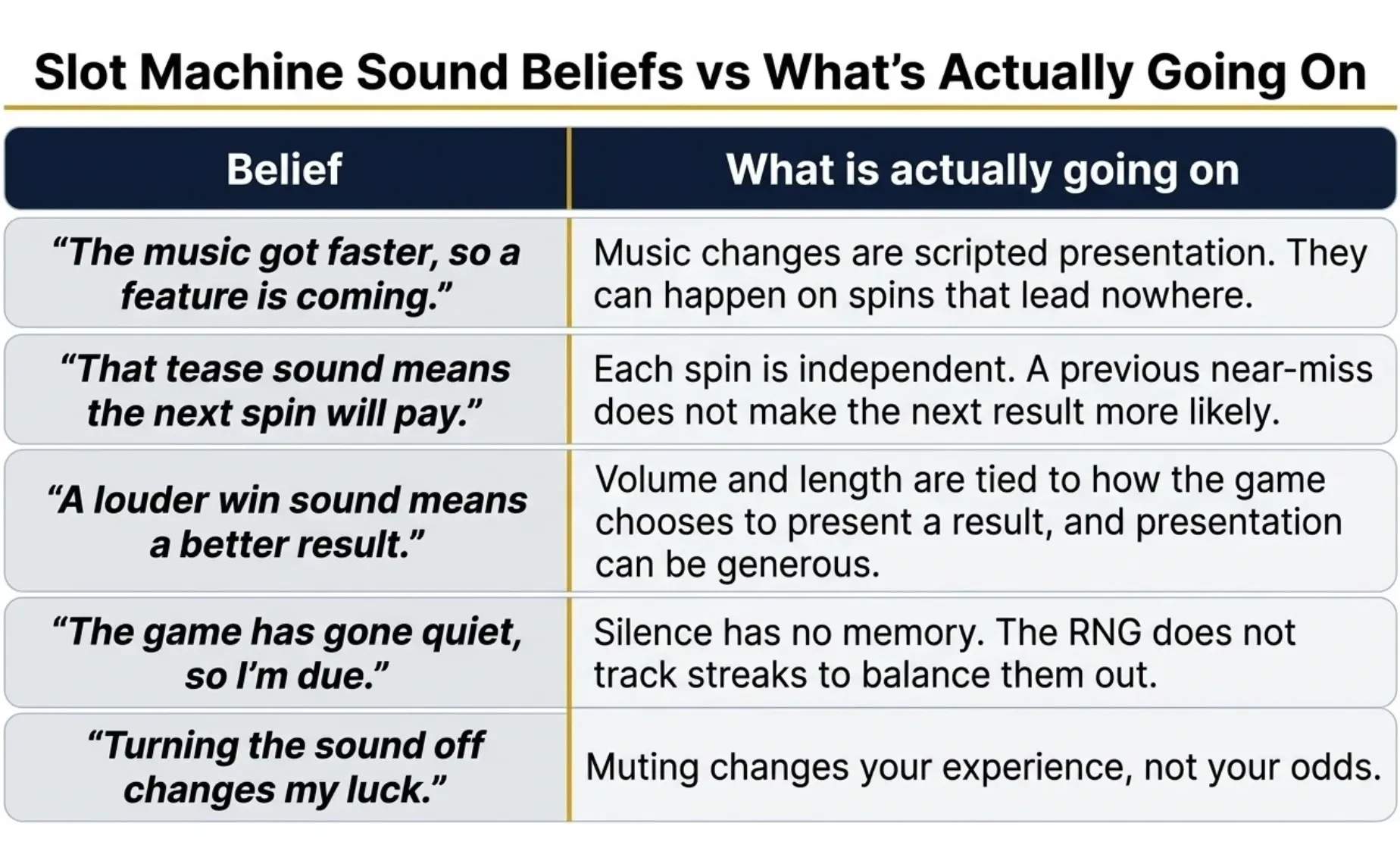
If you take one idea from this guide, take this: audio is the show, not the engine.
Slot Machine Sounds in Sweepstakes Casinos: A Quick, Accurate Explainer
Since you are reading this on a sweepstakes site, a short explanation of the model is useful. It affects how you should think about what the sounds are celebrating.
A sweepstakes casino is not a real-money gambling site, and it is not licensed or regulated the way a traditional online casino is. It operates under sweepstakes law rather than gambling law. Sweepstakes promotions have been used in marketing for a long time, and the central legal idea is that entry must be available without a purchase. That is why you will see the phrase "no purchase necessary."
Here is how the two virtual currencies usually work.
- Gold Coins are for play only. They have no cash value and cannot be redeemed. They exist so you can enjoy the games purely for fun.
- Sweeps Coins are promotional. They are typically given away through free entry methods, and under the site's official rules they can be redeemed for prizes once you meet the eligibility and verification requirements.
Free methods of entry, often called an alternative method of entry (AMOE), are a standard part of the model. Exact methods and rules differ by operator, so read the official rules on the site you use rather than relying on a general summary like this one. Eligibility also depends on where you live, since sweepstakes rules vary by jurisdiction, and some places restrict or exclude them.
Why does this matter for a guide about sound? Because the audio does not know which coin you are using. A chime on a Gold Coin spin sounds the same as a chime on a Sweeps Coin spin. If you play both, glance at the coin indicator now and then so a celebratory sound does not make you lose track of what is in play.
Nothing about the sweepstakes model guarantees prizes, and no sound or animation implies one. Treat every result as the output of a random process.
How to Listen Like an Informed Player
You do not need to ban sound to play thoughtfully. Plenty of people enjoy the audio and find it part of the fun. The aim is to stay in charge of how the sound affects you.
Notice what each sound is doing
Next time you play, try labeling sounds as they happen. Was that feedback, atmosphere, or a reward cue? Was the celebration sound attached to a return larger than your stake, or smaller? After a short session of doing this, many people find the sounds lose some of their pull, because they have become information about presentation instead of a mood happening to them.
Compare the sound to the number
When a jingle plays, look at your balance. Did it go up or down relative to before the spin? This habit directly counters the "losses disguised as wins" effect. The jingle describes how the game wants the spin to feel. The balance describes what happened.
Try a muted session
Mute the game for a short stretch and notice how it feels. Some people find they enjoy it less, which is a useful thing to learn. Others find they feel calmer and more aware of their pacing. Neither result is wrong. You are simply finding out how much of the experience comes from audio.
Use time limits instead of vibes
Sound can make time disappear, partly because loops and constant feedback give you no natural pause. Set a time limit before you start and use a phone timer or an on-site reminder if one is offered. Looking for a natural stopping point in the music does not work, because the music is built to continue.
Pay attention to how you feel
Notice whether you are playing because you are enjoying yourself or because the sound keeps pulling you into one more spin. If you feel frustrated, anxious, or tempted to chase a feeling, that is a good moment to stop and take a break. If play ever stops feeling like entertainment, support organizations and self-exclusion tools exist; check the responsible play section of the site you use and your local support services.
A Short Tour of Sound Styles Across Slot Themes
Different themes use sound in different ways, and recognizing the patterns makes you a sharper listener. The examples below describe general design tendencies, not specific games.
Classic fruit-style games
Classic-style slots usually echo mechanical machines: bells, clicks, a sharp coin-style cascade on a return. The sound palette is small, and each sound is easy to identify. Because the soundscape is sparse, you notice every cue.
Adventure and mythology themes
These tend toward orchestral or cinematic music, with sweeping strings and percussion. Feature rounds raise the intensity with bigger drums and faster rhythms. The music is closer to a film score than a casino noise, and it can be very engaging. It is worth remembering that cinematic music is designed to carry emotion, which makes it a strong mood setter.
Asian-inspired and dragon themes
Games built around dragons, lanterns, and similar imagery often use gongs, plucked strings, flutes, and drums. A gong strike is a natural fit for marking a feature or a large return because the sound has a long decay that feels weighty. As with every theme, the audio sets a mood and tells you nothing about the next spin.
Modern high-energy games
Newer titles often layer electronic beats, voice clips, and rapid-fire effects. Cascading-symbol games, where winning symbols vanish and new ones drop in, can produce a chain of rising tones, one per cascade. The sequence can feel like momentum. It is still a presentation of a single result that the RNG had already produced.
Common Misunderstandings About Slot Machine Sounds
A few myths come up often enough that they deserve their own space.
"Casinos pump in special sounds to make you play longer." The truth is more mundane and more general. Designers build sound to make games engaging, which is what most entertainment products do. Whether a specific sound design leads to longer sessions is a question we can't answer for any one game. What we can say is that engagement is a design goal, and that is reason enough to stay mindful.
"The jackpot sound is the same for every win." Usually not. Most games scale sound to the size of the return, and many use a distinct cue for features. But the scale can be generous relative to the real return, as discussed above.
"Quiet games are fairer." Fairness depends on how the RNG and the game's published rules work, not on how loud the game is. A silent game and a loud game can use the same underlying math.
"If I learn the sounds I can predict the game." Learning the sounds helps you understand the presentation. It does not help you predict anything, because the result is decided before the sound plays.
What Good Audio Design Looks Like
Not every use of sound is manipulative. There is good audio design in games, and recognizing it helps you separate the useful from the persuasive.
- Clear, proportionate feedback. Short sounds that confirm actions without shouting.
- Honest scaling. Louder, longer sounds for larger returns and quiet ones for small ones, with no celebration when the balance fell.
- Volume controls and mute options. Easy access to separate music and effects sliders respects the player.
- Calm defaults. Starting volumes that do not startle you.
- Accessibility. Visual cues that match audio cues, so players who cannot hear the game, or who play muted, do not miss information.
When you see these features, it suggests the designer thought about the player's experience. When you do not, it is a cue to rely more on your own checks.
A Practical Checklist for Your Next Session
Keep this short list in mind before you start.
- Check which coin type is active.
- Set a time limit and a start time.
- Find the volume and mute controls before the first spin.
- After a celebratory sound, glance at the balance.
- Remind yourself that no sound predicts the next result.
- Take a break when you notice yourself chasing a feeling.
Frequently Asked Questions
Do slot machine sounds affect whether I win?
No. Outcomes come from a random number generator that settles the result when you press spin. The sounds and animations display that result and cannot influence it. Muting the game will not change your odds, and a louder or more exciting sound does not mean a better result.
Why do slots play win sounds even when I lose money overall?
On games with many lines, a single line can return less than your total stake. The game may still play a win sound and animation for that line. Commentators describe this as "losses disguised as wins." The sound celebrates a line result, not your running total, so check your balance instead of relying on the jingle.
What are sweepstakes slots?
Sweepstakes slots are slot-style games offered through a sweepstakes model instead of a traditional real-money gambling model. You use virtual currencies. Gold Coins are for play only and have no redeemable value. Sweeps Coins are promotional and can be redeemed for prizes under the official rules, subject to eligibility. Entry is available with no purchase necessary.
Are sweepstakes casino slots the same as regular casino slots?
They look and sound similar, and they typically use an RNG as well, but the legal and economic structure differs. Sweepstakes casino slots operate under sweepstakes law and use promotional virtual currencies, while traditional online casinos operate under gambling licenses and use real-money wagers. Rules, eligibility, and protections differ, so read the official rules of any site you use.
Why do near-misses feel exciting?
Researchers have discussed near-misses for years and generally describe them as moments that feel close to success even though the outcome is a loss. Sound can heighten that feeling, for example with a rising tone before the last reel stops. The result is still fixed before the animation starts, and a near-miss does not make a later win more likely.
Is it better to play slots with the sound off?
It depends on you. Some people enjoy the audio and stay in control. Others find that muting makes them calmer and more aware of their pacing. Trying a muted session is a low-effort way to learn how much the sound affects your own experience.
How can I tell if a sound means I actually gained something?
Look at the balance or win display. A celebratory sound shows how the game presents a result. The numbers show what happened. Comparing the two after each celebration is a simple way to stay grounded.
Final Thoughts
Slot machine sounds are a craft. Feedback tones keep the interface feeling alive, music sets the mood, and reward cues mark moments the designers want you to notice. None of that is hidden magic, and none of it touches the result. The RNG decides first, and the audio performs second.
Once you hear that split, the experience tends to change. The fanfare is still pleasant, and a good soundtrack is still fun to listen to. But you hear it as a presentation instead of a promise. That is a healthier way to enjoy a game, on a sweepstakes site or anywhere else.
If you take a few habits away, keep these: watch the balance rather than the jingle, know which coin you are using, set a time limit, and step away when play stops feeling like entertainment. Everything on GoldenDragon.Casino is meant to be entertainment first, and a little awareness makes it better.
New to GoldenDragon.Casino? Use code DRAGON20 for 20% off when eligible. Limited to one use per user, valid through January 1, 2030.
Editorial note: This guide is general education written by the GoldenDragon.Casino editorial team. It is not legal, financial, or psychological advice. Sweepstakes rules and eligibility vary by location, so please read the official rules and responsible play information on the site before taking part. Last reviewed October 2026.