

Sweepstakes Casino Tournaments, Live Dealer and Keno: How The Other Game Formats Work
Published Nov 19, 2026
Casino
Key takeaways
- Sweepstakes casino tournaments rank players on a leaderboard. The scoring rule (biggest multiplier, total points, or play volume) decides what kind of player tends to finish on top, so read it before you join.
- Live dealer games use a real studio, a real dealer and physical cards or wheels. Cameras and recognition software turn what happens on the table into data on your screen.
- Keno draws 20 numbers from 80. The chance of matching every number you pick falls steeply as you pick more: about 1 in 326 for 4 spots and about 1 in 8.9 million for 10.
- All three formats can run in both Gold Coin (play for fun) and Sweeps Coin (promotional sweepstakes) modes, but availability depends on the operator and on state law.
- Formats change the experience, not the underlying math. No tournament structure, live table or keno pattern makes an outcome predictable.
Most people meet sweepstakes casinos through slots, so it can be surprising to find a leaderboard counting down in one corner of the lobby, a live blackjack table streamed from a studio, or a keno board waiting for picks. Sweepstakes casino tournaments, live dealer games and keno each work differently from a standard slot spin, and each one fits the sweepstakes model in its own way. This guide explains how the formats are structured, where the randomness comes from, what the math looks like and what to check in the official rules before you spend any time on them.
One thing first. This is a general explainer about the formats that exist across the sweepstakes sector. It does not describe what any single site, including GoldenDragon, offers. Game libraries change often, so the operator’s lobby and its official sweepstakes rules are the only reliable source for what is available to you.
A quick refresher on the sweepstakes model
Every format in this article sits on top of the same two-currency structure. If you already know it, skip ahead. If not, the short version is below, and our guide to how sweepstakes casinos work covers it in more depth.
Gold Coins are a play-for-fun currency. People receive them free or can purchase Gold Coin packages, but Gold Coins have no cash value and cannot be redeemed for anything.
Sweeps Coins are promotional sweepstakes entries. You cannot buy them directly. Operators give them away free, for example as a bonus alongside a Gold Coin package, through daily logins or social promotions, or through a free Alternative Method of Entry such as a mail-in request. Sweeps Coins won through play can be redeemed for prizes, subject to the official rules, identity verification and minimum thresholds.
That “no purchase necessary” route is what lets these platforms operate under sweepstakes and promotion law instead of gambling law. It is also why legality differs from state to state, and why several states have moved against the model since 2025. The details for each state are in our guide to sweepstakes casino laws.
Keep this structure in mind as you read. A tournament, a live table and a keno draw are just different ways of using Gold Coins or Sweeps Coins. The currency rules do not change because the game looks different.
How sweepstakes casino tournaments work
A tournament is a time-limited competition. Instead of simply playing a game for its own sake, you also earn a score, and that score places you on a leaderboard against everyone else who opted in. When the clock runs out, the top positions receive prizes from a pool the operator has set out in advance.
That sounds simple, but tournaments vary a lot. The format, the scoring rule and the way the prize pool is funded all change who tends to win and how much time you are likely to spend.
Common tournament formats
Operator industry guides describe a handful of recurring structures. A 2026 operator-side overview from Track360 groups them roughly like this:
Ongoing leaderboard: a rolling daily or weekly ranking with a recurring prize pool. It feels low pressure and rewards showing up regularly.
Time-boxed tournament: a fixed window (an hour, a day, a weekend) with a set pool. It means short bursts of activity and a clear end point.
Volume brackets: players are grouped into bands by how much they play, so you compete against people with similar habits.
Sit-and-go or quick event: a small field and a short session. It's fast, closer to a mini-game than a long race.
Some tournaments run only in Gold Coin mode, with Gold Coin prizes and nothing redeemable at stake. Others pay Sweeps Coins to the top finishers. The lobby or the tournament’s own rules page should say which mode applies, and those two versions can look almost identical on screen.
Scoring models and why they matter
The scoring rule is the single most important detail in any tournament, and it is often tucked away in small print. Common models include:
- Biggest single multiplier. Your best result relative to the amount you played on that spin sets your score. One lucky spin can top the board.
- Total win or net win. Your combined results across the event count. This tends to reward people who play longer.
- Total Gold Coins or Sweeps Coins played. Volume alone sets the rank. This favours whoever plays the most, which is worth knowing before you join.
- Points per session or per round. You collect points for activity milestones, so steady play can matter more than one big hit.
The same Track360 guide puts it bluntly from the operator side: every scoring rule “selects a winner profile.” A multiplier race is closer to a lottery among everyone who entered. A volume race rewards stamina and, in practice, the people who spend the most time and Gold Coins on the event. Neither is better. They are just different, and knowing which one you are in tells you a lot about your realistic chances.
Here is a simple scenario. Two players join the same one-hour slot event. Player A makes 60 spins and hits one 500x multiplier. Player B makes 600 spins with no big hits but plenty of small returns. In a biggest-multiplier tournament, Player A is near the top. In a total-volume tournament, Player B is far ahead. Same hour, same game, opposite outcome, purely because of the scoring rule.
Tie-breaks and provisional results
Ties happen more than you might expect, especially in multiplier races where several people can hit the same top result. Good tournament rules publish a tie-break in advance, such as whoever reached the score first. Guidance on leaderboard design from Sarasota Magazine’s Advantage Point explainer recommends exactly that: set the tie-break before play starts, apply it the same way every time, and label scores as provisional until the event closes and any disputes are settled.
If you cannot find the tie-break rule, that is worth noting. It does not mean anything is wrong, but it does mean you will learn the rule only after the fact.
How prize pools are funded
Prize pools usually follow one of three patterns:
- Guaranteed. The operator fixes the pool regardless of how many people take part.
- Contributed. The pool grows as more play happens during the event.
- Hybrid. A guaranteed minimum that can rise with participation.
For Sweeps Coin pools, the prizes are still promotional sweepstakes entries. Winning a leaderboard spot does not change the redemption rules. Any Sweeps Coins you receive are subject to the same verification steps, playthrough requirements and minimum thresholds as Sweeps Coins from any other source. For more on what happens after that, see our article on the Sweeps Coins redemption process.
What a tournament does not change
A tournament adds a leaderboard on top of a game. It does not change the game itself. The slot in a tournament uses the same random number generator and the same return-to-player design as it does outside one. Joining a race does not make a big multiplier more likely, and playing faster does not improve the odds of any individual spin.
What does change is behaviour. A countdown clock and a visible rank both push people to keep going. Operator guides openly treat tournaments as engagement tools, and the Track360 guide recommends that responsible play limits stay active during events for exactly that reason. If you notice that you are chasing a leaderboard spot rather than enjoying the game, that is the moment to stop.
Questions to ask before joining a tournament
- Is it Gold Coin only, or are Sweeps Coins at stake?
- What is the scoring rule, and which games count toward it?
- Is there a minimum play amount per spin for a result to count?
- How long does it run, and when are results final?
- How are ties settled?
- Do you need to opt in, or does all qualifying play count automatically?
Most of these answers live in the tournament terms, which normally sit one click away from the leaderboard.
How sweepstakes casino live dealer games work
A sweepstakes casino live dealer game is a real table game, played by a real person with physical cards, chips, a roulette wheel or a baccarat shoe, streamed to your screen as it happens. You make decisions through on-screen buttons, and the dealer runs the game in front of a camera.
This is the biggest technical departure from the rest of a sweepstakes lobby. Slots, digital table games and video keno are software: a random number generator produces the result. Live dealer games produce their results the physical way, with a shuffled deck or a spinning wheel, and then translate those results into digital data.
Inside a live dealer studio
Live dealer content comes from specialist studios that build sets designed for broadcast. A typical studio table includes:
- Several cameras covering different angles, usually including one directly over the table so each card is visible, and one tracking the roulette wheel and ball.
- Recognition software that reads the video feed. In card games it identifies each card’s rank and suit. At the roulette wheel it identifies which pocket the ball lands in. An explainer on optical character recognition in live casinos describes this three-step chain: cameras capture the table, software reads the result, and the platform shows it on your screen almost instantly. Some wheels also have sensors that confirm the result independently.
- A game control system that opens and closes the decision window, records each round and settles results.
- A dealer trained to follow a fixed procedure so the game is consistent and auditable.
In regulated real-money markets, regulators write rules for this kind of setup. New Jersey’s internet gaming rules on table game simulcasting, for example, require a control server that records all activity, keeps the outcome inaccessible until decisions are final, records dealer-verified results before posting them, and gives patrons real-time visual access to the game. Those rules apply to New Jersey’s licensed online casinos, not to sweepstakes platforms, but they show what a well-run studio setup is expected to do.
How live dealer fits the sweepstakes model
Some sweepstakes platforms offer live tables alongside their slots. A 2026 SportsGrid review of live games at sweeps sites found that most sweepstakes lobbies centre on slots, while some add a selection of live roulette, blackjack and baccarat, usually playable in both Gold Coin and Sweeps Coin modes.
The mechanics follow the same currency rules as everything else. In Gold Coin mode, the stream is identical but the result only moves a play-for-fun balance. In Sweeps Coin mode, results change your Sweeps Coin balance, which stays subject to the official rules for redemption.
A few practical differences tend to show up:
- Fewer tables. Live content costs more to produce than software, so lobbies usually carry a short list of live games.
- Higher minimum play per round than many slots, because each round takes dealer time.
- Set hours or occasional downtime for some tables.
- A dependence on your connection. A weak signal can mean a frozen stream at a decision point. Check the game rules for what happens if you disconnect mid-round.
Live dealer versus digital table games
The two formats differ in five ways. Live dealer results come from physical cards, a wheel or a shoe, while digital table games use a random number generator. The live pace is set by the dealer and is slower, while you set the pace in a digital game, so it is faster. Live games use a physical shuffle or a shuffling machine, while digital games use a software shuffle of a virtual deck. Live tables add dealer interaction and sometimes chat, while digital games have no social element. Live tables usually offer limited tables and times, while digital games are typically always on.
Neither version is “fairer” by default. A digital blackjack game reshuffles a virtual deck according to its own rules, which our article on card shuffling in digital games explains. A live game uses a real deck, but the rules on how many decks are used and when they are reshuffled still determine the math. The house edge comes from the rules of the game (for example, the single green zero in European roulette gives the house 1 pocket in 37, or about 2.7%) and that is true whether the wheel is real or simulated.
What to look for at a live table
Check the game’s info panel before playing a round. It should list the number of decks, the payout table, any side-game rules, the minimum and maximum play per round, and what happens if a round is interrupted. If those details are missing or hard to find, treat that as a reason to be cautious rather than a reason to experiment.
How sweepstakes casino keno works
Keno is a number-draw game with roots in lottery-style play. In a sweepstakes casino keno game, you pick numbers from a board, the game draws a set of winning numbers, and the result depends on how many of your picks match. Online versions are usually software games that use a random number generator for the draw, so a round takes seconds instead of the several minutes a lottery-run keno game might take.
The standard rules
Most keno games use the same basic layout as lottery keno. The Virginia Lottery’s keno guide describes the classic format well:
- The board has 80 numbers, 1 through 80.
- You choose how many “spots” to play, usually 1 to 10 (some online versions allow up to 15 or 20).
- The game draws 20 winning numbers.
- Your result depends on how many of your spots appear among the 20 drawn numbers. These are called “catches.”
- A paytable shows the return for each combination of spots picked and spots caught.
The paytable is where versions differ. Two keno games with identical boards can pay very differently, and that difference is where the house edge sits. Always read the paytable for the specific game in front of you.
The odds math, worked out
Keno odds follow a well-known formula from probability called the hypergeometric distribution. You do not need the name, only the logic. Of the 80 numbers, 20 are drawn and 60 are not. If you pick n spots and want exactly k of them to be drawn, you count:
- the ways to choose your k catches from the 20 drawn numbers, multiplied by
- the ways to choose your remaining n minus k picks from the 60 undrawn numbers,
- divided by all the ways to choose n numbers from 80.
Take a 4-spot pick where you want all four to hit. There are 4,845 ways to choose 4 numbers from the 20 drawn, and 1,581,580 ways to choose any 4 numbers from 80. Divide one by the other and you get about 1 in 326.
Running the same calculation for other pick sizes gives these figures. We computed them directly from the formula above. The 10-spot result matches the 1 in 8,911,711 top-prize odds on the Virginia Lottery's keno page, which uses the same 80-number, 20-draw format.
1 spot: catching every spot is 1 in 4, catching none is 1 in 1.3 (75%)
2 spots: catching every spot is 1 in 16.6, catching none is 1 in 1.8 (about 56%)
3 spots: catching every spot is 1 in 72.1, catching none is 1 in 2.4 (about 42%)
4 spots: catching every spot is 1 in 326.4, catching none is 1 in 3.2 (about 31%)
5 spots: catching every spot is 1 in 1,550.6, catching none is 1 in 4.4 (about 23%)
6 spots: catching every spot is 1 in 7,752.8, catching none is 1 in 6.0 (about 17%)
8 spots: catching every spot is 1 in 230,114.6, catching none is 1 in 11.3 (about 9%)
10 spots: catching every spot is 1 in 8,911,711.2, catching none is 1 in 21.8 (about 5%)
Two things stand out. First, each extra spot makes a full catch far less likely. Going from 8 spots to 10 makes catching all of them nearly 39 times harder. Second, on average you catch about a quarter of whatever you pick, because 20 of the 80 numbers are drawn. Pick 8 and the typical result is around 2 catches. That is why paytables for larger picks usually return nothing for low catch counts and save their payouts for 5, 6 or more.
Why the paytable matters more than your numbers
Since every number on the board has the same chance of being drawn in a properly working game, there is no “hot” or “cold” number and no pattern that improves the odds. Birthdays, diagonals and repeat picks all have identical chances. What you can compare is the paytable. A game that pays more for mid-range catches, or that publishes a higher return-to-player figure, is better value in pure math terms than one that does not. Our explainer on what RTP means shows how to read that figure, and gaming myths covers why past draws do not predict future ones.
Keno in Gold Coin and Sweeps Coin modes
Like other games in a sweepstakes lobby, keno usually runs in both modes. In Gold Coin mode it is purely for entertainment. In Sweeps Coin mode, the amount you choose per round comes from your Sweeps Coin balance, and any results stay subject to the official rules. Because a round can take seconds, it is easy to play many of them quickly. Setting a session time limit before you start helps keep that in check.
Comparing the three formats side by side
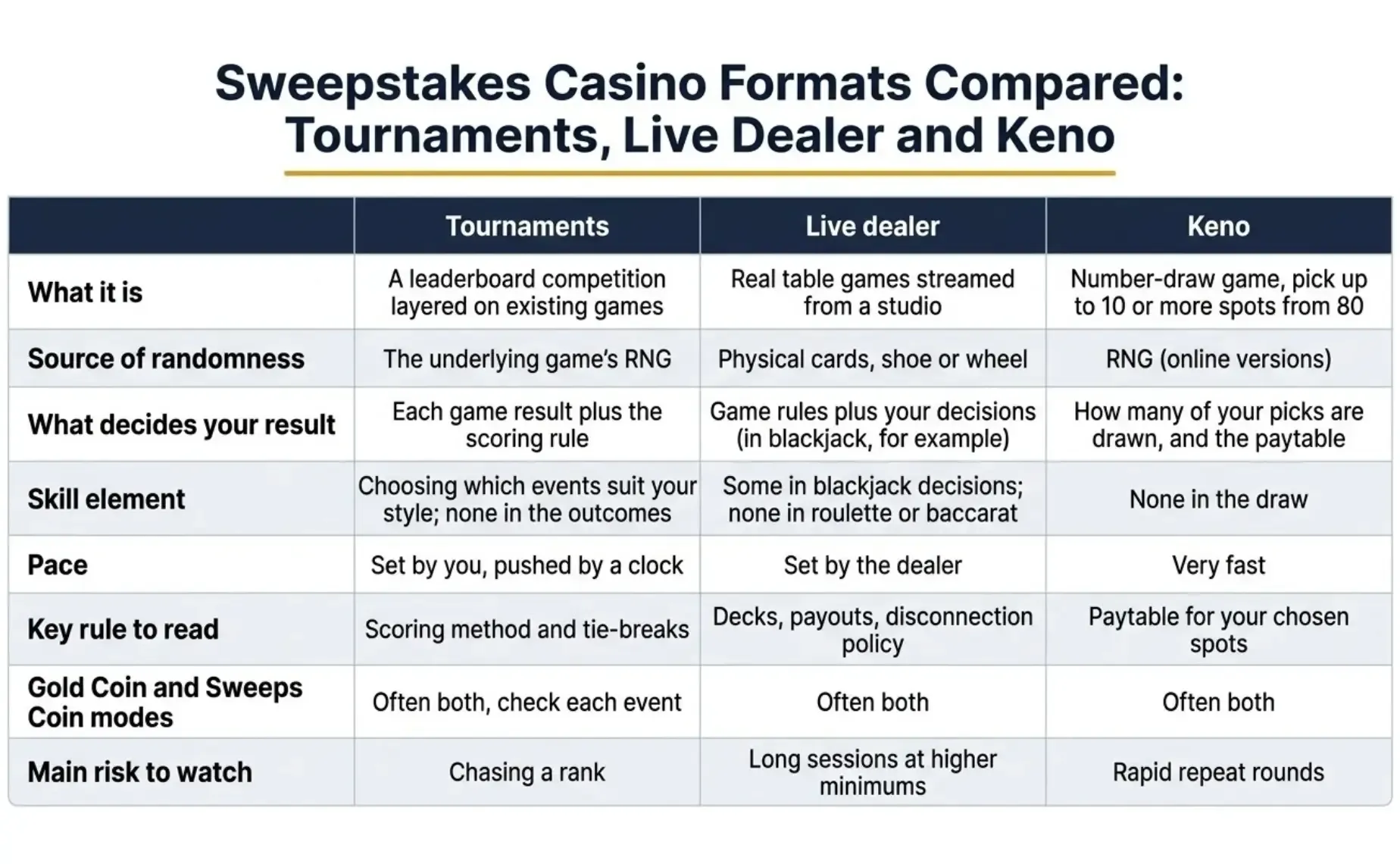
None of these formats offers an edge over the game’s built-in math. They change the experience: the social feel of a live table, the competitive pull of a leaderboard, or the quick rhythm of a keno draw. For a wider view of which games carry the lowest built-in house advantage, see what casino game has the best odds.
Common misunderstandings about these formats
Several assumptions come up again and again, and most of them are wrong.
“Tournament games pay more.” The game inside a tournament usually runs exactly as it does outside one. The prize pool is an extra, funded separately, and only the top places receive it.
“A live dealer can’t be manipulated, so it’s always the better choice.” Live play replaces software randomness with physical randomness. That can feel more transparent, but the house edge still comes from the game rules, and studio procedures matter as much as the cameras.
“Keno numbers that haven’t come up for a while are due.” Each draw is independent. A number that has missed 30 rounds has the same chance in the next round as one that hit last time.
“Sweeps Coins from a tournament are different.” Sweeps Coins are Sweeps Coins. Prizes from a leaderboard follow the same redemption rules as any others. If a tournament’s terms say otherwise, those terms will spell it out.
“If a format is available on a site, it is legal everywhere.” Availability depends on where you are. A game library can differ by state, and some states restrict the sweepstakes model entirely. As of November 2026, several states, including California (under AB 831, effective January 1, 2026), prohibit dual-currency online sweepstakes games, and the list keeps changing. Check the operator’s official rules for current eligible states.
Playing responsibly across all formats
Tournaments, live tables and fast keno rounds each push time spent in a different way. Some habits help with all three:
- Decide your session length before you open the lobby, and keep it.
- Use the responsible play tools the platform provides, such as session reminders, purchase limits on Gold Coin packages and cool-off periods.
- Treat Gold Coin purchases as an entertainment cost, the same way you would treat a cinema ticket.
- Stop if you are chasing a leaderboard position or a “due” keno number.
If gaming stops feeling like entertainment, free and confidential help is available. The National Council on Problem Gambling runs the national helpline, 1-800-MY-RESET (1-800-697-3738), by call, text or chat, 24 hours a day. The older 1-800-GAMBLER number remains active through the Council on Compulsive Gambling of New Jersey, focused on New Jersey resources.
Frequently asked questions
1. What are sweepstakes casino tournaments?
Sweepstakes casino tournaments are time-limited competitions where players earn a score while playing selected games, usually slots, and rank on a leaderboard. When the event ends, top finishers receive prizes from a set pool. Some events award Gold Coins only, while others pay Sweeps Coins, which remain subject to the official redemption rules. The scoring rule, such as biggest multiplier or total play, decides what kind of player tends to win, so read it first.
2. Do tournaments change the odds of the games?
No. A tournament adds a leaderboard and a prize pool on top of a game, but the game itself normally uses the same random number generator and return-to-player design it uses outside the event. Joining does not make big results more likely. What changes is the incentive to keep playing, which is why setting a time limit before a tournament is a sensible habit.
3. How do sweepstakes casino live dealer games work?
A live dealer game streams a real dealer running a physical table game, such as blackjack, roulette or baccarat, from a studio. Cameras and recognition software read each card or wheel result and send it to your screen. You make choices through on-screen buttons. In Gold Coin mode the result affects a play-for-fun balance, and in Sweeps Coin mode it affects a balance that is subject to the official sweepstakes rules.
4. Are live dealer games fairer than digital table games?
Not automatically. Live games use physical cards or wheels, while digital games use a random number generator. Both can be fair when properly run and tested. In both cases the house edge comes from the game rules, such as the number of decks or the zero pocket on a roulette wheel. Compare the published rules and payouts rather than assuming one delivery method is better.
5. What are the odds in sweepstakes casino keno?
In standard keno, 20 numbers are drawn from 80. The chance of catching every number you pick drops sharply as you pick more: about 1 in 4 for one spot, 1 in 326 for four spots, 1 in 7,753 for six spots and about 1 in 8.9 million for ten. On average you catch about a quarter of the numbers you pick. Your actual returns depend on the game’s paytable.
6. Is there a strategy for picking keno numbers?
No pick improves your chances in a properly working game. Every number has the same probability of being drawn in every round, and past draws do not influence future ones. The only meaningful choices are how many spots to play and which game’s paytable you use. Comparing published return-to-player figures is more useful than tracking hot or cold numbers.
7. Can I join tournaments or play keno without buying anything?
The sweepstakes model is built on a no purchase necessary principle. Gold Coins are given away free, and Sweeps Coins can be obtained through free methods such as a mail-in Alternative Method of Entry or promotions. Whether a specific tournament or game is open to you depends on the operator’s rules and your state, so check the official sweepstakes rules and the event terms.
8. Are these formats available in every state?
No. Sweepstakes platforms set their own lists of eligible states, and several states have restricted or banned the dual-currency model since 2025. Game libraries can also vary by location. As of November 2026 the situation continues to shift, so check the operator’s official rules for current eligibility before playing.
Learning more before you play
Tournaments, live dealer tables and keno all add variety to a sweepstakes lobby, and each has its own rules worth a few minutes of reading. The leaderboard terms tell you how a tournament is scored. The info panel at a live table tells you the decks and payouts. The paytable tells you what a keno pick is actually worth. If you want to understand how these pieces fit together, start with our guides to the sweepstakes model and sweepstakes rules explained, and always read the official sweepstakes rules of the platform you are using.
New to GoldenDragon.Casino? Use code DRAGON20 for 20% off when eligible. Limited to one use per user, valid through January 1, 2030.